Kirjojen hintavertailu. Mukana 12 657 676 kirjaa ja 12 kauppaa.

Kirjailija

Kat Jungnickel

Kirjat ja teokset yhdessä paikassa: 6 kirjaa, julkaisuja vuosilta 2018-2024, suosituimpien joukossa Bikes and Bloomers. Vertaile teosten hintoja ja tarkista saatavuus suomalaisista kirjakaupoista.

6 kirjaa

Kirjojen julkaisuhaarukka 2018-2024.

Wearable Utopias

Wearable Utopias

Kat Jungnickel; Ellen Fowles

MIT PRESS LTD
2024
nidottu
A collection of thought-provoking interviews with cutting-edge designers who transform ordinary wearables into extraordinary sites of personal expression, public engagement, and radical political action. Wearable Utopias explores the promise of wearables for reimagining social and political problems of today for diverse and inclusive worlds for tomorrow. Kat Jungnickel, Ellen Fowles, Katja May, and Nikki Pugh entangle science and technology studies, gender studies, and cultural studies with contemporary issues to highlight the role wearables can play in forging alternative paths through conventional landscapes. Featuring twenty-three interviews with new and established international designers, this collection covers everything from coats designed to protect digital privacy to high-performing jeans that combat air pollution and to hi-vis cyclewear as a response to urban harassment. The interviews in Wearable Utopias are organized into six key themes addressing a selection of pressing civic issues: expanding (wearables that push physical, social, and political boundaries), moving (wearables that enable participation in a wider range of sport and activities), concealing (wearables that defend privacy or keep secrets), connecting (wearables that link individuals to large-scale issues); leaking (wearables that challenge the idea that urinating and menstruating are problematic or taboo), and working (wearables that address inequalities in the workplace). Wearable Utopias offers insight and inspiration for students, researchers, designers, and anyone making things to wear who is frustrated with daily inequities and normative limitations and wants to do things differently. This book is part of the European Research Council-funded project Politics of Patents (POP): Reimagining Citizenship via Clothing Inventions, hosted at Goldsmiths, University of London, led by Kat Jungnickel with Ellen Fowles (Research Assistant), Katja May (Postdoctoral Fellow), and Nikki Pugh (Research Assistant). Wearable Utopias offers insight and inspiration for students, researchers, designers, and anyone making things to wear who is frustrated with daily inequities and normative limitations and wants to do things differently.
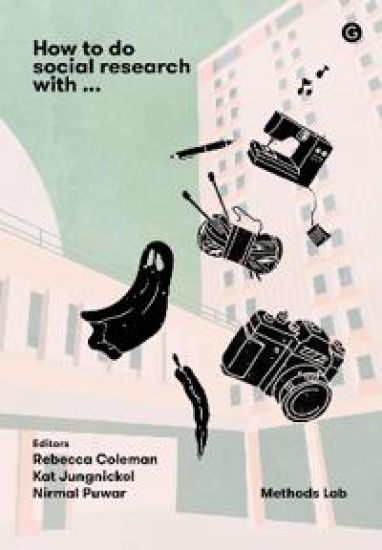
How To Do Social Research With

How To Do Social Research With

Rebecca Coleman; Kat Jungnickel

GOLDSMITHS, UNIVERSITY OF LONDON
2023
nidottu
A guide to the doing of critical and creative research with a range of unusual means to apprise places and build ethical relationships. This catalogue of methods draws on the wealth of cutting-edge critical and creative social research from the Goldsmiths Sociology Department to offer an engaged guide to doing research with a range of unexpected relations. The collection focuses on multiple assemblages of objects, media, materials, practices, relations, devices, and atmospheres, spanning methods and topics involving food to activism, knitting to ghosts, theater to documents, collaging to corridors. Through hands-on discussions of the practicalities, ethics, and politics of doing social research, the catalogue showcases a wide range of examples of what methods might mean and do. It builds a case for an understanding of contemporary social research as interdisciplinary, responsive, dynamic, vital, and urgent in studying and shaping social worlds. Goldsmiths Sociology Department is internationally recognized as being at the forefront of some of the most daring, original and unconventional methodological innovation. Their unbounded approach to social research offers textured yet clear paths through the problems and issues before us, as contributors present the methodological puzzles they have become knotted with. The short and imaginative case studies offer new ways of teaching, learning, and doing lively and rigorous research. This is research as close-up observations, infrastructural interventions and imaginative play. How to Do Social Research With ... will be essential for anyone interested in expanding their repertoire of social research methods.
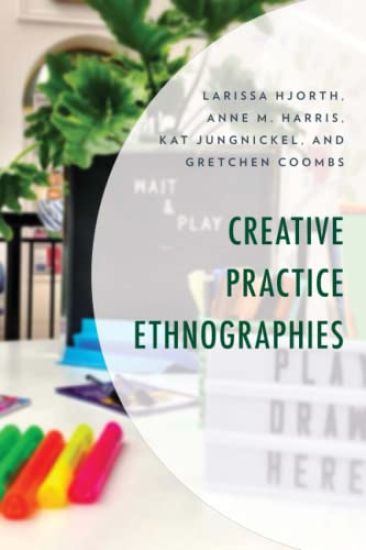
Creative Practice Ethnographies

Creative Practice Ethnographies

Larissa Hjorth; Anne M. Harris; Kat Jungnickel; Gretchen Coombs

Lexington Books
2021
nidottu
Creative Practice Ethnographies focuses on the intersection of creative practice and ethnography and offers new ways to think about the methods, practice, and promise of research in contemporary interdisciplinary contexts. How does creative practice inform new ways of doing ethnography and vice versa? What new forms of expression and engagement are made possible as a result of these creative synergies? By addressing these questions, the authors highlight the important roles that ethnography and creative practice play in socially impactful research. This book is aimed at interdisciplinary researchers, scholars, and students of art, design, sociology, anthropology, games, media, education, and cultural studies.
Bikes and Bloomers

Bikes and Bloomers

Kat Jungnickel

Goldsmiths, Unversity of London
2020
pokkari
An illustrated history of the evolution of British women's cycle wear.The bicycle in Victorian Britain is often celebrated as a vehicle of women's liberation. Less noted is another critical technology with which women forged new and mobile public lives--cycle wear. This illustrated account of women's cycle wear from Goldsmiths Press brings together Victorian engineering and radical feminist invention to supply a missing chapter in the history of feminism.Despite its benefits, cycling was a material and ideological minefield for women. Conventional fashions were unworkable, with skirts catching in wheels and tangling in pedals. Yet wearing "rational" cycle wear could provoke verbal and sometimes physical abuse from those threatened by newly mobile women. Seeking a solution, pioneering women not only imagined, made, and wore radical new forms of cycle wear but also patented their inventive designs. The most remarkable of these were convertible costumes that enabled wearers to transform ordinary clothing into cycle wear.Drawing on in-depth archival research and inventive practice, Kat Jungnickel brings to life in rich detail the little-known stories of six inventors of the 1890s. Alice Bygrave, a dressmaker of Brixton, registered four patents for a skirt with a dual pulley system built into its seams. Julia Gill, a court dressmaker of Haverstock Hill, patented a skirt that drew material up the waist using a mechanism of rings or eyelets. Mary and Sarah Pease, sisters from York, patented a skirt that could be quickly converted into a fashionable high-collar cape. Henrietta M ller, a women's rights activist of Maidenhead, patented a three-part cycling suit with a concealed system of loops and buttons to elevate the skirt. And Mary Ann Ward, a gentlewoman of Bristol, patented the "Hyde Park Safety Skirt," which gathered fabric at intervals using a series of side buttons on the skirt. Their unique contributions to cycling's past continue to shape urban life for contemporary mobile women.
Creative Practice Ethnographies

Creative Practice Ethnographies

Larissa Hjorth; Anne M. Harris; Kat Jungnickel; Gretchen Coombs

Lexington Books
2019
sidottu
Creative Practice Ethnographies focuses on the ways in which the collaboration between creative practice and ethnography offers new ways to think with and about the methods, practice and promise of research in contemporary interdisciplinary contexts. How does creative practice inform new ways of doing ethnography and vice versa? What new forms of expression and engagement are made possible as a result of these creative synergies? In sum, we pay particular attention to ways of being in the world that acknowledges creativity, complexities and multiplicities in research. In this book we seek to map why the intersection of ethnography and creative practice matters for doing socially impactful research. This book is aimed at interdisciplinary researchers from art, design, sociology, anthropology, games, media, education, and cultural studies. As interdisciplinary scholars with divergent creative practices who are constantly engaged in, with, and through the field, we are continuously searching through embodied practice ways of working with and reconfiguring the means and modes through which we do research. As such, our work operates at the intersection of ethnography and creative practice and we examine how they coalesce, overlap and interplay. In this book, we examine the doing of creative practice ethnographies through three interdisciplinary heuristics—techniques, translations and transmissions. It is via learnings from the field, in the form of interdisciplinary case studies, that we seek to provide insights into this productive synergy.
Bikes and Bloomers

Bikes and Bloomers

Kat Jungnickel

Goldsmith's Press
2018
sidottu
An illustrated history of the evolution of British women's cycle wear.The bicycle in Victorian Britain is often celebrated as a vehicle of women's liberation. Less noted is another critical technology with which women forged new and mobile public lives-cycle wear. This illustrated account of women's cycle wear from Goldsmiths Press brings together Victorian engineering and radical feminist invention to supply a missing chapter in the history of feminism.Despite its benefits, cycling was a material and ideological minefield for women. Conventional fashions were unworkable, with skirts catching in wheels and tangling in pedals. Yet wearing "rational" cycle wear could provoke verbal and sometimes physical abuse from those threatened by newly mobile women. Seeking a solution, pioneering women not only imagined, made, and wore radical new forms of cycle wear but also patented their inventive designs. The most remarkable of these were convertible costumes that enabled wearers to transform ordinary clothing into cycle wear.Drawing on in-depth archival research and inventive practice, Kat Jungnickel brings to life in rich detail the little-known stories of six inventors of the 1890s. Alice Bygrave, a dressmaker of Brixton, registered four patents for a skirt with a dual pulley system built into its seams. Julia Gill, a court dressmaker of Haverstock Hill, patented a skirt that drew material up the waist using a mechanism of rings or eyelets. Mary and Sarah Pease, sisters from York, patented a skirt that could be quickly converted into a fashionable high-collar cape. Henrietta Muller, a women's rights activist of Maidenhead, patented a three-part cycling suit with a concealed system of loops and buttons to elevate the skirt. And Mary Ann Ward, a gentlewoman of Bristol, patented the "Hyde Park Safety Skirt," which gathered fabric at intervals using a series of side buttons on the skirt. Their unique contributions to cycling's past continue to shape urban life for contemporary mobile women.