Kirjojen hintavertailu. Mukana 12 559 192 kirjaa ja 12 kauppaa.

Kirjailija

Kate Malleson

Kirjat ja teokset yhdessä paikassa: 4 kirjaa, julkaisuja vuosilta 1999-2020, suosituimpien joukossa The New Judiciary. Vertaile teosten hintoja ja tarkista saatavuus suomalaisista kirjakaupoista.

4 kirjaa

Kirjojen julkaisuhaarukka 1999-2020.

The New Judiciary

The New Judiciary

Kate Malleson

Routledge
2020
nidottu
During the last thirty years, the judiciary has undergone an unprecedented expansion in its size and power. Judges now have more influence over our private and public lives than ever before. The effect of this change has been to transform the judiciary from an inward-looking elite into an increasingly heterogeneous professional body. 'The New Judiciary' examines the developments which have taken place in the appointment, training and scrutiny of judges as a result of the expanding judicial role. It highlights the increasing tension between the requirements of judicial independence and accountability which these changes are producing. The traditional insulation of the judiciary from all external influences is being challenged by the need for greater openness and public scrutiny of the judicial process. The passing of the Human Rights Act 1998, incorporating the European Convention on Human Rights into domestic law represents another stage in this process by expanding the policy-making role of the senior judiciary still further. As a result, the continuing modernisation of the judiciary, which is the subject of this book, will be a increasingly important feature of the legal and political process in the years ahead.
The Politics of Judicial Independence in the UK's Changing Constitution

The Politics of Judicial Independence in the UK's Changing Constitution

Graham Gee; Robert Hazell; Kate Malleson; Patrick O'Brien

Cambridge University Press
2015
sidottu
Judicial independence is generally understood as requiring that judges must be insulated from political life. The central claim of this work is that far from standing apart from the political realm, judicial independence is a product of it. It is defined and protected through interactions between judges and politicians. In short, judicial independence is a political achievement. This is the main conclusion of a three-year research project on the major changes introduced by the Constitutional Reform Act 2005, and the consequences for judicial independence and accountability. The authors interviewed over 150 judges, politicians, civil servants and practitioners to understand the day-to-day processes of negotiation and interaction between politicians and judges. They conclude that the greatest threat to judicial independence in future may lie not from politicians actively seeking to undermine the courts, but rather from their increasing disengagement from the justice system and the judiciary.
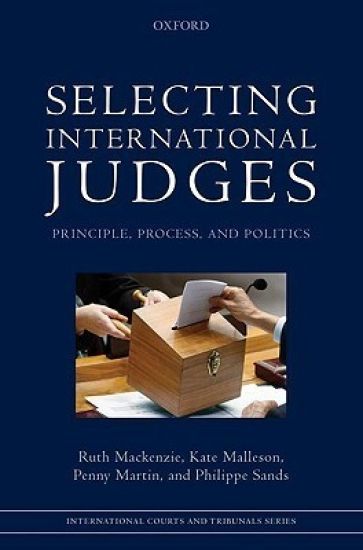
Selecting International Judges

Selecting International Judges

Ruth MacKenzie; Kate Malleson; Penny Martin; Philippe Sands QC

Oxford University Press
2010
sidottu
This book examines the way international court judges are chosen. Focusing principally on the judicial selection procedures of the International Court of Justice and International Criminal Court, it provides the first detailed examination of how the selection process works in practice at national and international levels: what factors determine whether a state will nominate a candidate? How is a candidate identified? What factors influence success or failure? What are the respective roles of merit, politics, and other considerations in the nomination and election process? The research was based on interviews, case studies and survey data in a range of different states. It concludes that although the nature and quality of nomination and election processes vary widely, a common theme indicates the powerful influence of domestic and international political considerations, and the significant role of a small group of diplomats, civil servants, lawyers, and academics, often without transparency or accountability. The processes allow overt political considerations to be introduced throughout the decision-making process in ways that may detract from the selection of the most highly qualified candidates and, ultimately, undermine independence. This is particularly evident in the election campaigning that has become a defining feature of the selection process, accompanied by widespread vote trading and reciprocal agreements between states. The effect of these practices is often to undermine the role of statutory selection criteria and to favour candidates from more politically powerful states. The book reviews new judicial selection models adopted or proposed in other international and regional courts, and considers a number of proposals for change to promote more independent, transparent, and merit-based nomination and election procedures.
The New Judiciary

The New Judiciary

Kate Malleson

Dartmouth Publishing Co Ltd
1999
sidottu
During the last thirty years, the judiciary has undergone an unprecedented expansion in its size and power. Judges now have more influence over our private and public lives than ever before. The effect of this change has been to transform the judiciary from an inward-looking elite into an increasingly heterogeneous professional body. 'The New Judiciary' examines the developments which have taken place in the appointment, training and scrutiny of judges as a result of the expanding judicial role. It highlights the increasing tension between the requirements of judicial independence and accountability which these changes are producing. The traditional insulation of the judiciary from all external influences is being challenged by the need for greater openness and public scrutiny of the judicial process. The passing of the Human Rights Act 1998, incorporating the European Convention on Human Rights into domestic law represents another stage in this process by expanding the policy-making role of the senior judiciary still further. As a result, the continuing modernisation of the judiciary, which is the subject of this book, will be a increasingly important feature of the legal and political process in the years ahead.