Kirjojen hintavertailu. Mukana 12 390 323 kirjaa ja 12 kauppaa.

Kirjailija

Katherine Barrett

Kirjat ja teokset yhdessä paikassa: 5 kirjaa, julkaisuja vuosilta 2000-2024, suosituimpien joukossa Making Government Work. Vertaile teosten hintoja ja tarkista saatavuus suomalaisista kirjakaupoista.

5 kirjaa

Kirjojen julkaisuhaarukka 2000-2024.

Making Government Work

Making Government Work

Katherine Barrett; Richard Greene

Rowman Littlefield
2019
sidottu
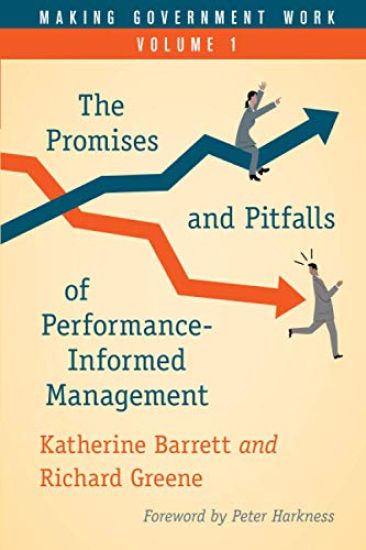
As performance management has evolved, it has encompassed many different tools and approaches including measurement, data analysis, evidence-based management, process improvement, research and evaluation. In the past, many of the efforts to improve performance in government have been fragmented, separated into silos and labeled with a variety of different names including performance-based budgeting, performance-informed management, managing for results and so on. Making Government Work: The Promises and Pitfalls of Performance-Informed Management by Katherine Barrett and Rich Greene is loaded with dozens of stories of what practitioners are currently working on—what’s working and what’s not. The benefits are ample, so are the challenges. This book describes both, along with practical steps taken by practitioners to make government work better. Readers will discover that while the authors strive to meet the documentation standards of carefully vetted academic papers, the approach they take is journalistic. Over the last year, Barrett and Greene talked to scores of state and local officials, as well as academics and other national experts to find out how performance management tools and approaches have changed, and what is coming in the near-term future. Performance management has been in a state of evolution for decades now, and so Barrett and Greene have endeavored to capture the state of the world as it is today. By detailing both the challenges and conquests of performance management in Making Government Work: The Promises and Pitfalls of Performance-Informed Management, Barrett and Greene insure readers will find the kind of balanced information that is helpful to both academics and practitioners—and that can move the field forward.
Making Government Work

Making Government Work

Katherine Barrett; Richard Greene

Rowman Littlefield
2019
nidottu
As performance management has evolved, it has encompassed many different tools and approaches including measurement, data analysis, evidence-based management, process improvement, research and evaluation. In the past, many of the efforts to improve performance in government have been fragmented, separated into silos and labeled with a variety of different names including performance-based budgeting, performance-informed management, managing for results and so on. Making Government Work: The Promises and Pitfalls of Performance-Informed Management by Katherine Barrett and Rich Greene is loaded with dozens of stories of what practitioners are currently working on—what’s working and what’s not. The benefits are ample, so are the challenges. This book describes both, along with practical steps taken by practitioners to make government work better. Readers will discover that while the authors strive to meet the documentation standards of carefully vetted academic papers, the approach they take is journalistic. Over the last year, Barrett and Greene talked to scores of state and local officials, as well as academics and other national experts to find out how performance management tools and approaches have changed, and what is coming in the near-term future. Performance management has been in a state of evolution for decades now, and so Barrett and Greene have endeavored to capture the state of the world as it is today. By detailing both the challenges and conquests of performance management in Making Government Work: The Promises and Pitfalls of Performance-Informed Management, Barrett and Greene insure readers will find the kind of balanced information that is helpful to both academics and practitioners—and that can move the field forward.
The Little Guide to Writing for Impact

The Little Guide to Writing for Impact

Katherine Barrett; Richard Greene; Donald F. Kettl

BLOOMSBURY PUBLISHING PLC
2024
sidottu
There is a tsunami of research being produced by social scientists, and most of them hope that their work will have impact on public policy. There is an enormous hunger by practitioners for insights into the work they are doing. Far too often, however, there is little connection between the two groups. Researchers complain that practitioners don’t pay enough attention to what they’re writing. Practitioners say that much of what they read isn’t understandable. We propose to write a short, handy guide like Strunk and White’s The Elements of Style, aimed at those who seek to translate their research into impact on the world of public affairs. It will help readers do so in academic journals; dissertations and other research-based papers by graduate and undergraduate students; commentaries for major government-focused publications like Governing and GovExec; op-eds for major publications and local newspapers; think tanks and foundations; policy memos aimed at stakeholders within government agencies and elected officials; and books. It will be designed so that its readers can quickly digest it from cover to cover, but it is our expectation that many will jump from chapter to chapter, seeking just the information they most covet. The chapter titles themselves will be punchy, and sometimes humorous, but with an emphasis on clarity. In addition, we will conclude each chapter with a series of bulleted take-aways, in the form of “Do’s and Don’ts”The chapters will develop lessons based on feedback we have gleaned from leading authors and editors, in addition to the authors’ cumulative 110 years in the realm of public administration. The book will provide specific real-world examples of what works—and what doesn’t. By way of illustration, examples will include a good pitch for an op-ed for a regional or a major newspaper; the opening paragraphs of a particularly well written journal abstract; and multiple concrete examples of clear concise writing – or unclear verbose writing – taken from published work.The result will be a guidebook for preparing more effective writing, as well as creating greater impact for useful policy ideas. Given the growing complexity of government problems and the declining trust in government’s operations, writing for impact has never been more important.
The Little Guide to Writing for Impact

The Little Guide to Writing for Impact

Katherine Barrett; Richard Greene; Donald F. Kettl

BLOOMSBURY PUBLISHING PLC
2024
nidottu
There is a tsunami of research being produced by social scientists, and most of them hope that their work will have impact on public policy. There is an enormous hunger by practitioners for insights into the work they are doing. Far too often, however, there is little connection between the two groups. Researchers complain that practitioners don’t pay enough attention to what they’re writing. Practitioners say that much of what they read isn’t understandable. We propose to write a short, handy guide like Strunk and White’s The Elements of Style, aimed at those who seek to translate their research into impact on the world of public affairs. It will help readers do so in academic journals; dissertations and other research-based papers by graduate and undergraduate students; commentaries for major government-focused publications like Governing and GovExec; op-eds for major publications and local newspapers; think tanks and foundations; policy memos aimed at stakeholders within government agencies and elected officials; and books. It will be designed so that its readers can quickly digest it from cover to cover, but it is our expectation that many will jump from chapter to chapter, seeking just the information they most covet. The chapter titles themselves will be punchy, and sometimes humorous, but with an emphasis on clarity. In addition, we will conclude each chapter with a series of bulleted take-aways, in the form of “Do’s and Don’ts”The chapters will develop lessons based on feedback we have gleaned from leading authors and editors, in addition to the authors’ cumulative 110 years in the realm of public administration. The book will provide specific real-world examples of what works—and what doesn’t. By way of illustration, examples will include a good pitch for an op-ed for a regional or a major newspaper; the opening paragraphs of a particularly well written journal abstract; and multiple concrete examples of clear concise writing – or unclear verbose writing – taken from published work.The result will be a guidebook for preparing more effective writing, as well as creating greater impact for useful policy ideas. Given the growing complexity of government problems and the declining trust in government’s operations, writing for impact has never been more important.
Powering Up

Powering Up

Katherine Barrett; Richard Greene

CQ Press
2000
nidottu
Billions of dollars are spent each year on technology in cities and states, from desktop computers to mainframes. It is impractical for non-specialists to master the complex inner-workings of these new technologies, yet public managers' reliance on information technology to govern effectively make IT planning and implementation crucial. Two respected journalists from Governing magazine provide a unique, nuts-and-bolts guide to help current practitioners, as well as students who will become tomorrow's city and state managers, successfully oversee IT specialists and maximize the potential of IT systems. This first book in the Governing Management Series draws on the authors' involvement in the Government Performance Project (conducted by the Syracuse's Maxwell School of Citizenship and Public Affairs). Barrett and Greene, after conducting nearly 100 interviews with practitioners on the front lines, look systematically at the best practices of cities and states that garnered high grades in the study. They offer real-world and up-to-the-minute guidance about procurement, strategic planning, training, out-sourcing, standardization, project management, cost-benefit analysis, and the appropriate use of the Internet in the public sector. Powering Up features summary take-away points and three in-depth case studies, pointing readers to both innovations to emulate and pitfalls to avoid.