Kirjojen hintavertailu. Mukana 12 595 353 kirjaa ja 12 kauppaa.

Kirjailija

Katherine Nelson

Kirjat ja teokset yhdessä paikassa: 6 kirjaa, julkaisuja vuosilta 1996-2026, suosituimpien joukossa Event Knowledge. Vertaile teosten hintoja ja tarkista saatavuus suomalaisista kirjakaupoista.

6 kirjaa

Kirjojen julkaisuhaarukka 1996-2026.

Event Knowledge

Event Knowledge

Katherine Nelson

TAYLOR FRANCIS LTD
2026
sidottu
Originally published in 1986, Event Knowledge: Structure and Function in Development was first undertaken because the authors were interested in certain phenomena of cognitive development in early childhood. In particular, they were struck by the discrepancy between young children’s apparent competence in everyday activities and their apparent incompetence on certain cognitive tasks. The research was designed in an attempt to identify the basis for children’s competence in everyday life. It evolved into an effort to find links between the everyday and the experimental realms, the hope that they could explain both the successes in one and failures in the other. Based on initial concerns and assumptions, the program of research described here was designed to explore how young children’s knowledge of their everyday world – its spatial-temporal structure, the people and objects that occupy it, and their activities – is organized and used, both in practical tasks and in abstract thinking. The approach was novel and it was hoped it would provide the foundation for a new approach to a theory of cognitive development. Today it can be read in its historical context.

Pocket Tutor ECG Interpretation

Pocket Tutor ECG Interpretation

Simon James; Katherine Nelson

JP Medical Ltd
2018
nidottu
Titles in the Pocket Tutor series give practical guidance on subjects that medical students and foundation doctors need help with ‘on the go’, at a highly-affordable price that puts them within reach of those rotating through modular courses or working on attachment. Topics reflect information needs stemming from today’s integrated undergraduate and foundation courses: Common presentationsInvestigation options (e.g. ECG, imaging)Clinical and patient-orientated skills (e.g. examinations, history-taking) The highly-structured, bite-size content helps novices combat the ‘fear factor’ associated with day-to-day clinical training, and provides a detailed resource that students and junior doctors can carry in their pocket. Key points New edition of the best-selling title that breaks down a complex and daunting subject using clearly-labelled, full-page ECG traces and concise but informative textRevised text and brand-new ECG traces bring the new edition fully up-to-dateNew chapters cover electrolyte and homeostatic disorders, and normal variantsLogical, sequential content: relevant basic science, then a guide to understanding a normal ECG and the building blocks of an abnormal ECG, before describing clinical disorders
Young Children’s Knowledge of Relational Terms

Young Children’s Knowledge of Relational Terms

Lucia A. French; Katherine Nelson

Springer-Verlag New York Inc.
2011
nidottu
An appreciation of temporal and logical relationships is one of the essential and defining features of human cognition. A central question in developmental psy­ chology, and in the philosophical speculations out of which psychology evolved, has been how children come to understand temporal and logical relationships. For many recent investigators, this question has been translated into empiri­ cal studies of children's acquisition of relational terms-words such as before, after, because, so, if, but, and or that permit the linguistic expression of logi­ cal relationships. In the mid 1970s, Katherine Nelson began to study young children's knowledge about routine activities in which they participated. The goal of this research was to understand how children represented their personal experiences and how these representations contributed to further cognitive development. A primary method used in the early phases of this research involved simply asking children to describe familiar events. They were asked, for example, "What happens when you have lunch at school?" or "What happens at a birthday party?" Hundreds of transcripts of children's responses to such questions were available when Lucia French became an NICHD Postdoctoral Fellow in Developmental Psychology at City University of New York in 1979.
Young Minds in Social Worlds

Young Minds in Social Worlds

Katherine Nelson

Harvard University Press
2009
nidottu
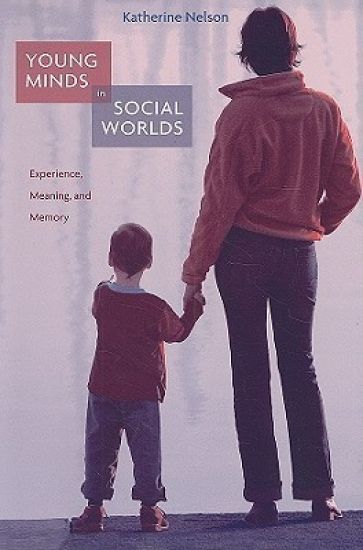
Katherine Nelson re-centers developmental psychology with a revived emphasis on development and change, rather than foundations and continuity. She argues that children be seen not as scientists but as members of a community of minds, striving not only to make sense, but also to share meanings with others. A child is always part of a social world, yet the child's experience is private. So, Nelson argues, we must study children in the context of the relationships, interactive language, and culture of their everyday lives.Nelson draws philosophically from pragmatism and phenomenology, and empirically from a range of developmental research. Skeptical of work that focuses on presumed innate abilities and the close fit of child and adult forms of cognition, her dynamic framework takes into account whole systems developing over time, presenting a coherent account of social, cognitive, and linguistic development in the first five years of life. Nelson argues that a child's entrance into the community of minds is a slow, gradual process with enormous consequences for child development, and the adults that they become. Original, deeply scholarly, and trenchant, Young Minds in Social Worlds will inspire a new generation of developmental psychologists.
Language in Cognitive Development

Language in Cognitive Development

Katherine Nelson

Cambridge University Press
1998
pokkari
Contemporary study of language and cognition in infancy and early childhood has received considerable, well deserved attention. However, little effort has been directed to the means by which language becomes a cognitive and communicative tool, as well as what the full implications of this development may be. This book highlights a transition from the study of language and cognition to that of language in cognition. It presents an integrative theory of cognitive development, emphasizing the important role that language plays in taking the two to five year old child to new levels of cognitive operations in memory, forming concepts, categories, processing narratives, and understanding other people’s intentions. Biological evolution is considered the source of both language and culture but it is argued that qualitatively different modes of thinking and knowing emerge therefrom.
Language in Cognitive Development

Language in Cognitive Development

Katherine Nelson

Cambridge University Press
1996
sidottu
Contemporary study of language and cognition in infancy and early childhood has received considerable, well deserved attention. However, little effort has been directed to the means by which language becomes a cognitive and communicative tool, as well as what the full implications of this development may be. This book highlights a transition from the study of language and cognition to that of language in cognition. It presents an integrative theory of cognitive development, emphasizing the important role that language plays in taking the two to five year old child to new levels of cognitive operations in memory, forming concepts, categories, processing narratives, and understanding other people’s intentions. Biological evolution is considered the source of both language and culture but it is argued that qualitatively different modes of thinking and knowing emerge therefrom.