Kirjojen hintavertailu. Mukana 12 328 301 kirjaa ja 12 kauppaa.

Kirjailija

Kathleen Barry

Kirjat ja teokset yhdessä paikassa: 5 kirjaa, julkaisuja vuosilta 1996-2020, suosituimpien joukossa Susan B. Anthony. Vertaile teosten hintoja ja tarkista saatavuus suomalaisista kirjakaupoista.

5 kirjaa

Kirjojen julkaisuhaarukka 1996-2020.

Susan B. Anthony

Susan B. Anthony

Kathleen Barry

New York University Press
2020
nidottu
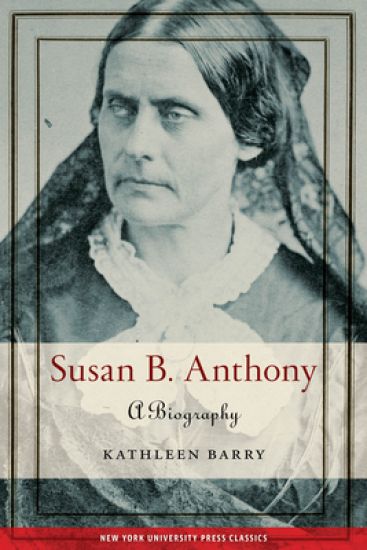
Brings to life one of the most significant figures in the crusade for women's rights in America This comprehensive biography of Susan B. Anthony traces the life of a feminist icon, bringing new depth to our understanding of her influence on the course of women's history. Beginning with her humble Quaker childhood in rural Massachusetts, taking readers through her late twenties when she left a secure teaching position to pursue activism, and ultimately tracing her evolution into a champion of women's rights, this book offers an in-depth look at the ways Anthony's life experiences shaped who she would become. Drawing on countless letters, diaries, and other documents, Kathleen Barry offers new interpretations of Anthony's relationship with feminist Elizabeth Cady Stanton, and illuminating insights on Anthony's views of men, marriage, and children. She paints a vivid picture of the political, economic, and cultural milieu of 19th-century America. And, above all, she brings a very real Susan B. Anthony to life. Here we find a powerful portrait of this most singular woman—who she was, what she felt, and how she thought. Complete with a new preface to honor the 100th anniversary of women's suffrage and Anthony's vital role in the fight for voting rights, this thorough biography gives us essential new insight into the life and legacy of an enduring American heroine.
Susan B. Anthony

Susan B. Anthony

Kathleen Barry

New York University Press
2020
sidottu
Brings to life one of the most significant figures in the crusade for women's rights in America This comprehensive biography of Susan B. Anthony traces the life of a feminist icon, bringing new depth to our understanding of her influence on the course of women's history. Beginning with her humble Quaker childhood in rural Massachusetts, taking readers through her late twenties when she left a secure teaching position to pursue activism, and ultimately tracing her evolution into a champion of women's rights, this book offers an in-depth look at the ways Anthony's life experiences shaped who she would become. Drawing on countless letters, diaries, and other documents, Kathleen Barry offers new interpretations of Anthony's relationship with feminist Elizabeth Cady Stanton, and illuminating insights on Anthony's views of men, marriage, and children. She paints a vivid picture of the political, economic, and cultural milieu of 19th-century America. And, above all, she brings a very real Susan B. Anthony to life. Here we find a powerful portrait of this most singular woman—who she was, what she felt, and how she thought. Complete with a new preface to honor the 100th anniversary of women's suffrage and Anthony's vital role in the fight for voting rights, this thorough biography gives us essential new insight into the life and legacy of an enduring American heroine.
Femininity in Flight

Femininity in Flight

Kathleen Barry

Duke University Press
2007
pokkari
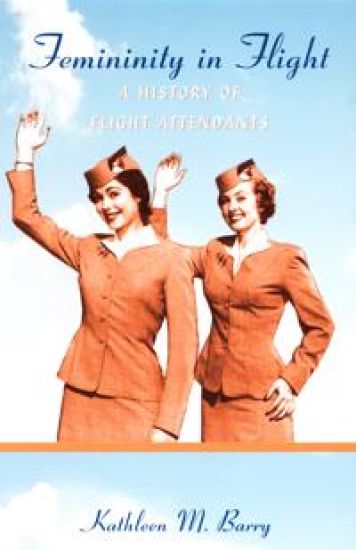
“In her new chic outfit, she looks like anything but a stewardess working. But work she does. Hard, too. And you hardly know it.” So read the text of a 1969 newspaper advertisement for Delta Airlines featuring a picture of a brightly smiling blond stewardess striding confidently down the aisle of an airplane cabin to deliver a meal. From the moment the first stewardesses took flight in 1930, flight attendants became glamorous icons of femininity. For decades, airlines hired only young, attractive, unmarried white women. They marketed passenger service aloft as an essentially feminine exercise in exuding charm, looking fabulous, and providing comfort. The actual work that flight attendants did-ensuring passenger safety, assuaging fears, serving food and drinks, all while conforming to airlines’ strict rules about appearance-was supposed to appear effortless; the better that stewardesses performed by airline standards, the more hidden were their skills and labor. Yet today flight attendants are acknowledged safety experts; they have their own unions. Gone are the no-marriage rules, the mandates to retire by thirty-two. In Femininity in Flight, Kathleen M. Barry tells the history of flight attendants, tracing the evolution of their glamorized image as ideal women and their activism as trade unionists and feminists.Barry argues that largely because their glamour obscured their labor, flight attendants unionized in the late 1940s and 1950s to demand recognition and respect as workers and self-styled professionals. In the 1960s and 1970s, flight attendants were one of the first groups to take advantage of new laws prohibiting sex discrimination. Their challenges to airlines’ restrictive employment policies and exploitive marketing practices (involving skimpy uniforms and provocative slogans such as “fly me”) made them high-profile critics of the cultural mystification and economic devaluing of “women’s work.” Barry combines attention to the political economy and technology of the airline industry with perceptive readings of popular culture, newspapers, industry publications, and first-person accounts. In so doing, she provides a potent mix of social and cultural history and a major contribution to the history of women’s work and working women’s activism.
Femininity in Flight

Femininity in Flight

Kathleen Barry

Duke University Press
2007
sidottu
“In her new chic outfit, she looks like anything but a stewardess working. But work she does. Hard, too. And you hardly know it.” So read the text of a 1969 newspaper advertisement for Delta Airlines featuring a picture of a brightly smiling blond stewardess striding confidently down the aisle of an airplane cabin to deliver a meal. From the moment the first stewardesses took flight in 1930, flight attendants became glamorous icons of femininity. For decades, airlines hired only young, attractive, unmarried white women. They marketed passenger service aloft as an essentially feminine exercise in exuding charm, looking fabulous, and providing comfort. The actual work that flight attendants did-ensuring passenger safety, assuaging fears, serving food and drinks, all while conforming to airlines’ strict rules about appearance-was supposed to appear effortless; the better that stewardesses performed by airline standards, the more hidden were their skills and labor. Yet today flight attendants are acknowledged safety experts; they have their own unions. Gone are the no-marriage rules, the mandates to retire by thirty-two. In Femininity in Flight, Kathleen M. Barry tells the history of flight attendants, tracing the evolution of their glamorized image as ideal women and their activism as trade unionists and feminists.Barry argues that largely because their glamour obscured their labor, flight attendants unionized in the late 1940s and 1950s to demand recognition and respect as workers and self-styled professionals. In the 1960s and 1970s, flight attendants were one of the first groups to take advantage of new laws prohibiting sex discrimination. Their challenges to airlines’ restrictive employment policies and exploitive marketing practices (involving skimpy uniforms and provocative slogans such as “fly me”) made them high-profile critics of the cultural mystification and economic devaluing of “women’s work.” Barry combines attention to the political economy and technology of the airline industry with perceptive readings of popular culture, newspapers, industry publications, and first-person accounts. In so doing, she provides a potent mix of social and cultural history and a major contribution to the history of women’s work and working women’s activism.
The Prostitution of Sexuality

The Prostitution of Sexuality

Kathleen Barry

New York University Press
1996
pokkari
An illuminating follow-up to Kathleen Barry's powerful landmark book, Female Sexual Slavery, that assesses the landscape of abuse prostitution 15 years later In 1979, Kathleen Barry's landmark book, Female Sexual Slavery, pulled back the curtain on a world of abuse prostitution that shocked the world. Documenting in devastating detail the lives of street prostitutes and the international traffic in women, Barry's work was called "powerful and compassionate" by Adrienne Rich and "a courageous and crusading book that should be read everywhere" by Gloria Steinem. The Los Angeles Times found it "a powerful work filled with disbelief, outrage, and documentation...sexual bondage shackles women as much today as it has for centuries." In The Prostitution of Sexuality, Barry assesses where we are 15 years later, how far we've come and, more importantly, how far we have still to go. Shifting her focus from the sexuality of prostitution to the prostitution of sexuality, Barry exposes the practice of teenage sexual exploitation and the flourishing Asian sex tour industry, emphasizing the world-wide role of the expanding multi-billion dollar pornography industry. The work identifies the global conditions of sexual exploitation, from sex industrialization in developing countries to the normalization of prostitution in the West. The Prostitution of Sexuality considers sexual exploitation a political condition and thus the foundation of women's subordination and the base from which discrimination against women is constructed and enacted. Breaking new ground, Barry convincingly argues for the need to integrate the struggle against sexual exploitation in prostitution into broader feminist struggles and to place it, as one of several connected issues, in the forefront of the feminist agenda. Barry concludes the book with a sampling of strategies—international, regional, local, and personal--that feminist activists have employed successfully since the early 1980s, highlighting new international legal strategies for human rights resulting from her work.