Kirjojen hintavertailu. Mukana 12 595 353 kirjaa ja 12 kauppaa.

Kirjailija

Keith D. Hjelmstad

Kirjat ja teokset yhdessä paikassa: 6 kirjaa, julkaisuja vuosilta 2004-2025, suosituimpien joukossa Fundamentals of Structural Dynamics. Vertaile teosten hintoja ja tarkista saatavuus suomalaisista kirjakaupoista.

6 kirjaa

Kirjojen julkaisuhaarukka 2004-2025.

Mechanics of Deformable Solids: An Introduction

Mechanics of Deformable Solids: An Introduction

Keith D. Hjelmstad

Springer International Publishing AG
2025
sidottu
This book provides a fresh approach to learning how solid bodies respond to loads, emphasizing clear derivations of the basic concepts from first principles. A consistent problem-solving framework fosters understanding by building and reinforcing the mathematical tools best suited to the task. Theoretical developments are augmented by an extensive set of MATLAB codes that not only show how to organize computations but also yield powerful tools for exploration and discovery. The book is aimed at engineering students at the sophomore level who have a background in calculus, linear algebra, and differential equations.
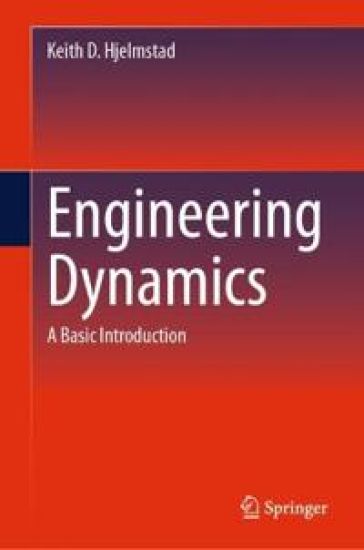
Engineering Dynamics

Engineering Dynamics

Keith D. Hjelmstad

Springer International Publishing AG
2024
sidottu
This book provides an innovative approach to learning dynamics of particles and rigid bodies, emphasizing a consistent problem-solving framework designed to help students understand the subject while building and reinforcing the mathematical tools needed to bridge the gap between physical intuition and quantitative results. The theoretical developments are supported by an extensive set of MATLAB codes that give the reader powerful tools for exploring and visualizing basic concepts. The book is aimed at engineering students at the sophomore level who have a background in calculus, linear algebra, and differential equations. Uses clear and consistent derivations of the basic concepts of dynamics and provides an extensive set of MATLAB codesEmbraces direct vector notation from the start and presents a consistent numerical framework for solving nonlinear differential equationsSimplifies one of the most difficult aspects of dynamics—relative motion—using a novel approach to kinematics

Fundamentals of Structural Dynamics

Fundamentals of Structural Dynamics

Keith D. Hjelmstad

Springer Nature Switzerland AG
2023
nidottu
This text closes the gap between traditional textbooks on structural dynamics and how structural dynamics is practiced in a world driven by commercial software, where performance-based design is increasingly important. The book emphasizes numerical methods, nonlinear response of structures, and the analysis of continuous systems (e.g., wave propagation). Fundamentals of Structural Dynamics: Theory and Computation builds the theory of structural dynamics from simple single-degree-of-freedom systems through complex nonlinear beams and frames in a consistent theoretical context supported by an extensive set of MATLAB codes that not only illustrate and support the principles, but provide powerful tools for exploration. The book is designed for students learning structural dynamics for the first time but also serves as a reference for professionals throughout their careers.
Fundamentals of Structural Dynamics

Fundamentals of Structural Dynamics

Keith D. Hjelmstad

Springer Nature Switzerland AG
2022
sidottu
This text closes the gap between traditional textbooks on structural dynamics and how structural dynamics is practiced in a world driven by commercial software, where performance-based design is increasingly important. The book emphasizes numerical methods, nonlinear response of structures, and the analysis of continuous systems (e.g., wave propagation). Fundamentals of Structural Dynamics: Theory and Computation builds the theory of structural dynamics from simple single-degree-of-freedom systems through complex nonlinear beams and frames in a consistent theoretical context supported by an extensive set of MATLAB codes that not only illustrate and support the principles, but provide powerful tools for exploration. The book is designed for students learning structural dynamics for the first time but also serves as a reference for professionals throughout their careers.
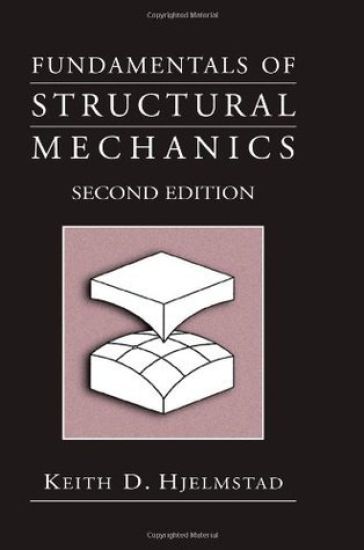
Fundamentals of Structural Mechanics

Fundamentals of Structural Mechanics

Keith D. Hjelmstad

Springer-Verlag New York Inc.
2010
nidottu
The last few decades have witnessed a dramatic increase in the application of numerical computation to problems in solid and structural mechanics. The burgeoning of computational mechanics opened a pedagogical gap between traditional courses in elementary strength of materials and the finite element method that classical courses on advanced strength of materials and elasticity do not adequately fill. In the past, our ability to formulate theory exceeded our ability to compute. In those days, solid mechanics was for virtuosos. With the advent of the finite element method, our ability to compute has surpassed our ability to formulate theory. As a result, continuum mechanics is no longer the province of the specialist. What an engineer needs to know about mechanics has been forever changed by our capacity to compute. This book attempts to capitalize on the pedagogi­ cal opportunities implicit in this shift of perspective. It now seems more ap­ propriate to focus on fundamental principles and formulations than on classical solution techniques.
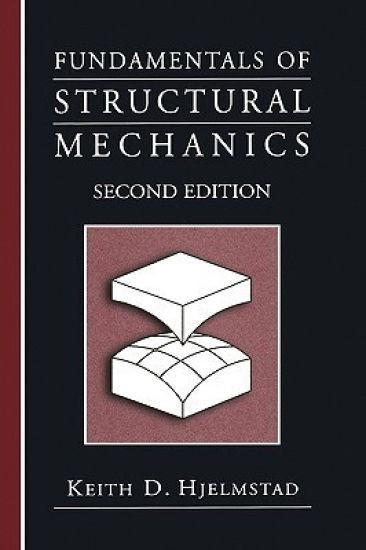
Fundamentals of Structural Mechanics

Fundamentals of Structural Mechanics

Keith D. Hjelmstad

Springer-Verlag New York Inc.
2004
sidottu
The last few decades have witnessed a dramatic increase in the application of numerical computation to problems in solid and structural mechanics. The burgeoning of computational mechanics opened a pedagogical gap between traditional courses in elementary strength of materials and the finite element method that classical courses on advanced strength of materials and elasticity do not adequately fill. In the past, our ability to formulate theory exceeded our ability to compute. In those days, solid mechanics was for virtuosos. With the advent of the finite element method, our ability to compute has surpassed our ability to formulate theory. As a result, continuum mechanics is no longer the province of the specialist. What an engineer needs to know about mechanics has been forever changed by our capacity to compute. This book attempts to capitalize on the pedagogi­ cal opportunities implicit in this shift of perspective. It now seems more ap­ propriate to focus on fundamental principles and formulations than on classical solution techniques.