Kirjojen hintavertailu. Mukana 12 595 353 kirjaa ja 12 kauppaa.

Kirjailija

Keith Thomas

Kirjat ja teokset yhdessä paikassa: 27 kirjaa, julkaisuja vuosilta 1991-2024, suosituimpien joukossa Instant Insights: Improving Crop Disease Management. Vertaile teosten hintoja ja tarkista saatavuus suomalaisista kirjakaupoista.

27 kirjaa

Kirjojen julkaisuhaarukka 1991-2024.

The Ends of Life

The Ends of Life

Keith Thomas

Oxford University Press
2010
nidottu
How should we live? That question was no less urgent for English men and women who lived between the early sixteenth and late eighteenth centuries than for this book's readers. Keith Thomas's masterly exploration of the ways in which people sought to lead fulfilling lives in those centuries between the beginning of the Reformation and the heyday of the Enlightenment illuminates the central values of the period, while casting incidental light on some of the perennial problems of human existence. Consideration of the origins of the modern ideal of human fulfilment and of obstacles to its realization in the early modern period frames an investigation that ranges from work, wealth, and possessions to the pleasures of friendship, family, and sociability. The cult of military prowess, the pursuit of honour and reputation, the nature of religious belief and scepticism, and the desire to be posthumously remembered are all drawn into the discussion, and the views and practices of ordinary people are measured against the opinions of the leading philosophers and theologians of the time. The Ends of Life offers a fresh approach to the history of early modern England, by one of the foremost historians of our time. It also provides modern readers with much food for thought on the problem of how we should live and what goals in life we should pursue.
The Ends of Life

The Ends of Life

Keith Thomas

Oxford University Press
2009
sidottu
How should we live? That question was no less urgent for English men and women who lived between the early sixteenth and late eighteenth centuries than for this book's readers. Keith Thomas's masterly exploration of the ways in which people sought to lead fulfilling lives in those centuries between the beginning of the Reformation and the heyday of the Enlightenment illuminates the central values of the period, while casting incidental light on some of the perennial problems of human existence. Consideration of the origins of the modern ideal of human fulfilment and of obstacles to its realization in the early modern period frames an investigation that ranges from work, wealth, and possessions to the pleasures of friendship, family, and sociability. The cult of military prowess, the pursuit of honour and reputation, the nature of religious belief and scepticism, and the desire to be posthumously remembered are all drawn into the discussion, and the views and practices of ordinary people are measured against the opinions of the leading philosophers and theologians of the time. The Ends of Life offers a fresh approach to the history of early modern England, by one of the foremost historians of our time. It also provides modern readers with much food for thought on the problem of how we should live and what goals in life we should pursue.
Changing Conceptions of National Biography

Changing Conceptions of National Biography

Keith Thomas

Cambridge University Press
2005
pokkari
The publication of the Oxford Dictionary of National Biography in September 2004 was an event of great literary and scholarly importance. In his Leslie Stephen Lecture, commemorating the founder of the original Dictionary of National Biography, the celebrated historian Keith Thomas surveys the many earlier attempts at collective biography, considers the relationship of the Oxford DNB to them, and offers a preliminary assessment of the Oxford DNB itself. The author, who has been chairman of the Supervisory Committee of the Oxford DNB since its inception, writes with intimate knowledge of the project. This Leslie Stephen Lecture complements the earlier Lecture on the DNB by the late Colin Matthew, Founder-Editor of the Oxford DNB, and published by Cambridge in 1997.
Religion and the Decline of Magic

Religion and the Decline of Magic

Keith Thomas

Penguin Books Ltd
2003
pokkari
Witchcraft, astrology, divination and every kind of popular magic flourished in England during the sixteenth and seventeenth centuries, from the belief that a blessed amulet could prevent the assaults of the Devil to the use of the same charms to recover stolen goods. At the same time the Protestant Reformation attempted to take the magic out of religion, and scientists were developing new explanations of the universe. Keith Thomas's classic analysis of beliefs held on every level of English society begins with the collapse of the medieval Church and ends with the changing intellectual atmosphere around 1700, when science and rationalism began to challenge the older systems of belief.
Development Control

Development Control

Keith Thomas

Routledge
1997
nidottu
Development Control" is a comprehensive introductory text for students of planning and related subjects. Drawing widely on the literature - the approach and treatment are very much geared to the needs of students on courses, rather than focusing on practical and "how-to-do-it" issues. It should be of interest to students in schools of planning, the built environment, estate management, land economy and other related subjects.
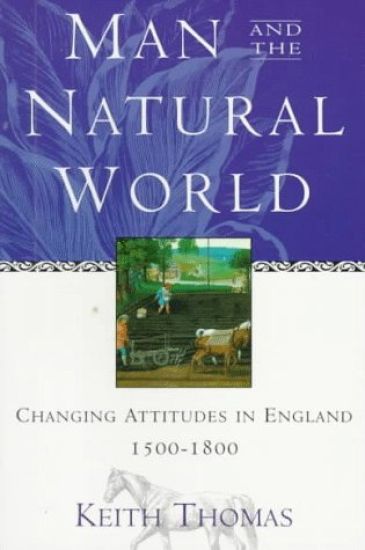
Man and the Natural World

Man and the Natural World

Keith Thomas

Oxford University Press
1996
nidottu
Throughout the ages man has struggled with his perceived place in the natural world. The idea of humans cultivating the Earth to suit specific needs is one of the greatest points of contention in this struggle. For how would have civilization progressed, if not by the clearance of the forests, the cultivation of the soil, and the conservation of wild landscape into human settlement? Yet what of the healing powers of unexploited nature, its long-term importance in the perpetuation of human civilization, and the inherent beauty of wild scenery? At no time were these questions addressed as pointedly and with such great consequence as in England between the sixteenth and late eighteenth centuries. Between 1500 and 1800 there occurred a whole cluster of changes in the way in which men and women, at all social levels, perceived and classified the natural world around them, explains Keith Thomas. New sensibilities arose toward animals, plants, and landscape. The relationship of man to other species was redefined; and his right to exploit those species for his own advantage was sharply challenged. Man and the Natural World aims not just to explain present interest in preserving the environment and protecting the rights of animals, but to reconstruct an earlier mental world. Thomas seeks to expose the assumptions beneath the perceptions, reasonings, and feelings of the inhabitants of early modern England toward the animals, birds, vegetation, and physical landscape among which they spent their lives, often in conditions of proximity which are now difficult for us to appreciate. It was a time when a conviction of man's ascendancy over the natural world gave way to a new concern for the environment and sense of kinship with other species. Here, for example, Thomas illustrates the changing attitudes toward the woodlands. John Morton observed in 1712, In a country full of civilized inhabitants timber could not be suffered to grow. It must give way to fields and pastures, which are of more immediate use and concern to life. Shortly thereafter, in 1763, Edwin Lascelles pronounced the The beauty of a country consists chiefly in the wood. People's relationships with animals were also in the process of dramatic change as seen in their growing obsession with pet keeping. The use of human names for animals, the fact that pets were rarely eaten, though not for gastronomic reasons, and pets being included in family portraits and often fed better than the servants all demonstrated a major shift in man's position on human uniqueness. The issues raised in this fascinating work are even more alive today than they were just ten years ago. Preserving the environment, saving the rain forests, and preventing the extinction of species may seem like fairly recent concerns, however, Man and the Natural World explores how these ideas took root long ago. These issues have much to offer not only environmental activists, but historians as well, for it is impossible to disentangle what the people of the past thought about plants and animals from what they thought about themselves.
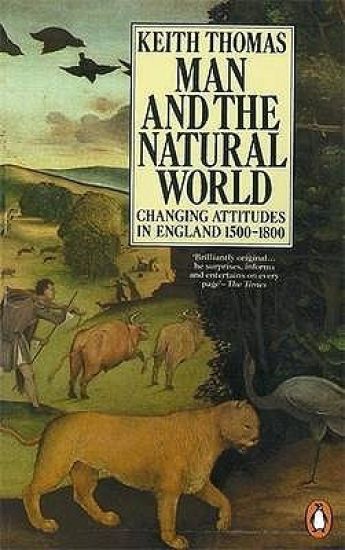
Man and the Natural World

Man and the Natural World

Keith Thomas

Penguin Books Ltd
1991
pokkari
'Man and the Natural World, an encyclopaedic study of man's relationship to animals and plants, is completely engrossing ... It explains everything - why we eat what we do, why we plant this and not that, why we keep pets, why we like some animals and not others, why we kill the things we kill and love the things we love ... It is often a funny book and one to read again and again' Paul Theroux, Sunday Times 'The English historian Keith Thomas has revealed modes of thought and ways of life deeply strange to us' Hilary Mantel, New York Review of Books'A treasury of unusual historical anecdote ... a delight to read and a pleasure to own' Auberon Waugh, Sunday Telegraph'A dense and rich work ... the return to the grass roots of our own environmental convictions is made by the most enchantingly minor paths' Ronald Blythe, Guardian