Kirjojen hintavertailu. Mukana 12 390 323 kirjaa ja 12 kauppaa.
Kirjailija
Ken Goldberg
Kirjat ja teokset yhdessä paikassa: 6 kirjaa, julkaisuja vuosilta 2010-2024, suosituimpien joukossa Instant Insights: Artificial Intelligence Applications in Agriculture. Vertaile teosten hintoja ja tarkista saatavuus suomalaisista kirjakaupoista.
Leisa Armstrong; N. Gandhi; P. Taechatanasat; Dean Diepeveen; Stefano Carpin; Ken Goldberg; Stavros Vougioukas; Ron Berenstein; Josh Viers; Jose Blasco; María Gyomar González González; Patricia Chueca; Sergio Cubero; Nuria Aleixos; Anne-Katrin Mahlein; Jan Behmann; David Bohnenkamp; René H. J. Heim; Sebastian Streit; Stefan Paulus
This collection features four peer-reviewed reviews on Artificial Intelligence (AI) applications in agriculture.The first chapter reviews developments in the use of AI techniques to improve the functionality of decision support systems in agriculture. It reviews the use of techniques such as data mining, artificial neural networks, Bayesian networks, support vector machines and association rule mining.The second chapter examines how robotic and AI can be used to improve precision irrigation in vineyards. The chapter pays particular attention to robot-assisted precision irrigation delivery (RAPID), a novel system currently being developed and tested at the University of California in the United States.The third chapter reviews the current state of mechanized collection technology, such as the development of harvest-assist platforms, as well as the possibilities of these machines to incorporate artificial vision systems to perform an in-field pre-grading of the product.The final chapter explores the emergence of the automated assessment of plant diseases and traits through new sensor systems, AI and robotics. The chapter then considers the application of these digital technologies in plant breeding, focussing on smart farming and plant phenotyping.
Feature Film Budgeting: A Step-by-Step Manual is a step-by-step guide to film budgeting in the $600k to $6.5 Million range. Be it the film student, Line Producer, 1st Assistant Director, or script writer, all will benefit from the easy-to-follow steps on how to create a film budget. This book walks the reader through how to: - find current and future salary rates for every Hollywood Guild - determine Prep and Wrap periods for all crew members - navigate the Guild contracts for easy understanding - analyze salary rates and how they were arrived at - simplify the application of fringe rates (tax percentages). Additionally, sample budgets are presented to reinforce knowledge gained in each chapter through a comprehensive breakdown. Notably, this manual covers films budgeted in the $600,000 to $6.5 Million range. This allows the reader to focus and excel at those budget levels before moving on to higher budget levels.
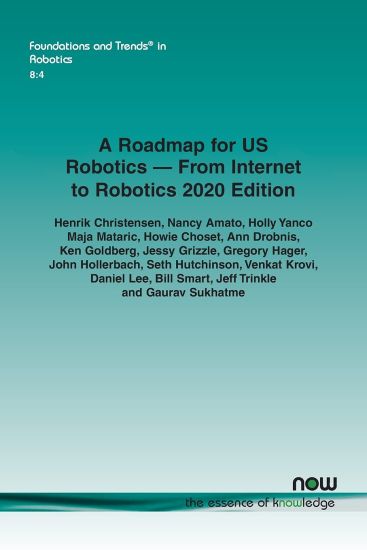
Henrik Christensen; Nancy Amato; Holly Yanco; Maja Mataric; Howie Choset; Ann Drobnis; Ken Goldberg; Jessy Grizzle; Gregory Hager; John Hollerbach; Seth Hutchinson; Venkat Krovi; Daniel Lee; Bill Smart; Jeff Trinkle; Gaurav Sukhatme
Recently the robotics industry celebrated its 60-year anniversary. We have used robots for more than six decades to empower people to do things that are typically dirty, dull and/or dangerous. The industry has progressed significantly over the period from basic mechanical assist systems to fully autonomous cars, environmental monitoring and exploration of outer space. We have seen tremendous adoption of IT technology in our daily lives for a diverse set of support tasks. Through use of robots we are starting to see a new revolution, as we not only will have IT support from tablets, phones, computers but also systems that can physically interact with the world and assist with daily tasks, work, and leisure activities. The “old” robot systems were largely mechanical support systems. Through the gradual availability of inexpensive computing, user interfaces, and sensors it is possible to build robot systems that were difficult to imagine before. The confluence of technologies is enabling a revolution in use and adoption of robot technologies for all aspects of daily life. Thirteen years ago, the process to formulate a roadmap was initiated at the Robotics Science and Systems (RSS) conference in Atlanta. Through support from the Computing Community Consortium (CCC) a roadmap was produced by a group of 120 people from industry and academia. The roadmap has been updated 2013 and 2016 prior to this update. The present document is a summary of the main societal opportunities identified, the associated challenges to deliver desired solutions and a presentation of efforts to be undertaken to ensure that US will continue to be a leader in robotics both in terms of research innovation, adoption of the latest technology, and adoption of appropriate policy frameworks that ensure that the technology is utilized in a responsible fashion.
Peter, a habitual peep show user, dreads dirt, fears contamination, and lives each day in strange fantasy and total emotional isolation. By strictly adhering to self-imposed mathematic rituals, he maintains his own orderly -- albeit lonely -- universe in a chaotic world. One day, he meets John, a lifelong mental patient. From their respective manias, they form an odd, but deep, friendship.A literary novel, Peter Squared is both tragic and funny. Through vivid characters and absurd situations, Peter Squared addresses such controversial questions as: Are neglected and abused children better off protected or left alone? Is smoking really bad for you? Does fellatio violate kosher dietary laws?
Since the dawn of the new millennium, robotics has undergone a major transf- mation in scope and dimensions. This expansion has been brought about by the maturityofthe?eldandtheadvancesinitsrelatedtechnologies.Fromapred- inantly industrial focus, robotics has been rapidly expanding into the challenges of the human world. The new generation of robots is expected to safely and dependably cohabit with humans in homes, workplaces, and communities, p- viding support in services,entertainment,education, healthcare,manufacturing, and assistance. Beyond its impact on physical robots, the body of knowledge robotics has produced is revealing a much wider rangeof applications reaching across diverse research areas and scienti?c disciplines, such as: biomechanics, haptics, neu- sciences, virtual prototyping, animation, surgery, and sensor networks among others. In return, the challenges of the new emerging areas are proving an ab- dant source of stimulation and insights for the ?eld of robotics. It is indeed at the intersection of disciplines that the most striking advances happen. The goal of the series of Springer Tracts in Advanced Robotics (STAR)isto bring, in a timely fashion, the latest advances and developments in robotics on thebasisoftheirsigni?canceandquality.Itisourhopethatthewiderdissemi- tion of research developments will stimulate more exchanges and collaborations among the research community and contribute to further advancement of this rapidly growing ?eld.