Kirjojen hintavertailu. Mukana 12 304 486 kirjaa ja 12 kauppaa.

Kirjailija

Ken Spours

Kirjat ja teokset yhdessä paikassa: 8 kirjaa, julkaisuja vuosilta 1999-2017, suosituimpien joukossa Education and Training 14-19. Vertaile teosten hintoja ja tarkista saatavuus suomalaisista kirjakaupoista.

8 kirjaa

Kirjojen julkaisuhaarukka 1999-2017.

Education and Training 14-19

Education and Training 14-19

Ann Hodgson; Ken Spours

SAGE Publications Ltd
2008
sidottu
14-19 education and training is a complex, fast changing and contested terrain which has been the focus of enormous controversy. This book will help those involved in the education of young people understand the wider context for 14-19 reform, the main dimensions of government policy and how it is likely to affect practice. It also offers alternative views about the way forward. The authors provide a comprehensive and up-to-date account of the emerging 14-19 phase in England, with a focus on A Levels and GCSEs, the 14-19 Diplomas, vocational learning, apprenticeships and institutional collaboration. Drawing on international and historical analysis, recent research and practice, as well as interviews with key policy actors, they set out the case for a more unified and strongly collaborative approach. The book is intended for education practitioners, policy-makers and researchers. It will also be of particular relevance to post-graduate students on PGCE, Masters and Doctoral programmes. The authors are both Readers of Education at the Institute of Education, University of London, and are co-directors of the Nuffield Review of 14-19 Education and Training in England and Wales.
Education and Training 14-19

Education and Training 14-19

Ann Hodgson; Ken Spours

SAGE Publications Ltd
2008
nidottu
14-19 education and training is a complex, fast changing and contested terrain which has been the focus of enormous controversy. This book will help those involved in the education of young people understand the wider context for 14-19 reform, the main dimensions of government policy and how it is likely to affect practice. It also offers alternative views about the way forward. The authors provide a comprehensive and up-to-date account of the emerging 14-19 phase in England, with a focus on A Levels and GCSEs, the 14-19 Diplomas, vocational learning, apprenticeships and institutional collaboration. Drawing on international and historical analysis, recent research and practice, as well as interviews with key policy actors, they set out the case for a more unified and strongly collaborative approach. The book is intended for education practitioners, policy-makers and researchers. It will also be of particular relevance to post-graduate students on PGCE, Masters and Doctoral programmes. The authors are both Readers of Education at the Institute of Education, University of London, and are co-directors of the Nuffield Review of 14-19 Education and Training in England and Wales.
Education for All

Education for All

Richard Pring; Geoffrey Hayward; Ann Hodgson; Jill Johnson; Ewart Keep; Alis Oancea; Gareth Rees; Ken Spours; Stephanie Wilde

Routledge
2009
nidottu
There are two key questions at the heart of the ongoing debate about education and training for all young people, irrespective of background, ability or attainment: What counts as an educated 19 year old today? Are the models of education we have inherited from the past sufficient to meet the needs of all young people, as well as the social and economic needs of the wider community?Education for All addresses these questions in the light of evidence collected over five years by the Nuffield Review of 14-19 Education and Training: the most rigorous investigation of every aspect of this key educational phase for decades. Written by the co-directors of the Nuffield Review, Education for All provides a critical, comprehensive and thoroughly readable overview of 14-19 education and training and makes suggestions for the kind of education and training that should be provided over the coming decade and beyond.The authors acknowledge that much has been achieved by the respective governments – massive investment in resources; closer collaboration between schools, colleges, training providers, voluntary agencies and employers; recognition and promotion of a wider range of qualifications. They are also optimistic about the good things that are going on in many secondary classrooms – enormous amounts of creativity; courageous efforts to meet problems; a deep concern and caring for many young people otherwise deprived of hope and opportunity. But they argue for a radical reshaping of the future in the light of a broader vision of education – a greater respect for more practical and active learning; a system of assessment which supports rather than impoverishes learning; respect for the professional expertise of the teacher; a more unified system of qualifications ensuring progression into higher education and employment; the creation of strongly collaborative and local learning systems; and a more reflective and participative approach to policy.Education for All should be read by everyone working in – or with an interest in – secondary-level education in England and Wales and beyond.
Education for All

Education for All

Richard Pring; Geoffrey Hayward; Ann Hodgson; Jill Johnson; Ewart Keep; Alis Oancea; Gareth Rees; Ken Spours; Stephanie Wilde

Routledge
2009
sidottu
There are two key questions at the heart of the ongoing debate about education and training for all young people, irrespective of background, ability or attainment: What counts as an educated 19 year old today? Are the models of education we have inherited from the past sufficient to meet the needs of all young people, as well as the social and economic needs of the wider community?Education for All addresses these questions in the light of evidence collected over five years by the Nuffield Review of 14-19 Education and Training: the most rigorous investigation of every aspect of this key educational phase for decades. Written by the co-directors of the Nuffield Review, Education for All provides a critical, comprehensive and thoroughly readable overview of 14-19 education and training and makes suggestions for the kind of education and training that should be provided over the coming decade and beyond.The authors acknowledge that much has been achieved by the respective governments – massive investment in resources; closer collaboration between schools, colleges, training providers, voluntary agencies and employers; recognition and promotion of a wider range of qualifications. They are also optimistic about the good things that are going on in many secondary classrooms – enormous amounts of creativity; courageous efforts to meet problems; a deep concern and caring for many young people otherwise deprived of hope and opportunity. But they argue for a radical reshaping of the future in the light of a broader vision of education – a greater respect for more practical and active learning; a system of assessment which supports rather than impoverishes learning; respect for the professional expertise of the teacher; a more unified system of qualifications ensuring progression into higher education and employment; the creation of strongly collaborative and local learning systems; and a more reflective and participative approach to policy.Education for All should be read by everyone working in – or with an interest in – secondary-level education in England and Wales and beyond.
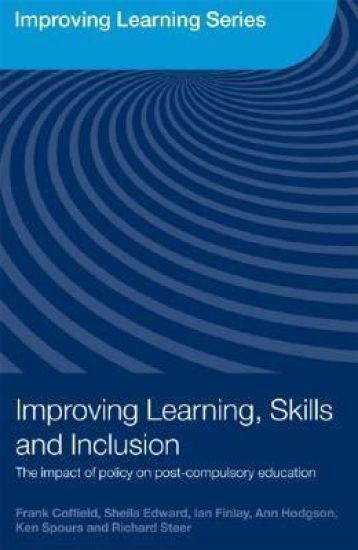
Improving Learning, Skills and Inclusion

Improving Learning, Skills and Inclusion

Frank Coffield; Sheila Edward; Ian Finlay; Ann Hodgson; Ken Spours; Richard Steer

Routledge
2008
sidottu
How can opportunities for teaching and learning be improved to ensure that many more people participate, gain qualifications and obtain decent jobs? Will government policies enable us to achieve these goals? What new ideas do we need to ensure a more inclusive, equitable and efficient learning system? These are some of the main concerns which underlie this thought-provoking book coming from a major research project looking at how policies affect learners, tutors, managers and institutional leaders in Further Education Colleges, Adult and Community Learning centres and in Work Based Learning sites.Post compulsory education in the UK has been constantly restructured by the New Labour government and has been subject to considerable policy turbulence over the last few years. This book attempts to understand this important but poorly understood sector by both talking to students and front-line staff and by interviewing the officials responsible for managing post-compulsory education and lifelong learning.By examining the sector simultaneously from the ‘bottom up’ and from ‘top down’, the authors show how recent policy is affecting three disadvantaged groups - 16-19 year olds who have fared poorly in official tests at school; unemployed adults learning basic skills; and employees at work learning basic skills. The authors conclude that there are serious failings and suggest principles and features of a more equitable and effective learning system.
Improving Learning, Skills and Inclusion

Improving Learning, Skills and Inclusion

Frank Coffield; Sheila Edward; Ian Finlay; Ann Hodgson; Ken Spours; Richard Steer

Routledge
2008
nidottu
How can opportunities for teaching and learning be improved to ensure that many more people participate, gain qualifications and obtain decent jobs? Will government policies enable us to achieve these goals? What new ideas do we need to ensure a more inclusive, equitable and efficient learning system? These are some of the main concerns which underlie this thought-provoking book coming from a major research project looking at how policies affect learners, tutors, managers and institutional leaders in Further Education Colleges, Adult and Community Learning centres and in Work Based Learning sites.Post compulsory education in the UK has been constantly restructured by the New Labour government and has been subject to considerable policy turbulence over the last few years. This book attempts to understand this important but poorly understood sector by both talking to students and front-line staff and by interviewing the officials responsible for managing post-compulsory education and lifelong learning.By examining the sector simultaneously from the ‘bottom up’ and from ‘top down’, the authors show how recent policy is affecting three disadvantaged groups - 16-19 year olds who have fared poorly in official tests at school; unemployed adults learning basic skills; and employees at work learning basic skills. The authors conclude that there are serious failings and suggest principles and features of a more equitable and effective learning system.