Kirjojen hintavertailu. Mukana 12 181 919 kirjaa ja 12 kauppaa.
Kirjailija
Kenneth Goldsmith
Kirjat ja teokset yhdessä paikassa: 17 kirjaa, julkaisuja vuosilta 1994-2026, suosituimpien joukossa Kay Rosen - Now And Then. Vertaile teosten hintoja ja tarkista saatavuus suomalaisista kirjakaupoista.
Kay Rosen (b. Corpus Christi, TX, 1943; lives in New York City and Gary, IN) has made art out of language since the 1970s. She garnered international acclaim with wall pieces spelling individual words, phrases, or strings of letters, often on a vast scale. Her works combine minimalist form, aesthetic force, and clever ideas in compelling ways. By modulating their arrangement and typographic and color design, the artist puts irritating twists on everyday terms and expressions. Subtle alterations often yield striking effects. Through punning, reframing, and onomatopoeic exploration, Rosen continually unearths unexpected layers of meaning. The publication presents wall pieces, paintings, drawings, prints, and video stills, inviting readers to discover or rediscover a multifaceted oeuvre that blends lightness and humor with analytical acumen in singular fashion. Kay Rosen obtained a B.A. in linguistics, Spanish, and French at Tulane University's Newcomb College in New Orleans, LA, in 1965. She then taught Spanish at Indiana University in Gary while attending studio classes at the School of the Art Institute of Chicago, where she subsequently taught for twenty-four years.
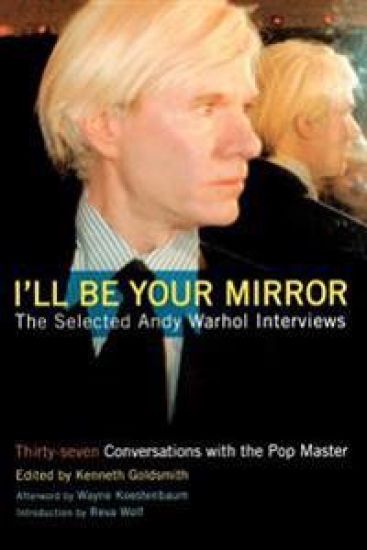
The Question-and-Answer interview was one of Andy Warhol's favorite communication vehicles, so much so that he named his own magazine after the form. Yet, never before has anyone published a collection of interviews that Warhol himself gave. I'll Be Your Mirror contains more then thirty conversations revealing this unique and important artist. Each piece presents a different facet of the Sphinx-like Warhol's ever-evolving personality. Writer Kenneth Goldsmith provides context and provenance for each selection. Beginning in 1962 with a notorious interview in which Warhol literally begs the interviewer to put words into his mouth, the book covers Warhol's most important artistic period during the '60s. As Warhol shifts to filmmaking in the '70s, this collection explores his emergence as socialite, scene-maker, and trendsetter; his influential Interview magazine; and the Studio 54 scene. In the 80s, his support of young artists like Jean-Michel Basquait, his perspective on art history and the growing relationship to technology in his work are shown. Finally, his return to religious imagery and spirituality are available in an interview conducted just months before his death.Including photographs and previous unpublished interviews, this collage of Warhol showcases the artist's ability to manipulate, captivate, and enrich American culture.
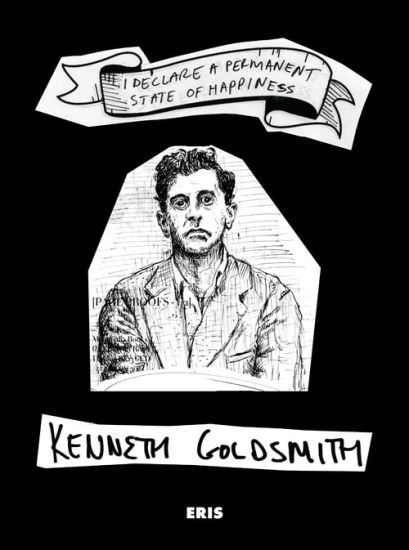
"My entire poetic production is founded upon Wittgenstein's later writings. Although it has sat on my shelf for decades, I never actually read the Tractatus. But I always loved the idea of it; I am a conceptual writer, after all."-- Kenneth Goldsmith A major philosophical work, one of the most important written in the twentieth century, Tractatus Logico-Philosophicus is Ludwig Wittgenstein's attempt to conquer reality through logic. Written as a series of precisely numbered propositions, it elucidates the relationship of language to logic and to reality, ending with an infamous statement of breathtaking clarity: "What can be said at all, can be said clearly; and what we cannot talk about we must pass over to silence". Originally conceived as part of ERIS's Marginalia series of hand-annotated classics, this special edition consists of sixty-two original artworks inspired by the famous tract. Collages, drawings, sketches, handwritten comments, blacked-out and blanched text, shopping receipts and scans-within-scans-these are some of the techniques that appear in the pages of this book. Kenneth Goldsmith, on his maiden voyage into the unforgiving rigour of Wittgenstein's Tractatus, shows no appetite for timidity. His works, placed side-by-side with the original text, reveal the breadth and depth not just of its original author's genius, but also of the intervening artist's creative fervour. This is a unique book, beautifully presented in large bound format, and including a handwritten afterword by the artist.
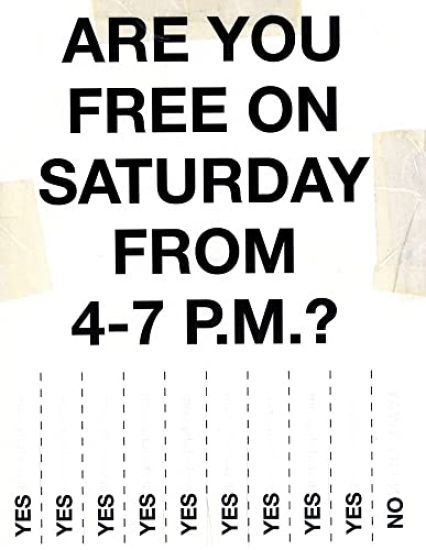
Between the late 1980s and 2020, from the end of the Reagan era to the beginning of the of the coronavirus, the artist Kenneth Goldsmith collected in the streets of New York hundreds of classified ads and other advertising posters. Hilarious, offbeat, absurd, even downright outrageous, sometimes breathtakingly beautiful, they all have in common their unpredictability as much as their total lack of utility. Borrowing either their codes to art brut, cubism or concrete poetry, they align in any case with the watchword of artistic modernity: to take an object and to divert it from any practical aim. Through this personal collection of “street poets and other visionaries”, Kenneth Goldsmith traces almost forty years of American history, questions the limits between what is art and what is not, and draws a history of the margins that is far from being as homogeneous as one might think.
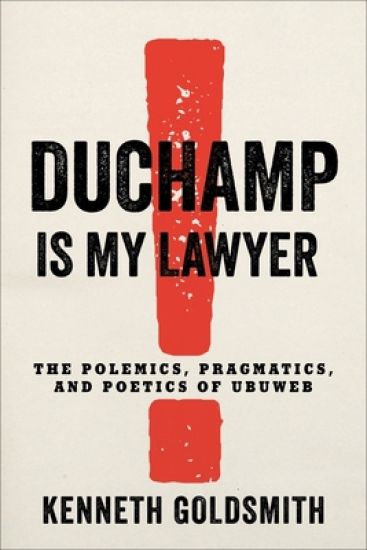
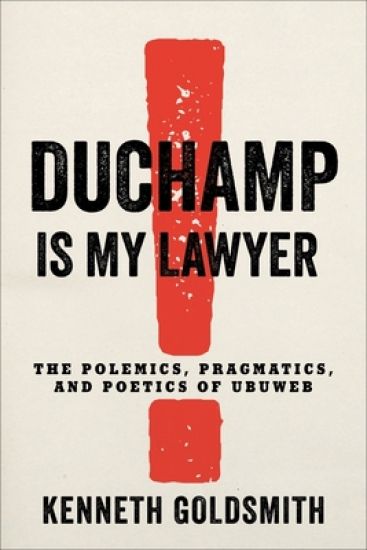
In 1996, during the relatively early days of the web, Kenneth Goldsmith created UbuWeb to post hard-to-find works of concrete poetry. What started out as a site to share works from a relatively obscure literary movement grew into an essential archive of twentieth- and twenty-first-century avant-garde and experimental literature, film, and music. Visitors around the world now have access to both obscure and canonical works, from artists such as Kara Walker, Yoko Ono, Pauline Oliveros, Samuel Beckett, Marcel Duchamp, Cecil Taylor, Glenn Ligon, William Burroughs, and Jean-Luc Godard.In Duchamp Is My Lawyer, Goldsmith tells the history of UbuWeb, explaining the motivations behind its creation and how artistic works are archived, consumed, and distributed online. Based on his own experiences and interviews with a variety of experts, Goldsmith describes how the site navigates issues of copyright and the ways that UbuWeb challenges familiar configurations and histories of the avant-garde. The book also portrays the growth of other “shadow libraries” and includes a section on the artists whose works reflect the aims, aesthetics, and ethos of UbuWeb. Goldsmith concludes by contrasting UbuWeb’s commitment to the free-culture movement and giving access to a wide range of artistic works with today’s gatekeepers of algorithmic culture, such as Netflix, Amazon, and Spotify.
Today it has become increasingly difficult to find a person or an object without some kind of connection to the internet. No Internet, No Art is dedicated to exploring what this situation entails with respect to one cultural field in particular: art. This anthology forms both the culmination and a continuation of a series of public events titled Lunch Bytes – Thinking about Art and Digital Culture, held in Washington, D. C. , which invited artists and experts from different fields to discuss their work in relation to this overarching theme. By opening up the often narrowly-defined discursive field of “post-internet,” artistic practices are examined thematically within the larger context of digital culture. As such, this anthology offers valuable new contributions to the fields of art history, media studies, philosophy, curatorial studies, and design. With contributions by: Philipp Albers, Kari Altmann, Karen Archey, Aram Bartholl, Michael Bell-Smith, David M. Berry, Natalie Bookchin, Andreas Broeckmann, Melanie Bühler, Harry Burke, Adam Cruces, Michel van Dartel, Annet Dekker, Niels van Doorn, Raffael Dörig, Claire L. Evans, Kenneth Goldsmith, Joel Holmberg, Paul Kneale, Katja Kwastek, Monica Lam, Geert Lovink, Pierre Lumineau, m-a-u-s-e-r, Greg Niemeyer, Nicolas Nova, Jaakko Pallasvuo, Christiane Paul, Daniel Pinkas, Domenico Quaranta, Jon Rafman, Rafaël Rozendaal, Cornelia Sollfrank, Jenna Sutela, Douglas Thomas, Mark Tribe, Brad Troemel, UBERMORGEN, Ben Vickers, Bernadette Wegenstein, Peter Weibel, Elvia Wilk.
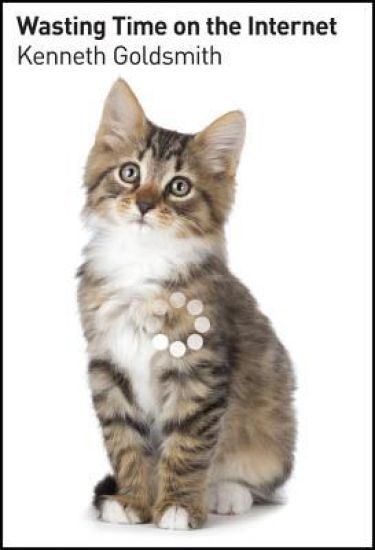
Using clear, readable prose, conceptual artist and poet Kenneth Goldsmith's manifesto shows how our time on the internet is not really wasted but is quite productive and creative as he puts the experience in its proper theoretical and philosophical context. Kenneth Goldsmith wants you to rethink the internet. Many people feel guilty after spending hours watching cat videos or clicking link after link after link. But Goldsmith sees that "wasted" time differently. Unlike old media, the internet demands active engagement-and it's actually making us more social, more creative, even more productive. When Goldsmith, a renowned conceptual artist and poet, introduced a class at the University of Pennsylvania called "Wasting Time on the Internet", he nearly broke the internet. The New Yorker, the Atlantic, the Washington Post, Slate, Vice, Time, CNN, the Telegraph, and many more, ran articles expressing their shock, dismay, and, ultimately, their curiosity. Goldsmith's ideas struck a nerve, because they are brilliantly subversive-and endlessly shareable. In Wasting Time on the Internet, Goldsmith expands upon his provocative insights, contending that our digital lives are remaking human experience. When we're "wasting time," we're actually creating a culture of collaboration. We're reading and writing more-and quite differently. And we're turning concepts of authority and authenticity upside-down. The internet puts us in a state between deep focus and subconscious flow, a state that Goldsmith argues is ideal for creativity. Where that creativity takes us will be one of the stories of the twenty-first century. Wide-ranging, counterintuitive, engrossing, unpredictable-like the internet itself-Wasting Time on the Internet is the manifesto you didn't know you needed.
Here is a kaleidoscopic assemblage and poetic history of New York: an unparalleled and original homage to the city, composed entirely of quotations. Drawn from a huge array of sources-histories, memoirs, newspaper articles, novels, government documents, emails-and organized into interpretive categories that reveal the philosophical architecture of the city, Capital is the ne plus ultra of books on the ultimate megalopolis.It is also a book of experimental literature that transposes Walter Benjamin's unfinished magnum opus of literary montage on the modern city, The Arcades Project, from 19th-century Paris to 20th-century New York, bringing the streets to life in categories such as "Sex," "Commodity," "Downtown," "Subway," and "Mapplethorpe."Capital is a book designed to fascinate and to fail-for can a megalopolis truly be written? Can a history, no matter how extensive, ever be comprehensive? Each reading of this book, and of New York, is a unique and impossible passage.
Against Translation is a text by American poet Kenneth Goldsmith (born 1961) published in eight volumes--English, French, Spanish, German, Chinese, Japanese, Russian and Arabic. The author discusses the impasses and shortcomings of translation and the virtues of an unapologetic linguistic “displacement. ” “Translation is the ultimate humanist gesture,” he states. “Polite and reasonable, it is an overly cautious bridge builder . in the end, it always fails, for the discourse it sets forth is inevitably off-register. ” Displacement, by contrast, never explains itself.
"I used to be an artist; then I became a poet; then a writer. Now when asked, I simply refer to myself as a word processor," Kenneth Goldsmith (born 1961) writes in "Theory." The acclaimed conceptual poet, who is the founder and editor of UbuWeb, a professor of Uncreative Writing at the University of Pennsylvania and the former host of a weekly radio show at WFMU, was also appointed MoMA's very first Poet Laureate in 2013. Goldsmith may be a word processor, but he has also proven to be a highly influential literary figure over the past two decades. His latest publication, "Theory," is a series of 500 texts-from poems to aphoristic thoughts to short stories-published on 500 sheets of paper and gathered unbound as a paper ream. This artist's book is the first of Goldsmith's publications to consolidate his diverse practices-from the radio to the Internet to his "uncreative" writing-in a single volume.
Can techniques traditionally thought to be outside the scope of literature, including word processing, databasing, identity ciphering, and intensive programming, inspire the reinvention of writing? The Internet and the digital environment present writers with new challenges and opportunities to reconceive creativity, authorship, and their relationship to language. Confronted with an unprecedented amount of texts and language, writers have the opportunity to move beyond the creation of new texts and manage, parse, appropriate, and reconstruct those that already exist. In addition to explaining his concept of uncreative writing, which is also the name of his popular course at the University of Pennsylvania, Goldsmith reads the work of writers who have taken up this challenge. Examining a wide range of texts and techniques, including the use of Google searches to create poetry, the appropriation of courtroom testimony, and the possibility of robo-poetics, Goldsmith joins this recent work to practices that date back to the early twentieth century. Writers and artists such as Walter Benjamin, Gertrude Stein, James Joyce, and Andy Warhol embodied an ethos in which the construction or conception of a text was just as important as the resultant text itself. By extending this tradition into the digital realm, uncreative writing offers new ways of thinking about identity and the making of meaning.
The follow-up to the critically acclaimed No. 111, Fidget ruthlessly documents every movement made by Goldsmith's body on Bloomsday (June 16) 1997 from 10 am to 11 pm. Literary critic Marjorie Perloff compares Fidget to 'a Beckett prose text,' and says many witty and intelligent things about it in her afterword.