Kirjojen hintavertailu. Mukana 12 390 323 kirjaa ja 12 kauppaa.

Kirjailija

Kenneth I. Carlaw

Kirjat ja teokset yhdessä paikassa: 3 kirjaa, julkaisuja vuosilta 2005-2022, suosituimpien joukossa Industrial Policy. Vertaile teosten hintoja ja tarkista saatavuus suomalaisista kirjakaupoista.

3 kirjaa

Kirjojen julkaisuhaarukka 2005-2022.

Industrial Policy

Industrial Policy

Kenneth I. Carlaw; Richard G. Lipsey

Cambridge University Press
2022
pokkari
Dismissing industrial policy because 'governments cannot pick winners' is counter-productive. This Element studying selected major innovations illustrates the fact that virtually all major new technologies have been developed by a synergetic cooperation between the public and the private sectors, each doing what it can do best. By examining how R&D is financed, rather than where it takes place, the authors show that the role of the public sector is much more pronounced than is often thought. The nature of the cooperation - who does what - varies with the nature of each innovation so that simple, one-size-fits-all, rules about what each sector should do are suspect. These results are particularly important because they challenge the scepticism in the United states and elsewhere about the importance of industrial policy, a scepticism that threatens to undermine the long-term, and necessary cooperation, between the public and private sectors in promoting growth-inducing innovations.
Economic Transformations

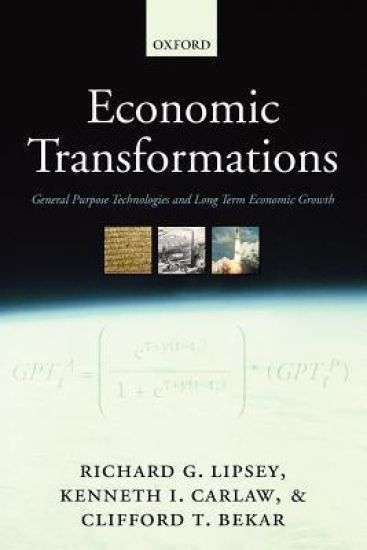
Economic Transformations

Richard G. Lipsey; Kenneth I. Carlaw; Clifford T. Bekar

Oxford University Press
2005
sidottu
This book examines the long term economic growth that has raised the West's material living standards to levels undreamed of by counterparts in any previous time or place. The authors argue that this growth has been driven by technological revolutions that have periodically transformed the West's economic, social and political landscape over the last 10,000 years and allowed the West to become, until recently, the world's only dominant technological force. Unique in the diversity of the analytical techniques used, the book begins with a discussion of the causes and consequences of economic growth and technological change. The authors argue that long term economic growth is largely driven by pervasive technologies now known as General Purpose (GPTs). They establish an alternative to the standard growth models that use an aggregate production function and then introduce the concept of GPTs, complete with a study of how these technologies have transformed the West since the Neolithic Agricultural Revolution. Early modern science is given more importance than in most other treatments and the 19th century demographic revolution is studied with a combination of formal models of population dynamics and historical analysis. The authors argue that once sustained growth was established in the West, formal models can shed much light on its subsequent behaviour. They build non-conventional, dynamic, non-stationary equilibrium models of GPT-driven growth that incorporate a range of phenomena that their historical studies show to be important but which are excluded from other GPT models in the interests of analytical tractability. The book concludes with a study of the policy implications that follow from their unique approach.
Economic Transformations

Economic Transformations

Richard G. Lipsey; Kenneth I. Carlaw; Clifford T. Bekar

Oxford University Press
2005
nidottu
This book examines the long term economic growth that has raised the West's material living standards to levels undreamed of by counterparts in any previous time or place. The authors argue that this growth has been driven by technological revolutions that have periodically transformed the West's economic, social and political landscape over the last 10,000 years and allowed the West to become, until recently, the world's only dominant technological force. Unique in the diversity of the analytical techniques used, the book begins with a discussion of the causes and consequences of economic growth and technological change. The authors argue that long term economic growth is largely driven by pervasive technologies now known as General Purpose (GPTs). They establish an alternative to the standard growth models that use an aggregate production function and then introduce the concept of GPTs, complete with a study of how these technologies have transformed the West since the Neolithic Agricultural Revolution. Early modern science is given more importance than in most other treatments and the 19th century demographic revolution is studied with a combination of formal models of population dynamics and historical analysis. The authors argue that once sustained growth was established in the West, formal models can shed much light on its subsequent behaviour. They build non-conventional, dynamic, non-stationary equilibrium models of GPT-driven growth that incorporate a range of phenomena that their historical studies show to be important but which are excluded from other GPT models in the interests of analytical tractability. The book concludes with a study of the policy implications that follow from their unique approach.