Kirjojen hintavertailu. Mukana 12 281 558 kirjaa ja 12 kauppaa.

Kirjailija

Kenneth S. Williams

Kirjat ja teokset yhdessä paikassa: 8 kirjaa, julkaisuja vuosilta 1998-2020, suosituimpien joukossa Invitation To Algebra: A Resource Compendium For Teachers, Advanced Undergraduate Students And Graduate Students In Mathematics. Vertaile teosten hintoja ja tarkista saatavuus suomalaisista kirjakaupoista.

Mukana myös kirjoitusasut: Kenneth S Williams

8 kirjaa

Kirjojen julkaisuhaarukka 1998-2020.

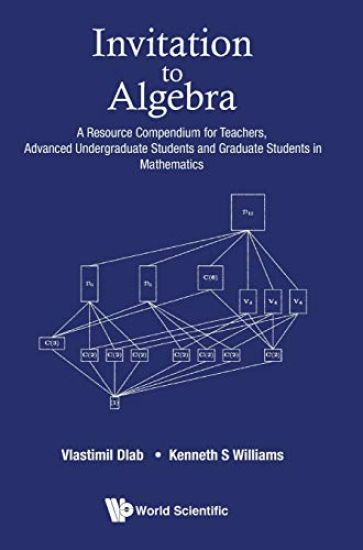
Invitation To Algebra: A Resource Compendium For Teachers, Advanced Undergraduate Students And Graduate Students In Mathematics
This book presents a compendium style account of a comprehensive mathematical journey from Arithmetic to Algebra. It contains material that is helpful to graduate and advanced undergraduate students in mathematics, university and college professors teaching mathematics, as well as some mathematics teachers teaching in the final year of high school. A successful teacher must know more than what a particular course curriculum asks for. A number of topics that are missing in present-day textbooks, and which may be attractive to students at the graduate or advanced undergraduate level in mathematics, for example, continued fractions, arithmetic progressions of higher order, complex numbers in plane geometry, differential schemes, path semigroups and path algebras, have been carefully presented. This reflects the aim of the book to attract students to mathematics.
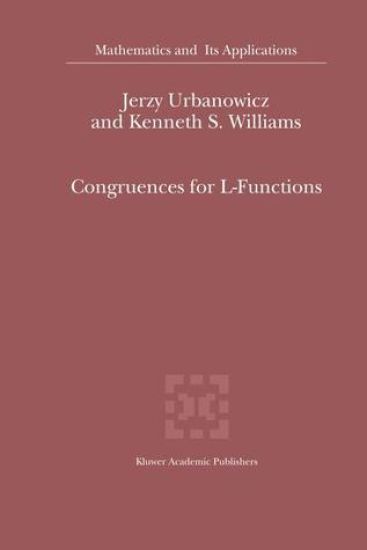
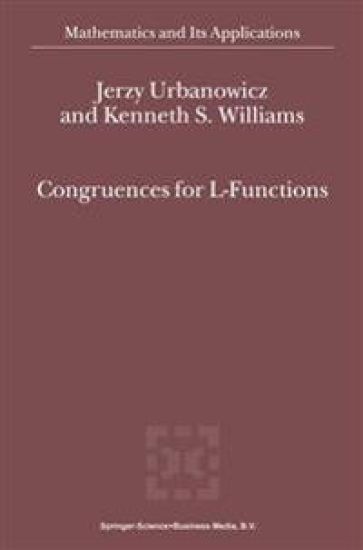
Congruences for L-Functions

Congruences for L-Functions

J. Urbanowicz; Kenneth S. Williams

Springer
2010
nidottu
In [Hardy and Williams, 1986] the authors exploited a very simple idea to obtain a linear congruence involving class numbers of imaginary quadratic fields modulo a certain power of 2. Their congruence provided a unified setting for many congruences proved previously by other authors using various means. The Hardy-Williams idea was as follows. Let d be the discriminant of a quadratic field. Suppose that d is odd and let d = PIP2· . . Pn be its unique decomposition into prime discriminants. Then, for any positive integer k coprime with d, the congruence holds trivially as each Legendre-Jacobi-Kronecker symbol (~) has the value + 1 or -1. Expanding this product gives ~ eld e:=l (mod4) where e runs through the positive and negative divisors of d and v (e) denotes the number of distinct prime factors of e. Summing this congruence for o
Number Theory in the Spirit of Liouville

Number Theory in the Spirit of Liouville

Kenneth S. Williams

Cambridge University Press
2010
pokkari
Joseph Liouville is recognised as one of the great mathematicians of the nineteenth century, and one of his greatest achievements was the introduction of a powerful new method into elementary number theory. This book provides a gentle introduction to this method, explaining it in a clear and straightforward manner. The many applications provided include applications to sums of squares, sums of triangular numbers, recurrence relations for divisor functions, convolution sums involving the divisor functions, and many others. All of the topics discussed have a rich history dating back to Euler, Jacobi, Dirichlet, Ramanujan and others, and they continue to be the subject of current mathematical research. Williams places the results in their historical and contemporary contexts, making the connection between Liouville's ideas and modern theory. This is the only book in English entirely devoted to the subject and is thus an extremely valuable resource for both students and researchers alike.
Number Theory in the Spirit of Liouville

Number Theory in the Spirit of Liouville

Kenneth S. Williams

Cambridge University Press
2010
sidottu
Joseph Liouville is recognised as one of the great mathematicians of the nineteenth century, and one of his greatest achievements was the introduction of a powerful new method into elementary number theory. This book provides a gentle introduction to this method, explaining it in a clear and straightforward manner. The many applications provided include applications to sums of squares, sums of triangular numbers, recurrence relations for divisor functions, convolution sums involving the divisor functions, and many others. All of the topics discussed have a rich history dating back to Euler, Jacobi, Dirichlet, Ramanujan and others, and they continue to be the subject of current mathematical research. Williams places the results in their historical and contemporary contexts, making the connection between Liouville's ideas and modern theory. This is the only book in English entirely devoted to the subject and is thus an extremely valuable resource for both students and researchers alike.
Introductory Algebraic Number Theory

Introductory Algebraic Number Theory

Saban Alaca; Kenneth S. Williams

Cambridge University Press
2003
sidottu
Algebraic number theory is a subject which came into being through the attempts of mathematicians to try to prove Fermat's last theorem and which now has a wealth of applications to diophantine equations, cryptography, factoring, primality testing and public-key cryptosystems. This book provides an introduction to the subject suitable for senior undergraduates and beginning graduate students in mathematics. The material is presented in a straightforward, clear and elementary fashion, and the approach is hands on, with an explicit computational flavour. Prerequisites are kept to a minimum, and numerous examples illustrating the material occur throughout the text. References to suggested reading and to the biographies of mathematicians who have contributed to the development of algebraic number theory are given at the end of each chapter. There are over 320 exercises, an extensive index, and helpful location guides to theorems and lemmas in the text.
Introductory Algebraic Number Theory

Introductory Algebraic Number Theory

Saban Alaca; Kenneth S. Williams

Cambridge University Press
2003
pokkari
Algebraic number theory is a subject which came into being through the attempts of mathematicians to try to prove Fermat's last theorem and which now has a wealth of applications to diophantine equations, cryptography, factoring, primality testing and public-key cryptosystems. This book provides an introduction to the subject suitable for senior undergraduates and beginning graduate students in mathematics. The material is presented in a straightforward, clear and elementary fashion, and the approach is hands on, with an explicit computational flavour. Prerequisites are kept to a minimum, and numerous examples illustrating the material occur throughout the text. References to suggested reading and to the biographies of mathematicians who have contributed to the development of algebraic number theory are given at the end of each chapter. There are over 320 exercises, an extensive index, and helpful location guides to theorems and lemmas in the text.
Congruences for L-Functions

Congruences for L-Functions

J. Urbanowicz; Kenneth S. Williams

Springer
2000
sidottu
In [Hardy and Williams, 1986] the authors exploited a very simple idea to obtain a linear congruence involving class numbers of imaginary quadratic fields modulo a certain power of 2. Their congruence provided a unified setting for many congruences proved previously by other authors using various means. The Hardy-Williams idea was as follows. Let d be the discriminant of a quadratic field. Suppose that d is odd and let d = PIP2· . . Pn be its unique decomposition into prime discriminants. Then, for any positive integer k coprime with d, the congruence holds trivially as each Legendre-Jacobi-Kronecker symbol (~) has the value + 1 or -1. Expanding this product gives ~ eld e:=l (mod4) where e runs through the positive and negative divisors of d and v (e) denotes the number of distinct prime factors of e. Summing this congruence for o
Gauss and Jacobi Sums

Gauss and Jacobi Sums

Bruce C. Berndt; Ronald J. Evans; Kenneth S. Williams

John Wiley Sons Inc
1998
sidottu
Devised in the 19th century, Gauss and Jacobi Sums are classical formulas that form the basis for contemporary research in many of today's sciences. This book offers readers a solid grounding on the origin of these abstract, general theories. Though the main focus is on Gauss and Jacobi, the book does explore other relevant formulas, including Cauchy.