

Kirjailija
Kenneth Smith
Kirjat ja teokset yhdessä paikassa: 36 kirjaa, julkaisuja vuosilta 2005-2023, suosituimpien joukossa The Young Minister's Wedding Ceremony Guide: a simple step by step guide for an elegant wedding ceremony. Vertaile teosten hintoja ja tarkista saatavuus suomalaisista kirjakaupoista.
36 kirjaa
Kirjojen julkaisuhaarukka 2005-2023.

The Demonic Expose: The Spiritual Warfare Handbook
Kenneth Smith
Createspace Independent Publishing Platform
2014
nidottu
Understanding the Bible 101: The Complete Bible Commentary
Kenneth Smith
Createspace Independent Publishing Platform
2014
nidottu

Adullam to Zion: The Kingdom Within You
Kenneth Smith
Createspace Independent Publishing Platform
2014
nidottu

Broken But Not Forgotten: The Incarceration Devotion
Kenneth Smith
Createspace Independent Publishing Platform
2014
nidottu

The Church Handbook: Everything You Need to Know about Maintaining a Growing Church
Kenneth Smith
Createspace Independent Publishing Platform
2014
nidottu

Shut the Hell Up!: the Power of the Tongue
Kenneth Smith
Createspace Independent Publishing Platform
2013
nidottu


This book, first published in 1951, focuses on the hitherto ignored contemporary critics of Malthus, giving them the attention they so rightly deserve.Dr Smith traces the Malthusian controversy step by step, from 1798, the date of the First Essay, to the death of Malthus in 1834. Investigating the precursors of Malthus and the genesis of the Malthusian Theory of Population, the book subjects the theory to a searching analysis in the light of not only contemporary criticism, but also subsequent developments and modern ideas. In addition, the book examines the application of the theory to the doctrine of perfectibility, to wages, to the poor laws, to emigration, and to the birth control movement.Fully annotated and written in an easy style, this work is indispensable to serious students of both population problems and the development of economic thought. Broad in scope, The Malthusian Controversy presents a new perspective on the most urgent of modern issues, the problem of world population.
This book provides a comprehensive guide to all three volumes of Karl Marx’s ‘Capital’, with advice on further reading and points for further discussion. Recognizing the contemporary relevance of ‘Capital’ in the midst of the current financial crisis, Kenneth Smith has produced an essential guide to Marx’s ideas, particularly on the subject of the circulation of money-capital. This guide uniquely presents the three volumes of ‘Capital’ in a different order of reading to that in which they were published, placing them instead in the order that Marx himself sometimes recommended as a more user-friendly way of reading. Dr Smith also argues that for most of the twentieth century, the full development of the capitalist mode of production (CMP) has been undermined by the existence of a non-capitalist ‘third world’, which has caused the CMP to take on the form of what Marx called a highly developed mercantile system, rather than one characterized by an uninterrupted circuit of industrial capital of the kind he expected would develop. While the guide can be read as a book in its own right, it also contains detailed references to Volumes I–III so that students, seminars and discussion groups can easily make connections between Smith’s explanations and the relevant parts of ‘Capital’.

This book provides a comprehensive guide to all three volumes of Karl Marx’s ‘Capital’, with advice on further reading and points for further discussion. Recognizing the contemporary relevance of ‘Capital’ in the midst of the current financial crisis, Kenneth Smith has produced an essential guide to Marx’s ideas, particularly on the subject of the circulation of money-capital. This guide uniquely presents the three volumes of ‘Capital’ in a different order of reading to that in which they were published, placing them instead in the order that Marx himself sometimes recommended as a more user-friendly way of reading. Dr Smith also argues that for most of the twentieth century, the full development of the capitalist mode of production (CMP) has been undermined by the existence of a non-capitalist ‘third world’, which has caused the CMP to take on the form of what Marx called a highly developed mercantile system, rather than one characterized by an uninterrupted circuit of industrial capital of the kind he expected would develop. While the guide can be read as a book in its own right, it also contains detailed references to Volumes I–III so that students, seminars and discussion groups can easily make connections between Smith’s explanations and the relevant parts of ‘Capital’.
The Art of M&A Strategy: A Guide to Building Your Company's Future through Mergers, Acquisitions, and Divestitures
Kenneth Smith; Alexandra Reed Lajoux
McGraw-Hill Professional
2012
sidottu
Seize the competitive advantage with today’s most powerful strategic tool—M&A“Given the influence of technology, globalization, and regulatory change, M&A will continue to shape our industries. For most companies, therefore, the consideration of M&A in strategy is now fundamental.”–from the Introduction to Part IThe Art of M&A Strategy is exactly what you need to build mergers, acquisitions, and divestitures into your overall business strategy—to make M&A a competitive advantage and avoid landing on the long list of M&A failures.Experts in the field of M&A, Smith and Lajoux demystify this otherwise complex subject by taking you through the types of M&A strategy and the key steps to successful M&A strategy development and implementation. The Art of M&A Strategy is conveniently organized into three sections:Part I presents a range of possible corporate strategy situations and provides the role and rationale for M&A in each, such as building and managing a portfolio, participating in industry consolidation, spurring corporate growth, and using acquisitions to create “real options.”Part II outlines how to determine the role of M&A in your strategy—taking into consideration industry context, competitive imperatives, and strategy options—and explains how to find and screen partners, decide whether to buy or sell, and engage the board of directors in M&A decisions.Part III covers M&A as a sustained corporate program, particularly in the context of international growth, outlining the most strategic aspects of post-merger integration, describing how to use advisors throughout the process, and examining core competencies required for successful M&A programs.The authors illuminate the purpose and process of applying M&A with real-world success stories involving Cisco, GE, Google, and many other companies that have leveraged M&A for strategic success. Use The Art of M&A Strategy to create a powerful strategy position for success in today’s changing business environment and to seize and hold competitive advantage.
A practical guide to understanding and awakening the human energy body - Shows how the energy body forms our reality from the infinite possibilities presented by our thoughts, feelings, and those around us - Illustrates the anatomy of the energy body, including its connections to the nervous system, chakras, and meridians - Provides step-by-step exercises to awaken the energy body, expand awareness, and begin consciously creating your own reality At a time when consciousness and other aspects of our energetic anatomy are finding their way into modern science, Kenneth Smith blends traditional shamanism with cutting-edge research in bioenergetics, neuroscience, and psychology to offer this user's guide to the energy body--explaining what it is, what its capabilities are, and how to harness it as a vehicle for higher consciousness and heightened awareness." " For more than 5,000 years, shamans of the Toltec tradition have worked with the energy body, learning its structure and perceptual capacities as well as mapping it as an objective, measurable part of our anatomy. Drawing from his decades-long involvement in this tradition and his work in the field of bioenergetics, Smith explains how the energy body shapes our perceptions, determines our state of consciousness, and forms our reality from the infinite possibilities presented by our thoughts, feelings, and those around us. Illustrating our energetic anatomy and its connections to the nervous system, chakras, and meridians, he provides step-by-step exercises to awaken the energy body, expand awareness, and begin consciously building a creative life." "

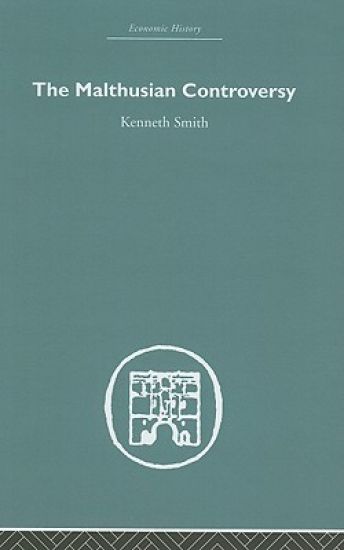
This book, first published in 1951, focuses on the hitherto ignored contemporary critics of Malthus, giving them the attention they so rightly deserve.Dr Smith traces the Malthusian controversy step by step, from 1798, the date of the First Essay, to the death of Malthus in 1834. Investigating the precursors of Malthus and the genesis of the Malthusian Theory of Population, the book subjects the theory to a searching analysis in the light of not only contemporary criticism, but also subsequent developments and modern ideas. In addition, the book examines the application of the theory to the doctrine of perfectibility, to wages, to the poor laws, to emigration, and to the birth control movement.Fully annotated and written in an easy style, this work is indispensable to serious students of both population problems and the development of economic thought. Broad in scope, The Malthusian Controversy presents a new perspective on the most urgent of modern issues, the problem of world population.