Kirjojen hintavertailu. Mukana 12 390 323 kirjaa ja 12 kauppaa.
Kirjailija
Kenneth W. Martin
Kirjat ja teokset yhdessä paikassa: 9 kirjaa, julkaisuja vuosilta 1995-2015, suosituimpien joukossa Feedback-Based Orthogonal Digital Filters. Vertaile teosten hintoja ja tarkista saatavuus suomalaisista kirjakaupoista.
Feedback-Based Orthogonal Digital Filters: Theory, Applications, and Implementation develops the theory of a feedback-based orthogonal digital filter and examines several applications where the filter topology leads to a simple and efficient solution. The development of the filter structure is linked to concepts in observer theory. Several signal processing problems can be represented as estimation problems, where a parametric representation of the input is used, to try and replicate it locally. This estimation problem can be solved using an identity observer, and the filter topology falls in this framework. Hence the filter topology represents a universal building block that can find application in several problems, such as spectral estimation, time-recursive computation of transforms, etc. Further, because of the orthogonality constraints satisfied by the structure, it also represents a robust solution under finite precision conditions. The book also presents the observer-based viewpoint of several signal processing problems, and shows that problems that are typically treated independently in the literature are in fact linked and can be cast in a single unified framework. In addition to examining the theoretical issues, the book describes practical issues related to a hardware implementation of the building block, in both the digital and analog domain. On the digital side, issues relating to implementation using semi-custom chips (FPGA's), and ASIC design are examined. On the analog side, the design and testing of a fabricated chip, that functions as a multi-sinusoidal phase-locked-loop, are described. Feedback-Based Orthogonal Digital Filters serves as an excellent reference. May be used as a text for advanced courses on the subject.
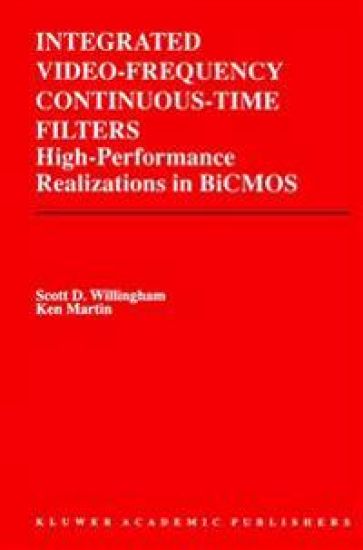
Advances in the state of the art mean the signal processing ICs of ever-increasing complexity are being introduced. While the typical portion of a large IC devoted to analog circuits has diminished, the performance of those surviving analog signal processing circuits remains vital and their design challenging. Moreover, the emerging high-definition TV technology has created a new area for IC development, one with formidable signal processing requirements. The antialiasing filters needed for one proposed HDTV decoder motivated the research documented in this book. Sharply selective filters place tight constraints on the permitted excess phase shifts of their constituent circuits. Combined with stringent requirements for low distortion at video frequencies, these constraints challenge the IC filter designer. Integrated Video-Frequency Continuous-Time Filters: High-Performance Realizations in BiCMOS deals with what is arguably the mainstay of analog signal processing circuits. Prominent applications in computer disk-drive read channels, video receivers, rf circuits, and antialiasing and reconstruction in data converters testifies to their importance. Moreover, they are excellent benchmarks for more general analog signal processors. Bipolar and MOSFET transistors, freely combined at the lowest circuit levels, provide the designer with an opportunity to develop potent variations on the standard idioms. The book considers the general principles of BiCMOS circuit design, through to a demanding design problem. This case-study approach allows a concrete discussion of the justification for and practical trade-offs of each design decision. Audience: A reference work for experienced IC designers and a text for advanced IC design students.
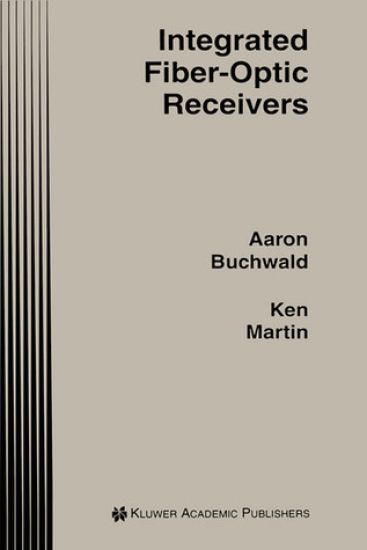
Integrated Fiber-Optic Receivers covers many aspects of the design of integrated circuits for fiber-optic receivers and other high-speed serial data links. Fundamental concepts are explained at the system level, circuit level, and semiconductor device level. Techniques for extracting timing information from the random data stream are described in considerable detail, as are all other aspects of receiver design. Integrated Fiber-Optic Receivers is organized in two parts. Part I covers the theory of communications systems as it applies to high-speed PAM (Pulse Amplitude Modulation) systems. The primary emphasis is on clock recovery circuits. Because theoretical concepts are generally grasped more easily by example, Part II is devoted to circuit design issues that illustrate example realizations of architectures described in Part I. Part II presents the transistor-level design, and measured results, of fundamental building blocks and test circuits. For practicing engineers, more than just reporting on the results of specific circuits, this book serves as a tutorial on the design of integrated high-speed broadband PAM data systems, such as: repeaters in long-haul, fiber-optic, trunk-lines transceivers for use in LANs and WANs; read channels for high-density data storage devices; and wireless communication handsets. Integrated Fiber-Optic Receivers may be used as a text for advanced courses in both analog circuit design and communication systems.
When first published this text by David Johns and Kenneth Martin quickly became a leading textbook for the advanced course on Analog IC Design. This new edition has been thoroughly revised and updated but continues the central themes of the first edition which made it so sucessful. This edition features extensive new material on CMOS IC device modeling, processing and layout. Coverage has been added on several types of circuits that have increased in importance in the past decade, such as generalized integer-N phase locked loops and their phase noise analysis, voltage regulators, and 1.5b-per-stage pipelined A/D converters. Two new chapters have been added to make the book more accessible to beginners in the field: frequency response of analog ICs; and basic theory of feedback amplifiers.
The 2nd Edition of Analog Integrated Circuit Design focuses on more coverage about several types of circuits that have increased in importance in the past decade. Furthermore, the text is enhanced with material on CMOS IC device modeling, updated processing layout and expanded coverage to reflect technical innovations. CMOS devices and circuits have more influence in this edition as well as a reduced amount of text on BiCMOS and bipolar information. New chapters include topics on frequency response of analog ICs and basic theory of feedback amplifiers.
Advances in the state of the art mean the signal processing ICs of ever-increasing complexity are being introduced. While the typical portion of a large IC devoted to analog circuits has diminished, the performance of those surviving analog signal processing circuits remains vital and their design challenging. Moreover, the emerging high-definition TV technology has created a new area for IC development, one with formidable signal processing requirements. The antialiasing filters needed for one proposed HDTV decoder motivated the research documented in this book. Sharply selective filters place tight constraints on the permitted excess phase shifts of their constituent circuits. Combined with stringent requirements for low distortion at video frequencies, these constraints challenge the IC filter designer. Integrated Video-Frequency Continuous-Time Filters: High-Performance Realizations in BiCMOS deals with what is arguably the mainstay of analog signal processing circuits. Prominent applications in computer disk-drive read channels, video receivers, rf circuits, and antialiasing and reconstruction in data converters testifies to their importance. Moreover, they are excellent benchmarks for more general analog signal processors. Bipolar and MOSFET transistors, freely combined at the lowest circuit levels, provide the designer with an opportunity to develop potent variations on the standard idioms. The book considers the general principles of BiCMOS circuit design, through to a demanding design problem. This case-study approach allows a concrete discussion of the justification for and practical trade-offs of each design decision. Audience: A reference work for experienced IC designers and a text for advanced IC design students.
Integrated Fiber-Optic Receivers covers many aspects of the design of integrated circuits for fiber-optic receivers and other high-speed serial data links. Fundamental concepts are explained at the system level, circuit level, and semiconductor device level. Techniques for extracting timing information from the random data stream are described in considerable detail, as are all other aspects of receiver design. Integrated Fiber-Optic Receivers is organized in two parts. Part I covers the theory of communications systems as it applies to high-speed PAM (Pulse Amplitude Modulation) systems. The primary emphasis is on clock recovery circuits. Because theoretical concepts are generally grasped more easily by example, Part II is devoted to circuit design issues that illustrate example realizations of architectures described in Part I. Part II presents the transistor-level design, and measured results, of fundamental building blocks and test circuits. For practicing engineers, more than just reporting on the results of specific circuits, this book serves as a tutorial on the design of integrated high-speed broadband PAM data systems, such as: repeaters in long-haul, fiber-optic, trunk-lines transceivers for use in LANs and WANs; read channels for high-density data storage devices; and wireless communication handsets. Integrated Fiber-Optic Receivers may be used as a text for advanced courses in both analog circuit design and communication systems.