Kirjojen hintavertailu. Mukana 12 341 676 kirjaa ja 12 kauppaa.

Kirjailija

Kermit L. Hall

Kirjat ja teokset yhdessä paikassa: 7 kirjaa, julkaisuja vuosilta 2004-2017, suosituimpien joukossa The Cherokee Cases. Vertaile teosten hintoja ja tarkista saatavuus suomalaisista kirjakaupoista.

7 kirjaa

Kirjojen julkaisuhaarukka 2004-2017.

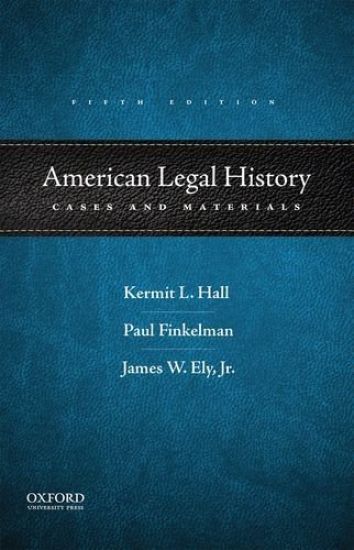
American Legal History: Cases and Materials

American Legal History: Cases and Materials

Kermit L. Hall; Paul Finkelman; James W. Ely

Oxford University Press
2017
nidottu
This highly acclaimed text provides a comprehensive selection of the most important documents in American legal history, integrating the history of public and private law from America's colonial origins to the present. Devoting special attention to the interaction of social and legal change, American Legal History: Cases and Materials, Fifth Edition, shows how legal ideas developed in tandem with specific historical events and reveals a rich legal culture unique to America. The book also deals with state and federal courts and looks at the relationship between the development of American society, politics, and economy and how it relates to the evolution of American law. Introductions and instructive headnotes accompany each document, tying legal developments to broader historical themes and providing a social and political context essential to an understanding of the history of law in America. Setting the legal challenges of the twenty-first century in a broad context, American Legal History, Fifth Edition, is an indispensable text for students and teachers of constitutional and legal history, the judicial process, and the effects of society on law.
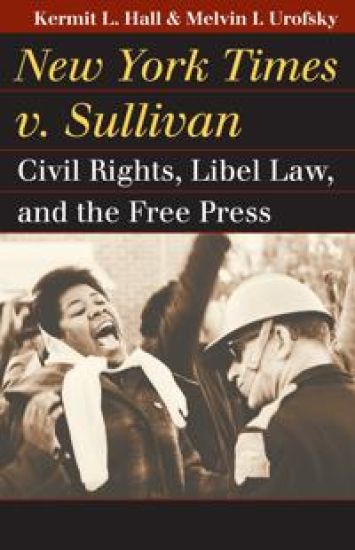
New York Times v. Sullivan

New York Times v. Sullivan

Kermit L. Hall; Melvin I. Urofsky

University Press of Kansas
2011
nidottu
Illuminating a classic case from the turbulent civil rights era of the 1960s, two of America’s foremost legal historians—Kermit Hall and Melvin Urofsky—provide a compact and highly readable updating of one of the most memorable decisions in the Supreme Court’s canon. When the New York Times published an advertisement that accused Alabama officials of willfully abusing civil rights activists, Montgomery police commissioner Lester Sullivan filed suit for defamation. Alabama courts, citing factual errors in the ad, ordered the Times to pay half a million dollars in damages. The Times appealed to the Supreme Court, which had previously deferred to the states on libel issues. The justices, recognising that Alabama’s application of libel law threatened both the nation’s free press and equal rights for African Americans, unanimously sided with the Times. As memorably recounted twenty years ago in Anthony Lewis’s Make No Law, the 1964 decision profoundly altered defamation law, which the Court declared must not hinder debate on public issues even if it includes “vehement, caustic, and sometimes unpleasantly sharp attacks on government and public officials.” The decision also introduced a new First Amendment test: a public official cannot recover damages for libel unless he proves that the statement was made with the knowledge that it was false or with reckless disregard of whether it was false. Hall and Urofsky, however, place a new emphasis on this iconic case. Whereas Lewis’s book championed freedom of the press, the authors here provide a stronger focus on civil rights and southern legal culture. They convey to readers the urgency of the civil rights movement and the vitriolic anger it inspired in the Deep South. Their insights place this landmark case within a new and enlightening frame.
New York Times v. Sullivan

New York Times v. Sullivan

Kermit L. Hall

University Press of Kansas
2011
sidottu
Illuminating a classic case from the turbulent civil rights era of the 1960s, two of America's foremost legal historians--Kermit Hall and Melvin Urofsky--provide a compact and highly readable updating of one of the most memorable decisions in the Supreme Court's canon.When the New York Timespublished an advertisement that accused Alabama officials of wilfully abusing civil rights activists, Montgomery police commissioner Lester Sullivan filed suit for defamation. Alabama courts, citing factual errors in the ad, ordered the Times to pay half a million dollars in damages. The Times appealed to the Supreme Court, which had previously deferred to the states on libel issues. The justices, recognising that Alabama's application of libel law threatened both the nation's free press and equal rights for African Americans, unanimously sided with the Times.As memorably recounted twenty years ago in Anthony Lewis's Make No Law, the 1964 decision profoundly altered defamation law, which the Court declared must not hinder debate on public issues even if it includes ""vehement, caustic, and sometimes unpleasantly sharp attacks on government and public officials."" The decision also introduced a new First Amendment test: a public official cannot recover damages for libel unless he proves that the statement was made with the knowledge that it was false or with reckless disregard of whether it was false.Hall and Urofsky, however, place a new emphasis on this iconic case. Whereas Lewis's book championed freedom of the press, the authors here provide a stronger focus on civil rights and southern legal culture. They convey to readers the urgency of the civil rights movement and the vitriolic anger it inspired in the Deep South. Their insights place this landmark case within a new and enlightening frame.
The Oxford Guide to United States Supreme Court Decisions

The Oxford Guide to United States Supreme Court Decisions

Kermit L. Hall

Oxford University Press Inc
2009
sidottu
This compact reference book contains the case articles from the prize-winning Oxford Companion to the United States Supreme Court. This new edition of the Guide will contain more than 450 entries on major Supreme Court cases, including 53 new entries on the latest landmark rulings. Among the new entries are United States v. American Library Association (censorship of internet content), United States v. Armstrong (selective prosecution), Atkins v. Virginia (executing the mentally retarded violates the Eighth Amendment's ban on cruel and unusual punishments), Boy Scouts v. Dale (freedom of association), Bush v. Gore (equal protection and recount), Nixon v. United States (political questions inappropriate for judicial resolution), , Gonzales v. Carhart and Gonzales v. Planned Parenthood Federation of America (abortion), Gonzales v. Raich, (Congress can proscribe all use of marijuana under commerce power), Morse v. Frederick (student's free speech), and Rumsfeld v. Forum for Academic and Institutional Rights (First Amendment and Solomon Amendment). Four decisions-Hamdi v. Bush, Hamdan v. Rumsfeld, Rasu v. Bush, and Rumsfeld v. Padila-will be considered in a single essay entitled "Enemy Combatant Cases." In addition to these new cases, both front and backmatter materials have been revised, including the Introduction, the Directory of Contributors, Case Index, Topical Index, and Appendix Two has been revised to note changes in the Supreme Court, including the death of Chief Justice Rehnquist and the retirement of Justice O'Connor, and their replacement by Chief Justice Roberts and Justice Alito.
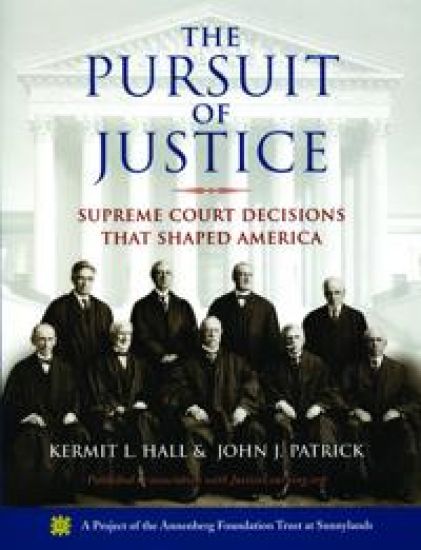
The Pursuit of Justice

The Pursuit of Justice

Kermit L. Hall; John J. Patrick

Oxford University Press Inc
2006
sidottu
With a survey of the thirty Supreme Court cases that, in the opinion of U.S. Supreme Court justices and leading civics educators and legal historians, are the most important for American citizens to understand, The Pursuit of Justice is the perfect companion for those wishing to learn more about American civics and government. The cases range across three centuries of American history, including such landmarks as Marbury v. Madison (1803), which established the principle of judicial review; Scott v. Sandford (1857), which inflamed the slavery argument in the United States and led to the Civil War; Plessy v. Ferguson (1896), which memorialized the concept of separate but equal; and Brown v. Board of Education (1954), which overturned Plessy. Dealing with issues of particular concern to students, such as voting, school prayer, search and seizure, and affirmative action, and broad democratic concepts such as separation of powers, federalism, and separation of church and state, the book covers all the major cases specified in the national and state civics and American history standards. For each case, there is an introductory essay providing historical background and legal commentary as well as excerpts from the decision(s); related documents such as briefs or evidence, with headnotes and/or marginal commentary, some possibly in facsimile; and features or sidebars on principal players in the decisions, whether attorneys, plaintiffs, defendants, or justices. An introductory essay defines the criteria for selecting the cases and setting them in the context of American history and government, and a concluding essay suggests the role that the Court will play in the future.
The Pursuit of Justice

The Pursuit of Justice

Kermit L. Hall; John J. Patrick

Oxford University Press Inc
2006
nidottu
With a survey of the thirty Supreme Court cases that, in the opinion of U.S. Supreme Court justices and leading civics educators and legal historians, are the most important for American citizens to understand, The Pursuit of Justice is the perfect companion for those wishing to learn more about American civics and government. The cases range across three centuries of American history, including such landmarks as Marbury v. Madison (1803), which established the principle of judicial review; Scott v. Sandford (1857), which inflamed the slavery argument in the United States and led to the Civil War; Plessy v. Ferguson (1896), which memorialized the concept of separate but equal; and Brown v. Board of Education (1954), which overturned Plessy. Dealing with issues of particular concern to students, such as voting, school prayer, search and seizure, and affirmative action, and broad democratic concepts such as separation of powers, federalism, and separation of church and state, the book covers all the major cases specified in the national and state civics and American history standards. For each case, there is an introductory essay providing historical background and legal commentary as well as excerpts from the decision(s); related documents such as briefs or evidence, with headnotes and/or marginal commentary, some possibly in facsimile; and features or sidebars on principal players in the decisions, whether attorneys, plaintiffs, defendants, or justices. An introductory essay defines the criteria for selecting the cases and setting them in the context of American history and government, and a concluding essay suggests the role that the Court will play in the future.
The Cherokee Cases

The Cherokee Cases

Jill Norgren; Kermit L. Hall; Melvin I. Urofsky

University of Oklahoma Press
2004
nidottu
This compact history is the first to explore two landmark U.S. Supreme Court cases of the early 1830s: Cherokee Nation v. Georgia and Worcester v. Georgia. Legal historian Jill Norgren details the extraordinary story behind these cases, describing how John Ross and other leaders of the Cherokee Nation, having internalized the principles of American law, tested their sovereignty rights before Chief Justice John Marshall in the highest court of the land. The Cherokees' goal was to solidify these rights and to challenge the aggressive actions that the government and people of Georgia carried out against them under the aegis of law. Written in a style accessible both to students and to general readers, The Cherokee Cases is an ideal guide to understanding the political development of the Cherokee Nation in the early nineteenth century and the tragic outcome of these cases so critical to the establishment of U.S. federal Indian law.