Kirjojen hintavertailu. Mukana 12 390 323 kirjaa ja 12 kauppaa.

Kirjailija

Kerry Segrave

Kirjat ja teokset yhdessä paikassa: 52 kirjaa, julkaisuja vuosilta 1993-2025, suosituimpien joukossa Death in a Hansom Cab; The 1904 Persecution of Nan Patterson. Vertaile teosten hintoja ja tarkista saatavuus suomalaisista kirjakaupoista.

52 kirjaa

Kirjojen julkaisuhaarukka 1993-2025.

Suntanning in 20th Century America

Suntanning in 20th Century America

Kerry Segrave

McFarland Co Inc
2005
pokkari
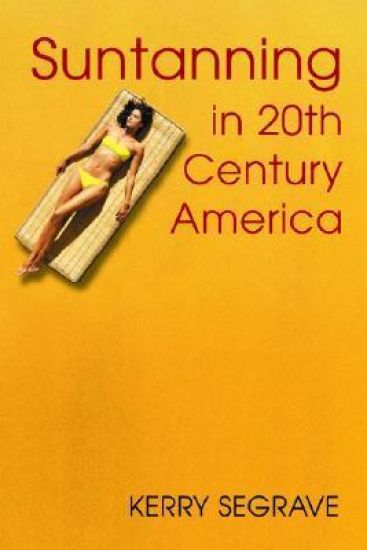
The suntan experienced a profound change in the last century. Considered a mark of the lower class for hundreds of years, tanning became a fad in the early 1920s and remains popular today. The tan, though, was much more than a matter of fashion,enjoying at first a boost from the medical establishment. Opinions ranging from hard science to quackery lauded the suntan as something of a panacea. Near the end of World War II, however, researchers increasingly warned against the hazards of overexposure to the sun, and a large new industry developed--sunscreen. Americans' current paradoxical obsession with the tan developed almost entirely from the conflicting rays of twentieth century thought. This history examines the twentieth century suntan as a social and scientific phenomenon. Beginning with the years 1900-1920, it debunks the myth that changing attitudes toward the tan sprang largely from the world of fashion. Initial pro-tanning medical hype, emerging negative opinions of sunbathing near the middle of the century, the development of sunscreens, the debate over sunscreen efficacy, and the sunless tan are all covered here. Numerous pictures demonstrate changing perceptions of the suntan, displaying advertisements for products that promoted, prevented or healed tans.
Women and Smoking in America, 1880-1950

Women and Smoking in America, 1880-1950

Kerry Segrave

McFarland Co Inc
2005
pokkari
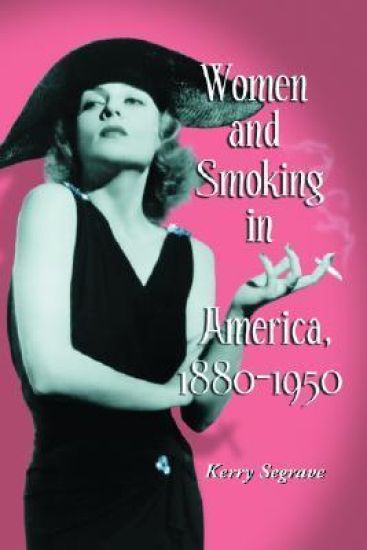
During the last 20 years of the 19th century, cigarette smoking was transformed from a lower-class habit to a favored form of tobacco use for men and practically the only form available to women. The trend continued to grow through the 1950s, when smoking was a significant part of America's social fabric for both men and women. This social history traces the evolution of women's smoking in the United States from 1880 to 1950. From 1880 to 1908, women were not allowed to smoke in public places, with strong opposition based on moral concerns. Most smoking was done by upper class women in the home, at private parties, or at socials. By 1908, women smokers went public in greater numbers and challenged the prejudices against smoking that applied to them alone. By 1919, most restaurants allowed women to smoke, though most other public places did not permit it. More and more women smokers went public in the period between 1919 and 1927, with college students leading the way. By 1928, advertisers began to target female smokers, and over the next two decades women smokers gradually gained equality with male smokers.
Endorsements in Advertising

Endorsements in Advertising

Kerry Segrave

McFarland Co Inc
2005
pokkari
The use of endorsements and testimonials to sell anything imaginable is a modern development, though the technique is centuries old. Before World War I, endorsement ads were tied to patent medicine, and were left with a bad reputation when that industry was exposed as quackery. The reputation was well earned: claims of a product's curative powers sometimes ran opposite the endorser's obituary, and Lillian Russell once testified that a certain compound had made her "feel like a new man." Distrusted by the public, banished from mainstream publications, endorsements languished until around 1920, but returned with a vengeance with the growth of consumerism and modern media. Despite its questionable effectiveness, endorsement advertising is now ubiquitous, costing advertisers (and consequently consumers) hundreds of millions of dollars annually. This exploration of modern endorsement advertising--paid or unsolicited testimonials endorsing a product--follows its evolution from a marginalized, mistrusted technique to a multibillion-dollar industry. Chapters recount endorsement advertising's changing form and fortunes, from Lux Soap's co-opting of early Hollywood to today's lucrative industry dependent largely on athletes. The social history of endorsement advertising is examined in terms of changing ethical and governmental views, shifting business trends, and its relationship to the growth of modern media, while the money involved and the question of effectiveness are scrutinized. The illustrated text includes five appendices that focus on companies, celebrities, athletes and celebrity endorsements.
Product Placement in Hollywood Films

Product Placement in Hollywood Films

Kerry Segrave

McFarland Co Inc
2004
pokkari
This is the history of advertising in motion pictures from the slide ads of the 1890s to the common practice of product placement in the present. Initially, product placement was seen as a somewhat sleazy practice and also faced opposition from the film industry itself; it has grown dramatically in the past 25 years. From Maillard's Chocolates advertising with a shot of Cardinal Richelieu enjoying a hot cup of cocoa in 1895, to product placements in 2002's Minority Report, for which advertisers were rumored to have paid $25 million, this book explores the developing union of corporate America and Hollywood. This work addresses such topics as television's conditioning of filmgoers to accept commercials, companies' donation of props, the debate about advertising such activities as smoking and drinking in films, and "product displacement," or demands by companies to keep their products absent from unpopular or controversial films. Film stills and a bibliography complete the book.
Foreign Films in America

Foreign Films in America

Kerry Segrave

McFarland Co Inc
2004
pokkari
Foreign films once enjoyed a position of prominence on American theater screens. By the start of World War I, however, the United States' film industry was strong enough to challenge that foreign presence and foreign films in America have been insignificant ever since. For about a century, the Hollywood cartel has dominated the production, distribution, and exhibition of movies domestically and around the world. This work traces the history of the foreign film in America from its domination in the early days to its low standing in the present, looking at the attempts made by foreign producers to increase their presence on American cinema screens, the responses by Hollywood to those attempts, and the oligopoly of Hollywood's few producers. The work discusses the cultural differences between foreign artistic expression and the commercialism of the American film and analyzes Hollywood's explanations for the lack of a foreign presence: Americans have "unique" tastes, they don't like subtitles, foreign films are immoral or badly made, trade union pressure, and so on. An appendix detailing the all-time gross earnings of foreign-language films and a full bibliography conclude the work, which is illustrated with stills and posters.
Lie Detectors

Lie Detectors

Kerry Segrave

McFarland Co Inc
2003
pokkari
The polygraph, most commonly known as the lie detector, was created and refined by academics in university settings with support from a few early police agencies. This work is a history of the machine, from the experimental work of the late 1800s that led directly to its creation, until the present. It covers early lie detectors and their inventors from the 1860s to the early 1920s, their use by the police and other law enforcement agencies in the 1930s and their use in Cold War America in the 1940s and 1950s. It then discusses the government's use of the polygraph in the 1960s, the PSE, a new take on the old polygraph, and private businesses' reliance on the polygraph in the 1970s and the government's increasing reluctance to use it in the 1980s. A chapter on new ideas and uses for the polygraph in the 1990s and after concludes the book.
Piracy in the Motion Picture Industry

Piracy in the Motion Picture Industry

Kerry Segrave

McFarland Co Inc
2003
pokkari
Film piracy began almost immediately after the birth of the film industry. Initially it was a within-the-industry phenomenon as studios stole from each other. As the industry grew and more money was involved, outsiders became more interested in piracy. Stolen material made its way offshore since detection was less likely. Hollywood's major film studios vigorously pursued pirates and had the situation fairly well under control by the middle 1970s--not eliminated but reduced to a low level--until videocassettes arrived. This work begins with a discussion of some of the earliest cases of piracy in vaudeville. It then considers how the problem continued to grow exacerbated by the lack of legal resource available to performers, and the ways film exhibitors cheated the film distributors and companies and the measures that the distributors and companies took to prevent piracy over the years. Also examined are the practices of American theater owners who tried to cheat Hollywood, especially through the practice known as bicycling--extra, unpaid for screenings of a legitimately held film--and altering paperwork to reduce the money owed to distributors on films screened on percentage contracts. Also examined, to a lesser degree, are Hollywood's own efforts to cheat, including the disregard of copyrights held by others.
Vending Machines

Vending Machines

Kerry Segrave

McFarland Co Inc
2002
pokkari
Although the 1880s are considered the beginning of the vending machine era, these devices have existed for a couple of thousand years. The earliest reference to a vending machine was made by Hero--a Greek mathematician, physicist and engineer who probably lived in Alexandria during the first century a.d.--who described and illustrated a coin-operated device to be used for vending sacrificial water in Egyptian temples. Completely automatic, the device was set in operation by the insertion of a five-drachma coin. This work traces the history of the vending machine from its inception to its current place in popular American culture, with the eight chapters covering significant eras. Successes and failures of the machines, economic factors influencing the popularity (or lack thereof) of vending machines, and the struggle of industry to become a dominant, large-scale method of retailing products are discussed. This text is richly illustrated and includes appendices on vending dollar value, vending sales by location type and vending statistics.
Jukeboxes

Jukeboxes

Kerry Segrave

McFarland Co Inc
2002
pokkari
This work traces the history of the jukebox from its origins in the invention of the phonograph by Thomas Alva Edison in the 1880s up to its relative modern obscurity. The jukebox's first twenty years were essentially experimental because of the low technical quality and other limitations. It then practically disappeared for a quarter-century, beaten out by the player piano as the coin-operated music machine of choice. But then, new and improved, it reemerged and quickly spread in popularity across America, largely as a result of the repeal of Prohibition and the increased number of bars around the nation. Other socially important elements of the jukebox's development are also covered: it played patriotic tunes during wartime and, located in youth centers, entertained young people and kept them out of "trouble." The industry's one last fling due to a healthy export trade is also covered, and the book rounds out with the decline in the 1950s and the fadeout into obscurity. Richly illustrated.
Age Discrimination by Employers

Age Discrimination by Employers

Kerry Segrave

McFarland Co Inc
2001
pokkari
In 1907, the editor of The New York Times wrote, "Employers, naturally, look to the young. A man or woman of advanced years is too apt to be given to old-fashioned ways of doing things, and open to suspicion of having the unforgivable fault, in modern business, of slowness." Age discrimination has existed throughout the 20th century, sometimes in the public eye and sometimes not. This book examines the problem as it relates to the employment sector in the United States throughout the century: how the issue has been treated by the media, what is the extent of age bias, how older workers were viewed, the reasons and rationales presented by business enterprises for their refusal to hire older workers, and the responses of governments to the problem. Some foreign data are used for comparison purposes; age bias exists in all industrial societies, regardless of the type of government a country provides for itself.
Shoplifting

Shoplifting

Kerry Segrave

McFarland Co Inc
2001
pokkari
Shoplifting is a practice that has been engaged in for centuries, but it was only after the Civil War that the prevalence of shoplifting and societal awareness of it, became significant. In the 1860s the typical shoplifter was from the lower classes; by 1900 it was an upper-class woman who shoplifted from a huge department store "because" she was a "kleptomaniac", and in the 1960s it was teenagers stealing for kicks. Shoplifting: A Social History looks at the activity of shoplifting for the last 140 years: the types of people singled out as the principal offenders, retailers' ambivalent responses to the activity, selective prosecution, the utilization of high-tech antitheft devices, and suing shoplifters to recover costs. Also examined are media accounts which have often used exaggerated numbers when discussing the activity and the effect of private justice on the offense. Discrepancies in treatment of lower-class women versus "respectable" women shoplifters will be of interest to women's studies scholars.
Anti-Rock

Anti-Rock

Kerry Segrave; Linda Martin

Da Capo Press Inc
1993
pokkari
Rock is a music of rebellion against authority, and has consequently frightened and outraged people throughout its forty-year history. Anti-Rock is the first book to detail the objections of rock's detractors. Critics from parents to religious groups, industry executives to scientists, government spokesmen to eccentric crusaders, have all attacked rock vehemently with comments such as "It's the jungle strain gets'em all worked up" it's "one step from fascism" and "These deafening, dope-ridden, degenerate mob scenes have no more place in our America than would a publicly promoted gang rape." Here is: Albert Goldman, writing in the New York Times in 1968, comparing Mick Jagger to Adolf Hitler. A 1981 university study concluding that prolonged exposure to disco music "causes homosexuality in mice and deafness in pigs." Dr. John, a New York physician, writing in 1977 that rock music causes "a breakdown in the synchronization of the two sides of the brain." Tipper Gore, the former Vice-President's wife, co-chair of the Parents Music Resource centre and author of Raising PG Kids in an X-Rated Society, commenting on heavy metal lyrics: "I'm a fairly with-it person, but this stuff is curling my hair."