Kirjojen hintavertailu. Mukana 12 390 323 kirjaa ja 12 kauppaa.

Kirjailija

Kevin Brancato

Kirjat ja teokset yhdessä paikassa: 12 kirjaa, julkaisuja vuosilta 2003-2012, suosituimpien joukossa Retaining F-22a Tooling: Options and Costs. Vertaile teosten hintoja ja tarkista saatavuus suomalaisista kirjakaupoista.

12 kirjaa

Kirjojen julkaisuhaarukka 2003-2012.

Retaining F-22a Tooling: Options and Costs

Retaining F-22a Tooling: Options and Costs

John C. Graser; Kevin Brancato; Guy Weichenberg; Soumen Saha; Akilah Wallace

RAND
2011
pokkari
The last F-22A aircraft is scheduled for delivery in early 2012, so decisions must be made as to what tooling will be retained and what will be disposed of. The authors find that, for a modest, one-time additional cost of $17 million and a very small additional annual recurring cost, the Air Force can retain all F-22A unique government tools. They also find a difference of less than $1 billion between the costs of two different restart options.
The Economics of Air Force Medical Service Readiness

The Economics of Air Force Medical Service Readiness

John C. Graser; Daniel Blum; Kevin Brancato; James J. Burks; Edward W. Chan

RAND
2011
pokkari
The Air Force Medical Service (AFMS) currently runs three in-theater hospitals for severely injured or wounded personnel. Part of the practioners' preparation was treating DoD beneficiaries for a broad range of injuries and illnesses. Opportunities for this preparation are not as numerous in house as they once were, and AFMS does not always get proper credit for those gained elsewhere. Proper credit for that work is important for funding.
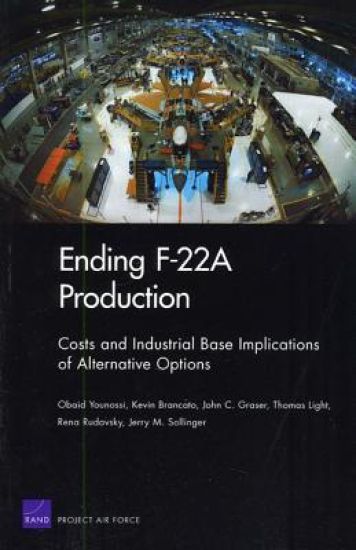
Ending F22a Production

Ending F22a Production

Obaid Younossi; Kevin Brancato; John C. Graser; Thomas Light; Rena Rudavsky

RAND
2009
pokkari
In April 2009, the Department of Defense decided to terminate production of the F-22A Raptor. In advance of the decision, the Air Force asked RAND Project AIR FORCE to identify the costs and the industrial base implications of various shutdown options. This monograph evaluates the implications of three shutdown options for the F-22A industrial capability: shutdown; shutdown and restart; and warm production, in which a small number of aircraft are produced until a decision is made to return to full-rate production.
Why Has the Cost of Fixed-wing Aircraft Risen?

Why Has the Cost of Fixed-wing Aircraft Risen?

Mark V. Arena; Obaid Younossi; Kevin Brancato; Irv Blickstein; Clifford A. Grammich

RAND
2008
pokkari
This report explores why, in recent decades, military fixed-wing aircraft costs have escalated beyond the rates of commonly used inflation indices, examining both economy-driven factors that the Services cannot control and customer-driven ones that they can. The authors found that this trend of cost increases is true for all types of aircraft
Improving the Cost Estimation of Space Systems

Improving the Cost Estimation of Space Systems

Obaid Younossi; Mark A. Lorell; Kevin Brancato; Cynthia R. Cook; Mel Eisman; Bernard Fox; John C. Graser; Kim Yool; Robert S. Leonard; Shari Lawrence Pfleeger

RAND
2008
pokkari
Why have the costs of acquiring space systems been so high? What are the sources of the problem? To answer these questions, RAND undertook an extensive study of two space systems - the Space Based Infrared SystemHigh (SBIRS) and the Global Positioning System (GPS).This title analyzes the reason for the comparatively high growth in the cost of space systems by means of an in-depth study of two systems: SBIRS-High and GPS.
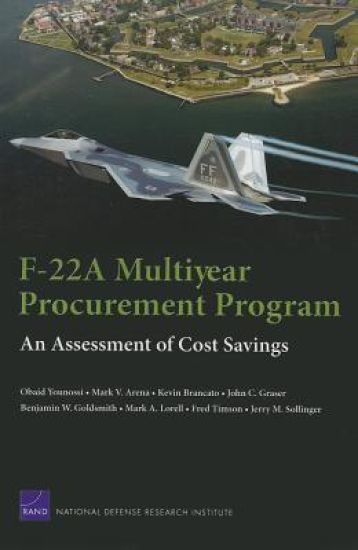
F-22a Multiyear Procurement Program: an Assessment of Cost Savings

F-22a Multiyear Procurement Program: an Assessment of Cost Savings

Obaid Younossi; Mark V. Arena; Kevin Brancato; John C. Graser; Benjamin W. Goldsmith

RAND
2007
pokkari
Congress asked RAND for an independent review of whether the estimated savings from proposed multiyear contracts for 60 F-22A aircraft over three years would yield the promised savings. Researchers found that a multiyear procurement of three lots of F-22A fighters would save an estimated $411 million-about 4.5 percent of the total contract value-and that savings attributed to the multiyear contract by the contractors appear to be reasonable.
New Paths to Success

New Paths to Success

Peter Schirmer; Dina G. Levy; Harry J. Thie; Joy S. Moini; Margaret C. Harrell; Kimberly Curry; Kevin Brancato; Megan Abbott

RAND
2005
pokkari
Are there feasible alternatives to the present "up-or-out" policy for U.S. military officers? Most military officers are subject to a policy known as "0up-or-out," which requires separation from service if they are not promoted or selectively continued within a certain period of time or when they encounters established grade/tenure limits. RAND considered a range of potential substitutes for, or modifications of, the existing policy and recommends that the Department of Defense implement four demonstration projects to establish the relative value of specific policy alternatives and requirements.
Aligning the Stars

Aligning the Stars

Margaret C. Harrell; Harry J. Thie; Peter Schirmer; Kevin Brancato

RAND
2004
pokkari
Recommends alternative promotion models to address the high turr over of the military's general and flag officers. The Department of Defense (DoD) experiences a high turnover from its general and flag officers (G/FOs). A concern exists that simply lengthening the stay of senior officers will only clog the system, stagnating promotions through out the entire officer corps. In response to this, RAND researchers analyzed the current system, reviewed literature on corporate management practices, and modeled different ways of managing G/FOs. In addition to proposing variations to the promotion model, the authors address the concerns expressed by those in DoD and Congress about implementing such changes.
Aft and Fore

Aft and Fore

Harry J. Thie; Margaret C. Harrell; Kevin Brancato; Jefferson P. Marquis; Clifford M. Graf II; Roland J. Yardley; Jerry M Sollinger

RAND
2003
pokkari
Focusing on its ability to meet current and future demands, the Navy recently examined its officer structure and asked RAND to analyze changes in authorizations and inventory, to compare authorizations and inventory and potential gaps in costs related to them, and to estimate personnel requirements for the years 2010 and 2017. Based on their research, the authors determine trends and cycles in officer requirements and inventory as well as the evolution of policy and the management of the officer corps. (PW)