Kirjojen hintavertailu. Mukana 12 390 323 kirjaa ja 12 kauppaa.

Kirjailija

Kevin M. Kruse

Kirjat ja teokset yhdessä paikassa: 9 kirjaa, julkaisuja vuosilta 2007-2026, suosituimpien joukossa Fault Lines. Vertaile teosten hintoja ja tarkista saatavuus suomalaisista kirjakaupoista.

Mukana myös kirjoitusasut: Kevin M Kruse

9 kirjaa

Kirjojen julkaisuhaarukka 2007-2026.

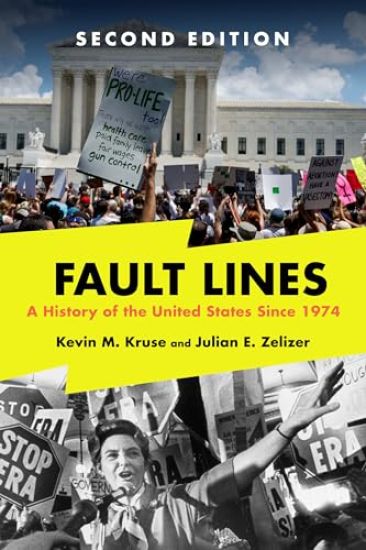
Fault Lines

Fault Lines

Kevin M. Kruse; Julian E. Zelizer

WW NORTON CO
2026
nidottu
In this masterful history, leading historians and best-selling authors Kevin M. Kruse and Julian E. Zelizer uncover the origins of the current moment in America, answering the question: When—and how—did the country become so polarised? It starts in 1974 with the Watergate crisis, the OPEC oil embargo, desegregation, busing riots in Boston and the wind-down of the Vietnam War. Ever-widening historical fault lines over economic inequality, race, gender and sex norms firing up a polarised political landscape followed. Fault Lines is also the story of the profound transformations of the media and the political system fuelling the fire. This edition has been brought up to date with significant updates throughout, a new chapter on the Trump administration; and a new epilogue on the Biden administration and the 2024 general election.
Fault Lines

Fault Lines

Kevin M. Kruse; Julian E. Zelizer

WW Norton Co
2020
nidottu
In the middle of the 1970s, America entered a new era of doubt and division. Major political, economic and social crises—Watergate, Vietnam, the rights revolutions of the 1960s–had cracked the existing social order. In the years that followed, the story of our own lifetimes would be written. Longstanding historical fault lines over income inequality, racial division and a revolution in gender roles and sexual norms would deepen and fuel a polarised political landscape. In Fault Lines, leading historians Kevin M. Kruse and Julian E. Zelizer reveal how the divisions of the present day began almost four decades ago, and how they were echoed and amplified by a fracturing media landscape that witnessed the rise of cable TV, the Internet and social media. How did the United States become so divided? Fault Lines offers one of the few comprehensive, wide-angle history views towards an answer.
Fault Lines

Fault Lines

Kevin M. Kruse; Julian E. Zelizer

WW Norton Co
2019
sidottu
In the middle of the 1970s, America entered a new era of doubt and division. Major political, economic and social crises—Watergate, Vietnam, the rights revolutions of the 1960s–had cracked the existing social order. In the years that followed, the story of our own lifetimes would be written. Longstanding historical fault lines over income inequality, racial division and a revolution in gender roles and sexual norms would deepen and fuel a polarised political landscape. In Fault Lines, leading historians Kevin M. Kruse and Julian E. Zelizer reveal how the divisions of the present day began almost four decades ago, and how they were echoed and amplified by a fracturing media landscape that witnessed the rise of cable TV, the internet and social media. How did the United States become so divided? Fault Lines offers one of the few comprehensive, wide-angle history views towards an answer.
Fog of War

Fog of War

Kevin M. Kruse; Stephen Tuck

Oxford University Press Inc
2012
sidottu
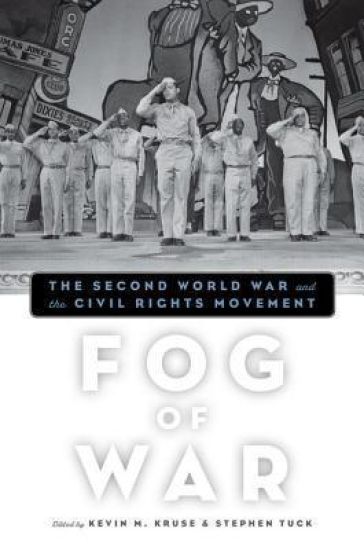
This collection is a timely reconsideration of the intersection between two of the dominant events of twentieth-century American history, the upheaval wrought by the Second World War and the social revolution brought about by the African American struggle for equality. Scholars from a wide range of fields explore the impact of war on the longer history of African American protest from many angles: from black veterans to white segregationists, from the rural South to northern cities, from popular culture to federal politics, and from the American confrontations to international connections. It is well known that World War II gave rise to human rights rhetoric, discredited a racist regime abroad, and provided new opportunities for African Americans to fight, work, and demand equality at home. It would be all too easy to assume that the war was a key stepping stone to the modern civil rights movement. But the authors show that in reality the momentum for civil rights was not so clear cut, with activists facing setbacks as well as successes and their opponents finding ways to establish more rigid defenses for segregation. While the war set the scene for a mass movement, it also narrowed some of the options for black activists.
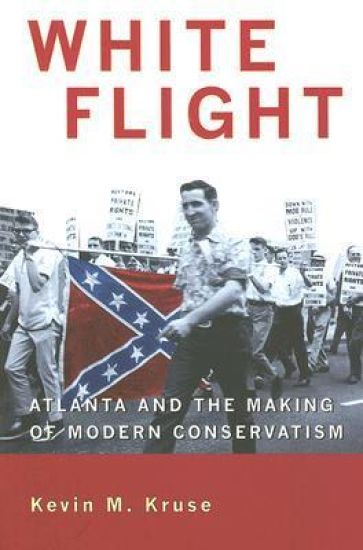
White Flight

White Flight

Kevin M. Kruse

Princeton University Press
2007
pokkari
During the civil rights era, Atlanta thought of itself as "The City Too Busy to Hate," a rare place in the South where the races lived and thrived together. Over the course of the 1960s and 1970s, however, so many whites fled the city for the suburbs that Atlanta earned a new nickname: "The City Too Busy Moving to Hate." In this reappraisal of racial politics in modern America, Kevin Kruse explains the causes and consequences of "white flight" in Atlanta and elsewhere. Seeking to understand segregationists on their own terms, White Flight moves past simple stereotypes to explore the meaning of white resistance. In the end, Kruse finds that segregationist resistance, which failed to stop the civil rights movement, nevertheless managed to preserve the world of segregation and even perfect it in subtler and stronger forms. Challenging the conventional wisdom that white flight meant nothing more than a literal movement of whites to the suburbs, this book argues that it represented a more important transformation in the political ideology of those involved. In a provocative revision of postwar American history, Kruse demonstrates that traditional elements of modern conservatism, such as hostility to the federal government and faith in free enterprise, underwent important transformations during the postwar struggle over segregation. Likewise, white resistance gave birth to several new conservative causes, like the tax revolt, tuition vouchers, and privatization of public services. Tracing the journey of southern conservatives from white supremacy to white suburbia, Kruse locates the origins of modern American politics.
Voter Suppression in U.S. Elections

Voter Suppression in U.S. Elections

Stacey Abrams; Carol Anderson; Kevin M. Kruse; Heather Cox Richardson; Heather Ann Thompson

University of Georgia Press
2020
pokkari
Historians have long been engaged in telling the story of the struggle for the vote. In the wake of recent contested elections, the suppression of the vote has returned to the headlines, as awareness of the deep structural barriers to the ballot, particularly for poor, black, and Latino voters, has called attention to the historical roots of issues related to voting access.Perhaps most notably, former state legislator Stacey Abrams’s campaign for Georgia's gubernatorial race drew national attention after she narrowly lost to then-secretary of state Brian Kemp, who had removed hundreds of thousands of voters from the official rolls. After her loss, Abrams created Fair Fight, a multimillion-dollar initiative to combat voter suppression in twenty states. At an annual conference of the Organization of American Historians, leading scholars Carol Anderson, Kevin M. Kruse, Heather Cox Richardson, and Heather Anne Thompson had a conversation with Abrams about the long history of voter suppression at the Library Company of Philadelphia. This book is a transcript of that extraordinary conversation, edited by Jim Downs. Voter Suppression in U.S. Elections offers an enlightening, history-informed conversation about voter disenfranchisement in the United States. By gathering scholars and activists whose work has provided sharp analyses of this issue, we see how historians in general explore contentious topics and provide historical context for students and the broader public.The book also includes a “top ten” selection of essays and articles by such writers as journalist Ari Berman, Pulitzer Prize–winning historian David Blight, and civil rights icon John Lewis.
Voter Suppression in U.S. Elections

Voter Suppression in U.S. Elections

Stacey Abrams; Carol Anderson; Kevin M. Kruse; Heather Cox Richardson; Heather Ann Thompson

University of Georgia Press
2020
sidottu
Historians have long been engaged in telling the story of the struggle for the vote. In the wake of recent contested elections, the suppression of the vote has returned to the headlines, as awareness of the deep structural barriers to the ballot, particularly for poor, black, and Latino voters, has called attention to the historical roots of issues related to voting access.Perhaps most notably, former state legislator Stacey Abrams’s campaign for Georgia's gubernatorial race drew national attention after she narrowly lost to then-secretary of state Brian Kemp, who had removed hundreds of thousands of voters from the official rolls. After her loss, Abrams created Fair Fight, a multimillion-dollar initiative to combat voter suppression in twenty states. At an annual conference of the Organization of American Historians, leading scholars Carol Anderson, Kevin M. Kruse, Heather Cox Richardson, and Heather Anne Thompson had a conversation with Abrams about the long history of voter suppression at the Library Company of Philadelphia. This book is a transcript of that extraordinary conversation, edited by Jim Downs. Voter Suppression in U.S. Elections offers an enlightening, history-informed conversation about voter disenfranchisement in the United States. By gathering scholars and activists whose work has provided sharp analyses of this issue, we see how historians in general explore contentious topics and provide historical context for students and the broader public.The book also includes a “top ten” selection of essays and articles by such writers as journalist Ari Berman, Pulitzer Prize–winning historian David Blight, and civil rights icon John Lewis.
One Nation Under God

One Nation Under God

Kevin M Kruse; Kevin Kruse

Basic Books
2015
sidottu
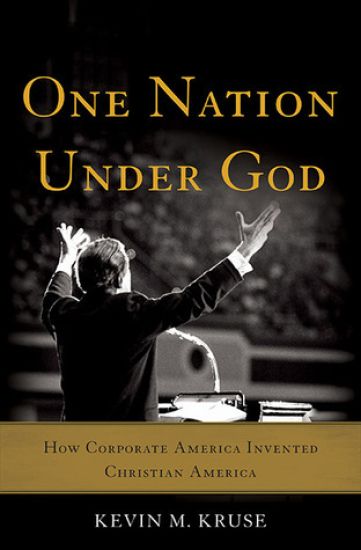
We're often told that the United States is, was, and always has been a Christian nation. But in One Nation Under God , historian Kevin M. Kruse reveals that the idea of Christian America" is an invention,and a relatively recent one at that.As Kruse argues, the belief that America is fundamentally and formally a Christian nation originated in the 1930s when businessmen enlisted religious activists in their fight against FDR's New Deal. Corporations from General Motors to Hilton Hotels bankrolled conservative clergymen, encouraging them to attack the New Deal as a program of pagan statism" that perverted the central principle of Christianity: the sanctity and salvation of the individual. Their campaign for freedom under God" culminated in the election of their close ally Dwight Eisenhower in 1952.But this apparent triumph had an ironic twist. In Eisenhower's hands, a religious movement born in opposition to the government was transformed into one that fused faith and the federal government as never before. During the 1950s, Eisenhower revolutionized the role of religion in American political culture, inventing new traditions from inaugural prayers to the National Prayer Breakfast. Meanwhile, Congress added the phrase under God" to the Pledge of Allegiance and made In God We Trust" the country's first official motto. With private groups joining in, church membership soared to an all-time high of 69%. For the first time, Americans began to think of their country as an officially Christian nation.During this moment, virtually all Americans,across the religious and political spectrum,believed that their country was one nation under God." But as Americans moved from broad generalities to the details of issues such as school prayer, cracks began to appear. Religious leaders rejected this lowest common denomination" public religion, leaving conservative political activists to champion it alone. In Richard Nixon's hands, a politics that conflated piety and patriotism became sole property of the right.Provocative and authoritative, One Nation Under God reveals how the unholy alliance of money, religion, and politics created a false origin story that continues to define and divide American politics to this day.
Fog of War

Fog of War

Kevin M. Kruse; Stephen Tuck

Oxford University Press Inc
2012
nidottu
This collection is a timely reconsideration of the intersection between two of the dominant events of twentieth-century American history, the upheaval wrought by the Second World War and the social revolution brought about by the African American struggle for equality. Scholars from a wide range of fields explore the impact of war on the longer history of African American protest from many angles: from black veterans to white segregationists, from the rural South to northern cities, from popular culture to federal politics, and from the American confrontations to international connections. It is well known that World War II gave rise to human rights rhetoric, discredited a racist regime abroad, and provided new opportunities for African Americans to fight, work, and demand equality at home. It would be all too easy to assume that the war was a key stepping stone to the modern civil rights movement. But the authors show that in reality the momentum for civil rights was not so clear cut, with activists facing setbacks as well as successes and their opponents finding ways to establish more rigid defenses for segregation. While the war set the scene for a mass movement, it also narrowed some of the options for black activists.