Kirjojen hintavertailu. Mukana 12 560 591 kirjaa ja 12 kauppaa.

Kirjailija

Kim Wheatley

Kirjat ja teokset yhdessä paikassa: 3 kirjaa, julkaisuja vuosilta 1999-2016, suosituimpien joukossa Shelley and His Readers. Vertaile teosten hintoja ja tarkista saatavuus suomalaisista kirjakaupoista.

3 kirjaa

Kirjojen julkaisuhaarukka 1999-2016.

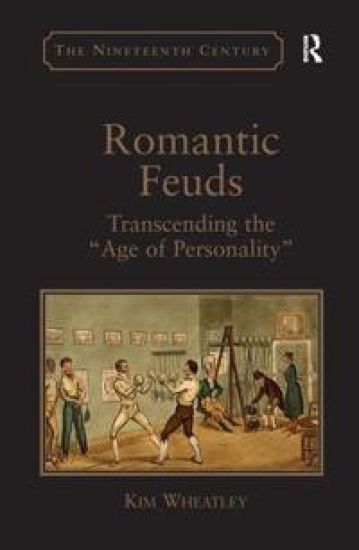
Romantic Feuds

Romantic Feuds

Kim Wheatley

Routledge
2016
nidottu
Romantic writers such as Robert Southey and Samuel Taylor Coleridge aspired to rise above the so-called 'age of personality,' a new culture of politicized print gossip and personal attacks. Nevertheless, Southey, Coleridge, and other Romantic-era figures such as Leigh Hunt, William Hazlitt, Sydney Owenson, and the explorer John Ross became enmeshed in lively feuds with the major periodicals of the day, the Edinburgh Review and the Quarterly Review. Kim Wheatley focuses on feuds from the second and third decades of the nineteenth century, suggesting that by this time the vituperative rhetoric of the Edinburgh and the Quarterly had developed into what Coleridge called 'a habit of malignity.' Attending to the formal strategies of the reviewers' surprisingly creative prose, she traces how her chosen feuds take on lives of their own, branching off into other print media, including the weekly press and monthly magazines. Ultimately, Wheatley shows, these hostile exchanges incorporated literary genres and Romantic themes such as the idealized poetic self, the power of the supernatural, and the quest for the sublime. By turning episodes of print warfare into stories of transfiguration, the feuds thus unexpectedly contributed to the emergence of Romanticism.
Romantic Feuds

Romantic Feuds

Kim Wheatley

Ashgate Publishing Limited
2013
sidottu
Romantic writers such as Robert Southey and Samuel Taylor Coleridge aspired to rise above the so-called 'age of personality,' a new culture of politicized print gossip and personal attacks. Nevertheless, Southey, Coleridge, and other Romantic-era figures such as Leigh Hunt, William Hazlitt, Sydney Owenson, and the explorer John Ross became enmeshed in lively feuds with the major periodicals of the day, the Edinburgh Review and the Quarterly Review. Kim Wheatley focuses on feuds from the second and third decades of the nineteenth century, suggesting that by this time the vituperative rhetoric of the Edinburgh and the Quarterly had developed into what Coleridge called 'a habit of malignity.' Attending to the formal strategies of the reviewers' surprisingly creative prose, she traces how her chosen feuds take on lives of their own, branching off into other print media, including the weekly press and monthly magazines. Ultimately, Wheatley shows, these hostile exchanges incorporated literary genres and Romantic themes such as the idealized poetic self, the power of the supernatural, and the quest for the sublime. By turning episodes of print warfare into stories of transfiguration, the feuds thus unexpectedly contributed to the emergence of Romanticism.
Shelley and His Readers

Shelley and His Readers

Kim Wheatley

University of Missouri Press
1999
sidottu
In this work, a full-length critical analysis of the dialogue between Shelley's poetry and its contemporary reviewers, Kim Wheatley argues that Shelley's idealism can be recovered through the study of its reception. Incorporating extensive research in major early-19th-century British periodicals, Wheatley integrates a reception-based methodology with careful textual analysis to demonstrate that the contemporary reception of Shelley's work registers the immediate impact of the poet's increasingly idealistic passion for reforming the world. Wheatley examines Shelley's poetry within the context of Romantic-era ""paranoid politics"", a heightened language of defenisveness and persecution incorporating Miltonic and apocalyptic imagery that paints adversaries as Satanic rebels against the orthodoxy. A simultaneously empowering and disabling dynamic, the paranoid style embodies a preoccupation with the efficacy of the printed word, thus singling out radical writers such as Shelley for personal attacks. Using Shelley's ""Queen Mab"" as an example of his early radical poetry, Wheatley demonstrates that the poet, like his contemporary reviewers, is caught up in the paranoid rhetoric. Failing to challenge the assumptions of paranoid politics - conspiracy and contagion - Shelley takes merely an oppositional stance. However, Shelley's later poems, exemplified by ""Prometheus Unbound"" and ""Adonais"", introduce a boldly innovative approach. These less explicitly political poems transcend the dynamics of paranoid politics by incorporating an experimental language that creates an interplay between poem and reader. Shifting to an apolitical conception of the aeshetic, Shelley's poetry is able to move beyond cultural paranoia. The final chapter of this study argues that the posthumous reception of ""Adonais"" uniquely replicates the elegiac moves and complex idealism of the poem, concluding with a discussion of how the Shelley circle aestheticized the poet after his death. The book offers a new approach to the question of how to recuperate Romantic idealism in the face of such literary criticism as deconstructionism and historicism. The use of reception-based methodology should make this book valuable not only to specialists of the Romantic period but also to anyone interested in literary criticism.