Kirjojen hintavertailu. Mukana 12 390 323 kirjaa ja 12 kauppaa.

Kirjailija

Kirk Heilbrun

Kirjat ja teokset yhdessä paikassa: 11 kirjaa, julkaisuja vuosilta 2001-2023, suosituimpien joukossa Wrightsman's Psychology and the Legal System. Vertaile teosten hintoja ja tarkista saatavuus suomalaisista kirjakaupoista.

11 kirjaa

Kirjojen julkaisuhaarukka 2001-2023.

Wrightsman's Psychology and the Legal System

Wrightsman's Psychology and the Legal System

Kirk Heilbrun; Edith Greene; Amy Douglass

CENGAGE LEARNING, INC
2023
nidottu
Does trauma spark brazen acts? Do eyewitnesses offer accurate reports? Can jurors distinguish truth from lies? Can experts predict mass shootings? What best explains biasing influences on police? You find the answers to these and other thought-provoking questions in the best-selling WRIGHTMAN'S PSYCHOLOGY AND THE LEGAL SYSTEM, 10E. This edition provides an eye-opening overview of psychology's contributions to the 2022 legal system and the important roles of trained psychologists within the legal system. Real cases, such as Kyle Rittenhouse and Ahmaud Arbery, illustrate the flesh and blood of today’s psychological issues -- from the motivations of offenders to discretion in sentencing. The latest content explores social and racial injustice, current crime statistics and the impact of COVID-19 on crime. New content also examines the psychology behind the latest crime-countering technology as you examine psychology methods and research at work in today’s legal system.
Problem-Solving Courts and the Criminal Justice System

Problem-Solving Courts and the Criminal Justice System

David DeMatteo; Kirk Heilbrun; Alice Thornewill; Shelby Arnold

Oxford University Press Inc
2019
sidottu
Problem-solving courts provide judicially supervised treatment for behavioral health needs commonly found among criminal offenders, including substance abuse and mental health disorders, and they treat a variety of offender populations. These courts employ a team-based approach consisting of a judge, defense attorney, prosecutor, and treatment providers, representing a significant paradigm shift in how the justice system treats offenders with special needs. Despite the proliferation of problem-solving courts, there remains some uncertainty about how they function, how effective they are, and the most promising ways to implement problem-solving justice. Problem-Solving Courts and the Criminal Justice System provides a comprehensive foundation of knowledge related to problem-solving courts and the role they play in the United States criminal justice system. The book begins with an overview that explores precipitating factors in these courts' development, relevant political influence, and their history, purposes, benefits, and drawbacks, followed by a detailed discussion of specific types of problem solving courts, including drug courts, mental health courts, and veterans courts, among many others. Next a review of the legal and ethical considerations of alternative methods to standard prosecution is complemented by an examination of the methodological challenges faced by researchers when attempting to study the effectiveness of problem-solving courts. The book concludes with a discussion of future directions in terms of research, practice, and policy relating to these courts in the United States. Problem-Solving Courts and the Criminal Justice System is appropriate for professionals, researchers, and students in the fields of mental health, criminal justice, and law.
Wrightsman's Psychology and the Legal System

Wrightsman's Psychology and the Legal System

Edith Greene; Kirk Heilbrun

Wadsworth Publishing Co Inc
2018
sidottu
Does trauma spark brazen acts? Are eyewitnesses accurate reporters? Can jurors distinguish truth from lies? Answer these and more in WRIGHTMAN'S PSYCHOLOGY AND THE LEGAL SYSTEM, 9th Edition. Real cases such as Bill Cosby and Dylann Roof illustrate the flesh and blood of the psychological issues considered in the book--from the motivations of offenders to discretion in sentencing. This book gives you an eye-opening overview of psychology's contributions to the legal system--and the many roles available to trained psychologists within the system.
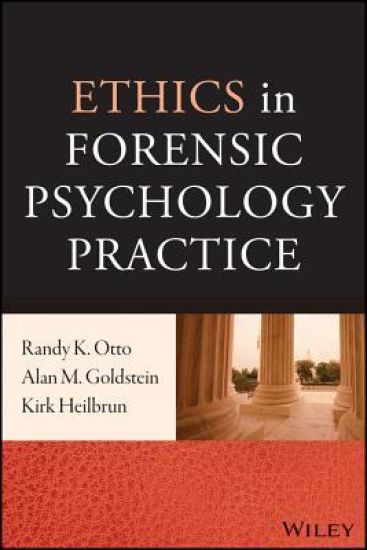
Ethics in Forensic Psychology Practice

Ethics in Forensic Psychology Practice

Randy K. Otto; Alan M. Goldstein; Kirk Heilbrun

John Wiley Sons Inc
2017
sidottu
AN AUTHORITATIVE GUIDE TO THE CURRENT SPECIALTY GUIDELINES FOR FORENSIC PSYCHOLOGY Ethics in Forensic Psychology Practice is a comprehensive and authoritative resource that addresses major concerns of professionals who conduct evaluations, provide treatment, carry out research, as well as a guide for those who teach and train in diverse legal contexts. Including on the American Psychological Association's current Specialty Guidelines for Forensic Psychology, the standard measure for ethical and legal conduct, this important volume is organized around substantive practice issues that cut across various functions and roles. The authors include a range of topics such as training, business practices, roles, privacy, confidentiality, report writing, testifying, and more.
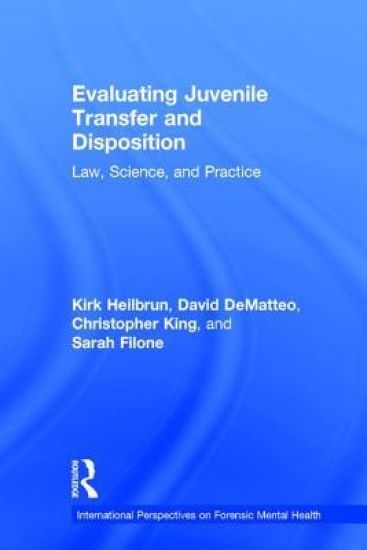
Evaluating Juvenile Transfer and Disposition

Evaluating Juvenile Transfer and Disposition

Kirk Heilbrun; David DeMatteo; Christopher King; Sarah Filone

Routledge
2017
nidottu
Focusing on juvenile transfer and disposition evaluations, this volume provides an up-to-date integration of current law, science, and practice with respect to juvenile risk assessment, treatment needs/amenability, and sophistication-maturity. Included are perspectives relating to international practices, use of specialized assessment tools, and a separate chapter on resentencing following US Supreme Court decisions on juveniles sentenced to mandatory life without parole. This text will be a useful and comprehensive reference for forensic psychologists and other mental health professionals engaged in juvenile evaluation, as well as legal professionals, juvenile and criminal justice professionals, and others involved with juvenile assessment, decision-making, and rehabilitation.
Evaluating Juvenile Transfer and Disposition

Evaluating Juvenile Transfer and Disposition

Kirk Heilbrun; David DeMatteo; Christopher King; Sarah Filone

Routledge
2017
sidottu
Focusing on juvenile transfer and disposition evaluations, this volume provides an up-to-date integration of current law, science, and practice with respect to juvenile risk assessment, treatment needs/amenability, and sophistication-maturity. Included are perspectives relating to international practices, use of specialized assessment tools, and a separate chapter on resentencing following US Supreme Court decisions on juveniles sentenced to mandatory life without parole. This text will be a useful and comprehensive reference for forensic psychologists and other mental health professionals engaged in juvenile evaluation, as well as legal professionals, juvenile and criminal justice professionals, and others involved with juvenile assessment, decision-making, and rehabilitation.
Principles of Forensic Mental Health Assessment

Principles of Forensic Mental Health Assessment

Kirk Heilbrun

Springer-Verlag New York Inc.
2013
nidottu
Most of the literature in forensic mental health assessment is organized around the particular legal issue that is the focus of a given assessment, tool, or research study. This book starts with a different assumption: There are broad principles of forensic assessment that are applicable across different legal issues. If such principles exist, they should be derived from and supported by sources of authority in ethics, law, science, and prof- sional practice. This is what I seek to do in this book, with each of the 29 broad principles of forensic mental health assessment described and a- lyzed from the perspective of these sources of authority. There are a number of individuals who have contributed in various ways to making this a better book. It seems best to begin with a general acknowledgment: Those interested in forensic mental health assessment, particularly my colleagues from the American Psychology–Law Society and the American Board of Forensic Psychology, have been an extraor- narily helpful and congenial group. I have learned a great deal from them over the years and they challenged me to undertake the daunting task of trying to capture the broad views of the field in this book.
Wrightsman's Psychology and the Legal System

Wrightsman's Psychology and the Legal System

Edith Greene; Kirk Heilbrun

Wadsworth Publishing Co Inc
2013
sidottu
WRIGHTMAN'S PSYCHOLOGY AND THE LEGAL SYSTEM shows you the critical importance of psychology's concepts and methods to the functioning of many aspects of today's legal system. Featuring topics such as competence to stand trial, the insanity defense, expert forensic testimony, analysis of eye witness identification, criminal profiling, and many others, this best-selling book gives you a comprehensive overview of psychology's contributions to the legal system, and the many roles available to trained psychologists within the system. Available with InfoTrac® Student Collections http://gocengage.com/infotrac.
Evaluation for Risk of Violence in Adults

Evaluation for Risk of Violence in Adults

Kirk Heilbrun

Oxford University Press Inc
2010
nidottu
Forensic mental health assessment (FMHA) has grown into a specialization informed by research and professional guidelines. This series presents up-to-date information on the most important and frequently conducted forms of FMHA. The 19 topical volumes address best approaches to practice for particular types of evaluation in the criminal, civil, and juvenile/family areas. Each volume contains a thorough discussion of the relevant legal and psychological concepts, followed by a step-by-step description of the assessment process from preparing for the evaluation to writing the report and testifying in court. Volumes include the following helpful features: Boxes that zero in on important information for use in evaluations Tips for best practice and cautions against common pitfalls Highlighting of relevant case law and statutes Separate list of assessment tools for easy reference Helpful glossary of key terms for the particular topic In making recommendations for best practice, authors consider empirical support, legal relevance, and consistency with ethical and professional standards. These volumes offer invaluable guidance for anyone involved in conducting or using forensic evaluations.
Foundations of Forensic Mental Health Assessment

Foundations of Forensic Mental Health Assessment

Kirk Heilbrun; Thomas Grisso; Alan M. Goldstein

Oxford University Press Inc
2008
nidottu
There appears to be nearly universal acknowledgement of a need to disseminate scientific research in forensic assessments to those 'in the trenches'. The Best Practices in Forensic Mental Health Assessment series was developed to directly address this need. This first book in the series will be the only volume to be written by the series editors as a 'road map'. As such, it will lay out the standards of best practices and how they plan to define and derive them throughout the rest of the titles in the series.
Principles of Forensic Mental Health Assessment

Principles of Forensic Mental Health Assessment

Kirk Heilbrun

Kluwer Academic/Plenum Publishers
2001
sidottu
Most of the literature in forensic mental health assessment is organized around the particular legal issue that is the focus of a given assessment, tool, or research study. This book starts with a different assumption: There are broad principles of forensic assessment that are applicable across different legal issues. If such principles exist, they should be derived from and supported by sources of authority in ethics, law, science, and prof- sional practice. This is what I seek to do in this book, with each of the 29 broad principles of forensic mental health assessment described and a- lyzed from the perspective of these sources of authority. There are a number of individuals who have contributed in various ways to making this a better book. It seems best to begin with a general acknowledgment: Those interested in forensic mental health assessment, particularly my colleagues from the American Psychology–Law Society and the American Board of Forensic Psychology, have been an extraor- narily helpful and congenial group. I have learned a great deal from them over the years and they challenged me to undertake the daunting task of trying to capture the broad views of the field in this book.