Kirjojen hintavertailu. Mukana 12 595 353 kirjaa ja 12 kauppaa.

Kirjailija

Kirk Ludwig

Kirjat ja teokset yhdessä paikassa: 8 kirjaa, julkaisuja vuosilta 2005-2026, suosituimpien joukossa Donald Davidson's Truth-Theoretic Semantics. Vertaile teosten hintoja ja tarkista saatavuus suomalaisista kirjakaupoista.

8 kirjaa

Kirjojen julkaisuhaarukka 2005-2026.

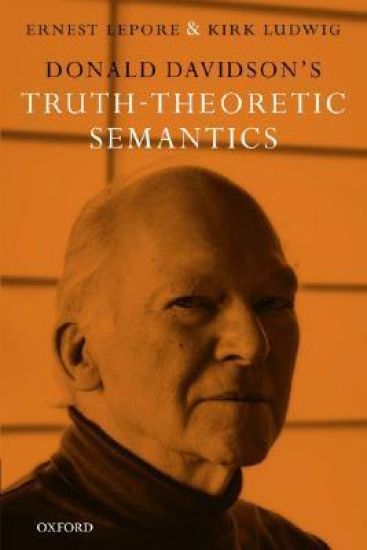
Donald Davidson's Truth-Theoretic Semantics

Donald Davidson's Truth-Theoretic Semantics

Ernest LePore; Kirk Ludwig

Clarendon Press
2007
sidottu
Ernest Lepore and Kirk Ludwig examine the foundations and applications of Davidson's influential program of truth-theoretic semantics for natural languages. The program uses an axiomatic truth theory for a language, which meets certain constraints, to serve the goals of a compositional meaning theory. Lepore and Ludwig explain and clarify the motivations for the approach, and then consider how to apply the framework to a range of important natural language constructions, including quantifiers, proper names, indexicals, simple and complex demonstratives, quotation, adjectives and adverbs, the simple and perfect tenses, temporal adverbials and temporal quantifiers, tense in sentential complement clauses, attitude and indirect discourse reports, and the problem of interrogative and imperative sentences. They not only discuss Davidson's own contributions to these subjects but consider criticisms, developments, and alternatives as well. They conclude with a discussion of logical form in natural language in light of the approach, the role of the concept of truth in the program, and Davidson's view of it. Anyone working on meaning will find this book invaluable.
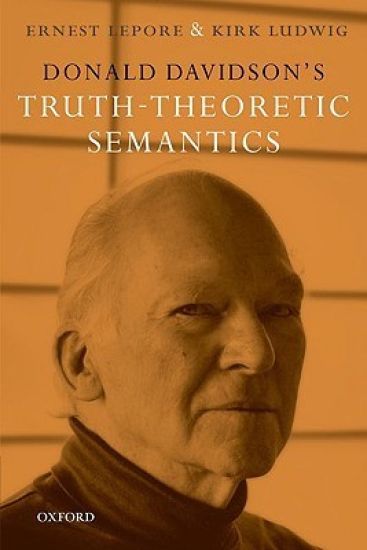
Donald Davidson's Truth-Theoretic Semantics

Donald Davidson's Truth-Theoretic Semantics

Ernest LePore; Kirk Ludwig

Oxford University Press
2009
nidottu
Ernest Lepore and Kirk Ludwig examine the foundations and applications of Davidson's influential program of truth-theoretic semantics for natural languages. The program uses an axiomatic truth theory for a language, which meets certain constraints, to serve the goals of a compositional meaning theory. Lepore and Ludwig explain and clarify the motivations for the approach, and then consider how to apply the framework to a range of important natural language constructions, including quantifiers, proper names, indexicals, simple and complex demonstratives, quotation, adjectives and adverbs, the simple and perfect tenses, temporal adverbials and temporal quantifiers, tense in sentential complement clauses, attitude and indirect discourse reports, and the problem of interrogative and imperative sentences. They not only discuss Davidson's own contributions to these subjects but consider criticisms, developments, and alternatives as well. They conclude with a discussion of logical form in natural language in light of the approach, the role of the concept of truth in the program, and Davidson's view of it. Anyone working on meaning will find this book invaluable.
Donald Davidson

Donald Davidson

Ernie Lepore; Kirk Ludwig

Clarendon Press
2007
nidottu
Donald Davidson (1917-2003) was one of the most important philosophers of the late twentieth century. His work on language and the theory of meaning has been particularly influential.Two of the world's leading authorities on Davidson's philosophy, Ernest Lepore and Kirk Ludwig, provide a systematic exposition of his work in this field and of his contributions to philosophy of mind, metaphysics, and epistemology which spring from it. Their second aim is to assess Davidson's program critically, to mark its successes, but also to identify where its ccomplishments fall short of its ambitions, and, since it is an on-going research program, to assess its prospects for the future, and to contribute to the expansion of that program. Criticizing and extending Davidson's thought, as well as providing an introduction to it, Lepore and Ludwig address a broad academic audience. Their work will be of fundamental importance for those who are coming to Davidson's work for the first time; while some philosophical sophistication and training is presupposed, it is accessible both to advanced undergraduates and to graduate students. It will also be welcomed by professional philosophers, linguists, and anyone wishing to assess and understand Davidson's remarkable intellectual legacy.
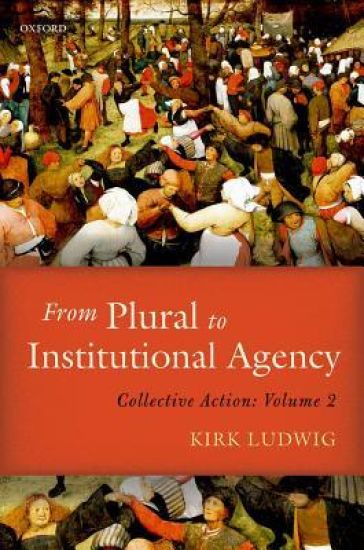
From Plural to Institutional Agency

From Plural to Institutional Agency

Kirk Ludwig

Oxford University Press
2017
sidottu
Kirk Ludwig presents a philosophical account of institutional action, such as action by corporations and nation states, arguing that it can be understood exhaustively in terms of the agency of individuals and concepts constructed out of materials that are already at play in our understanding of individual action. He thus argues for a strong form of methodological individualism. The book provides a new account of the logical form of grammatically singular group action sentences (e.g. 'Company laid off 10,000 workers'), and features new analyses of the concepts of a constitutive rule, status function, status role, collective acceptance, and proxy agency. He also provides an analysis of the structure of corporate action, including the status of corporations as legal persons, and of the nature of state action in relation to its citizens. This is the companion volume to From Individual to Plural Agency (OUP 2016), extending the multiple-agents account of collective action set out in the earlier volume.
From Individual to Plural Agency

From Individual to Plural Agency

Kirk Ludwig

Oxford University Press
2016
sidottu
Kirk Ludwig develops a novel reductive account of plural discourse about collective action and shared intention. Part I develops the event analysis of action sentences, provides an account of the content of individual intentions, and on that basis an analysis of individual intentional action. Part II shows how to extend the account to collective action, intentional and unintentional, and shared intention, expressed in sentences with plural subjects. On the account developed, collective action is a matter of there being multiple agents of an event and it requires no group agents per se. Shared intention is a matter of agents in a group each intending that they bring about some end in accordance with a shared plan. Thus their participatory intentions (their we-intentions) differ from individual intentions not in their mode but in their content. Joint intentional action then is a matter of a group of individuals successfully executing a shared intention. The account does not reduce shared intention to aggregates of individual intentions. However, it argues that the content of we-intentions can be analyzed wholly in terms of concepts already at play in our understanding of individual intentional action. The account thus vindicates methodological individualism for plural agency. The account is contrasted with other major positions on shared intention and joint action, and defended against objections. This forms the foundation for a reductive account of the agency of mobs and institutions, expressed in grammatically singular action sentences about groups and their intentions, in a second volume.