Kirjojen hintavertailu. Mukana 12 316 336 kirjaa ja 12 kauppaa.

Kirjailija

Klaus Bichteler

Kirjat ja teokset yhdessä paikassa: 5 kirjaa, julkaisuja vuosilta 1973-2010, suosituimpien joukossa Integration Theory. Vertaile teosten hintoja ja tarkista saatavuus suomalaisista kirjakaupoista.

5 kirjaa

Kirjojen julkaisuhaarukka 1973-2010.

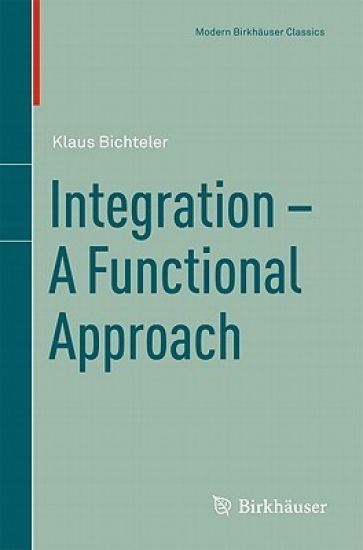
Integration - A Functional Approach

Integration - A Functional Approach

Klaus Bichteler

Birkhauser Verlag AG
2010
nidottu
This book covers Lebesgue integration and its generalizations from Daniell's point of view, modified by the use of seminorms. Integrating functions rather than measuring sets is posited as the main purpose of measure theory. From this point of view Lebesgue's integral can be had as a rather straightforward, even simplistic, extension of Riemann's integral; and its aims, definitions, and procedures can be motivated at an elementary level. The notion of measurability, for example, is suggested by Littlewood's observations rather than being conveyed authoritatively through definitions of (sigma)-algebras and good-cut-conditions, the latter of which are hard to justify and thus appear mysterious, even nettlesome, to the beginner. The approach taken provides the additional benefit of cutting the labor in half. The use of seminorms, ubiquitous in modern analysis, speeds things up even further. The book is intended for the reader who has some experience with proofs, a beginning graduate student for example. It might even be useful to the advanced mathematician who is confronted with situations - such as stochastic integration - where the set-measuring approach to integration does not work.
Stochastic Integration with Jumps

Stochastic Integration with Jumps

Klaus Bichteler

Cambridge University Press
2010
pokkari
Stochastic processes with jumps and random measures are importance as drivers in applications like financial mathematics and signal processing. This 2002 text develops stochastic integration theory for both integrators (semimartingales) and random measures from a common point of view. Using some novel predictable controlling devices, the author furnishes the theory of stochastic differential equations driven by them, as well as their stability and numerical approximation theories. Highlights feature DCT and Egoroff's Theorem, as well as comprehensive analogs results from ordinary integration theory, for instance previsible envelopes and an algorithm computing stochastic integrals of càglàd integrands pathwise. Full proofs are given for all results, and motivation is stressed throughout. A large appendix contains most of the analysis that readers will need as a prerequisite. This will be an invaluable reference for graduate students and researchers in mathematics, physics, electrical engineering and finance who need to use stochastic differential equations.
Integration - A Functional Approach

Integration - A Functional Approach

Klaus Bichteler

Birkhauser Verlag AG
1998
sidottu
This book covers Lebesgue integration and its generalizations from Daniell's point of view, modified by the use of seminorms. Integrating functions rather than measuring sets is posited as the main purpose of measure theory. From this point of view Lebesgue's integral can be had as a rather straightforward, even simplistic, extension of Riemann's integral; and its aims, definitions, and procedures can be motivated at an elementary level. The notion of measurability, for example, is suggested by Littlewood's observations rather than being conveyed authoritatively through definitions of (sigma)-algebras and good-cut-conditions, the latter of which are hard to justify and thus appear mysterious, even nettlesome, to the beginner. The approach taken provides the additional benefit of cutting the labor in half. The use of seminorms, ubiquitous in modern analysis, speeds things up even further. The book is intended for the reader who has some experience with proofs, a beginning graduate student for example. It might even be useful to the advanced mathematician who is confronted with situations - such as stochastic integration - where the set-measuring approach to integration does not work.