Kirjojen hintavertailu. Mukana 12 592 998 kirjaa ja 12 kauppaa.

Kirjailija

Kostas Boyiopoulos

Kirjat ja teokset yhdessä paikassa: 3 kirjaa, julkaisuja vuosilta 2015-2020, suosituimpien joukossa Decadent Romanticism: 1780-1914. Vertaile teosten hintoja ja tarkista saatavuus suomalaisista kirjakaupoista.

3 kirjaa

Kirjojen julkaisuhaarukka 2015-2020.

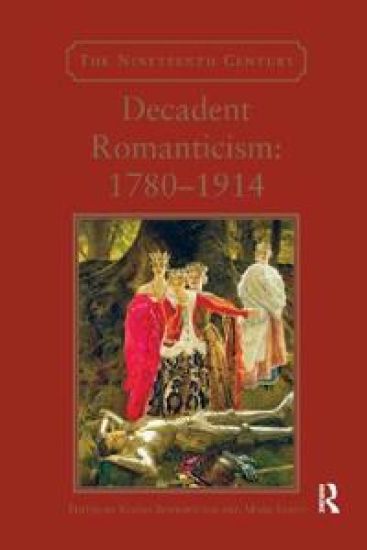
Decadent Romanticism: 1780-1914

Decadent Romanticism: 1780-1914

Kostas Boyiopoulos; Mark Sandy

Routledge
2020
nidottu
For Decadent authors, Romanticism was a source of powerful imaginative revisionism, perversion, transition, and partial negation. But for all these strong Decadent reactions against the period, the cultural phenomenon of Decadence shared with Romanticism a mutual distrust of the philosophy of utilitarianism and the aesthetics of neo-Classicism. Reflecting on the interstices between Romantic and Decadent literature, Decadent Romanticism reassesses the diverse and creative reactions of Decadent authors to Romanticism between 1780 and 1914, while also remaining alert to the prescience of the Romantic imagination to envisage its own distorted, darker, perverted, other self. Creative pairings include William Blake and his Decadent critics, the recurring figure of the sphinx in the work of Thomas De Quincey and Decadent writers, and Percy Shelley with both Mathilde Blind and Swinburne. Not surprisingly, John Keats’s works are a particular focus, in essays that explore Keats’s literary and visual legacies and his resonance for writers who considered him an icon of art for art’s sake. Crucial to this critical reassessment are the shared obsessions of Romanticism and Decadence with subjectivity, isolation, addiction, fragmentation, representation, romance, and voyeurism, as well as a poetics of desire and anxieties over the purpose of aestheticism.
Decadent Romanticism: 1780-1914

Decadent Romanticism: 1780-1914

Kostas Boyiopoulos; Mark Sandy

Routledge
2015
sidottu
For Decadent authors, Romanticism was a source of powerful imaginative revisionism, perversion, transition, and partial negation. But for all these strong Decadent reactions against the period, the cultural phenomenon of Decadence shared with Romanticism a mutual distrust of the philosophy of utilitarianism and the aesthetics of neo-Classicism. Reflecting on the interstices between Romantic and Decadent literature, Decadent Romanticism reassesses the diverse and creative reactions of Decadent authors to Romanticism between 1780 and 1914, while also remaining alert to the prescience of the Romantic imagination to envisage its own distorted, darker, perverted, other self. Creative pairings include William Blake and his Decadent critics, the recurring figure of the sphinx in the work of Thomas De Quincey and Decadent writers, and Percy Shelley with both Mathilde Blind and Swinburne. Not surprisingly, John Keats’s works are a particular focus, in essays that explore Keats’s literary and visual legacies and his resonance for writers who considered him an icon of art for art’s sake. Crucial to this critical reassessment are the shared obsessions of Romanticism and Decadence with subjectivity, isolation, addiction, fragmentation, representation, romance, and voyeurism, as well as a poetics of desire and anxieties over the purpose of aestheticism.
The Decadent Image

The Decadent Image

Kostas Boyiopoulos

Edinburgh University Press
2015
sidottu
This book explores culturally significant encounters between sensuality and artifice in the poetry of Wilde, Symons, and Dowson. This book enquires into the problem of venerating artificiality and the inaccessibility of beauty associated with it whilst engaging in the sensuous, immediate experience as it is advocated by Walter Pater. It examines for the first time together poems by three protagonists of the 1890s: Oscar Wilde, Arthur Symons, and Ernest Dowson. It sees their poems as sites where the self sensually collides with or is immersed in their artifice. This is understood through the shift from Aestheticism to Decadence, which is marked by a greater emphasis on heterodox erotic experience. This study examines Wilde's early poetry and its role in triggering this shift. It shows how the idea of an erotic encounter with artifice reaches its apex in Symons, and how in Dowson it ripens into vexed non encounters. This is the first monograph study to focus exclusively on Decadent poetry. It gives original attention to Oscar Wilde's early poetry which has been relatively neglected. It provides original readings of Symons's and Dowson's poetry including poems never discussed before. It makes a clear and explicit distinction between 'Aestheticism' and 'Decadence', defining the nuances of their relationship.