Kirjojen hintavertailu. Mukana 12 595 353 kirjaa ja 12 kauppaa.

Kirjailija

Kostas Kalimtzis

Kirjat ja teokset yhdessä paikassa: 5 kirjaa, julkaisuja vuosilta 2000-2018, suosituimpien joukossa Aristotle on Political Enmity and Disease. Vertaile teosten hintoja ja tarkista saatavuus suomalaisista kirjakaupoista.

5 kirjaa

Kirjojen julkaisuhaarukka 2000-2018.

An Inquiry into the Philosophical Concept of Scholê

An Inquiry into the Philosophical Concept of Scholê

Kostas Kalimtzis

Bloomsbury Academic
2018
nidottu
Though the ancient Greek philosophical concept of scholê is usually translated as ‘leisure’, there is a vast difference between the two. Leisure, derived from Latin licere, has its roots in Roman otium and connotes the uses of free time in ways permitted by the status quo. Scholê is the actualization of mind and one’s humanity within a republic that devotes its culture to making such a choice possible. This volume traces the background in Greek culture and the writings of Plato of a daring proposal presented by Aristotle, that scholê is a principle for political organization. The concept of scholê by and large did not survive Aristotle. To sharpen our understanding of scholê the book goes on to identify the concepts of leisure which we have inherited from the intellectuals of the Hellenistic and Roman empires and the early Church Fathers. Scholê also had its contrary ascholia – busyness – which Plato described as a social and psychological pathology and his analysis suggests why, due to these ills, current visions of a leisure society are highly unlikely.
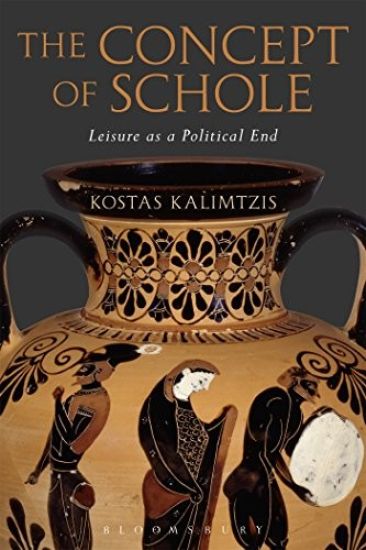
An Inquiry into the Philosophical Concept of Scholê

An Inquiry into the Philosophical Concept of Scholê

Kostas Kalimtzis

Bloomsbury Academic
2017
sidottu
Though the ancient Greek philosophical concept of scholê is usually translated as ‘leisure’, there is a vast difference between the two. Leisure, derived from Latin licere, has its roots in Roman otium and connotes the uses of free time in ways permitted by the status quo. Scholê is the actualization of mind and one’s humanity within a republic that devotes its culture to making such a choice possible. This volume traces the background in Greek culture and the writings of Plato of a daring proposal presented by Aristotle, that scholê is a principle for political organization. The concept of scholê by and large did not survive Aristotle. To sharpen our understanding of scholê the book goes on to identify the concepts of leisure which we have inherited from the intellectuals of the Hellenistic and Roman empires and the early Church Fathers. Scholê also had its contrary ascholia – busyness – which Plato described as a social and psychological pathology and his analysis suggests why, due to these ills, current visions of a leisure society are highly unlikely.
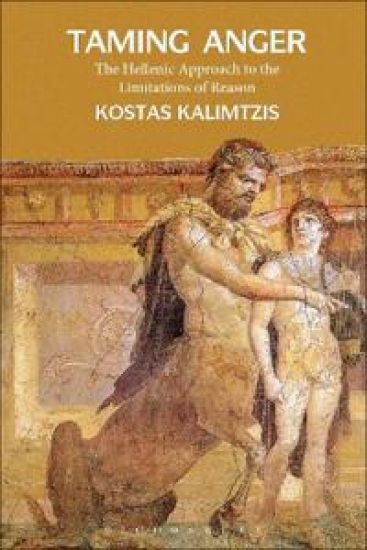
Taming Anger

Taming Anger

Kostas Kalimtzis

Bloomsbury Academic
2013
nidottu
From Homer to Aristotle, understanding anger and harnessing its power was at the core of Hellenic civilization. Homer created the framework for philosophical inquiries into anger, one that persisted until it was overturned by Stoicism and Christianity. Plato saw anger as the guardian of justice and Aristotle conceived of it as bound to friendship. Yet both showed that anger can become a guardian of injustice and a defender of our psychological abnormalities. Plato claimed that reason is a tertiary factor in controlling anger and Aristotle argued that non-cognitive powers can issue commands for anger's arousal - findings that shed light as to why cognitive therapeutic approaches often prove to be ineffective. Both proposed nurturing the thumos, the receptacle of anger and the seat of self-esteem. Aristotle's view of public anger as an early warning sign of social dissolution continues to be relevant to this day. In this carefully argued study, Kostas Kalimtzis examines the theories of anger in the context of the ancient world with an eye to their implications for the modern predicament.
Taming Anger

Taming Anger

Kostas Kalimtzis

Bristol Classical Press
2012
sidottu
From Homer to Aristotle, understanding anger and harnessing its power was at the core of Hellenic civilization. Homer created the framework for philosophical inquiries into anger, one that persisted until it was overturned by Stoicism and Christianity. Plato saw anger as the guardian of justice and Aristotle conceived of it as bound to friendship. Yet both showed that anger can become a guardian of injustice and a defender of our psychological abnormalities. Plato claimed that reason is a tertiary factor in controlling anger and Aristotle argued that non-cognitive powers can issue commands for anger's arousal - findings that shed light as to why cognitive therapeutic approaches often prove to be ineffective. Both proposed nurturing the thumos, the receptacle of anger and the seat of self-esteem. Aristotle's view of public anger as an early warning sign of social dissolution continues to be relevant to this day. In this carefully argued study, Kostas Kalimtzis examines the theories of anger in the context of the ancient world with an eye to their implications for the modern predicament.
Aristotle on Political Enmity and Disease

Aristotle on Political Enmity and Disease

Kostas Kalimtzis

State University of New York Press
2000
pokkari
Explores Aristotle's theory of the causes that give rise to stasis ('civic disorder'), and provides an original and systematic account of his understanding of political justice and friendship. This book explores Aristotle's theory of stasis, a word usually translated to mean "revolution," "civic disorder," or "sedition." It examines Aristotle's writings on stasis, especially Book 5 of the Politics, within the tradition established by ancient Greek poets, medical writers, philosophers, and orators, who held that the root sense of stasis was in fact nosos, or "disease." Aristotle's theory of the causes of stasis is presented in a cohesive manner, as factors that can account for political disease within the entire range of diverse constitutions. Aristotle is shown to have proceeded from the standpoint that the polis had to be cast in a mode of political friendship, what the Greeks called homonoia or "political friendship", and that when other standards for friendship such as wealth or liberty are practiced to an extreme, then the function of the polis may be "arrested." The telic functions of the polis are replaced by disordered "movements" whose paralyzing effect-as evidenced by transformations in values and language, and the pursuit of private-interest ends-is typical of a dysfunctional condition that often ends in senseless violence and civil war.