Kirjojen hintavertailu. Mukana 12 595 353 kirjaa ja 12 kauppaa.
Kirjailija
Kris Heyde
Kirjat ja teokset yhdessä paikassa: 5 kirjaa, julkaisuja vuosilta 1997-2020, suosituimpien joukossa The Nuclear Shell Model. Vertaile teosten hintoja ja tarkista saatavuus suomalaisista kirjakaupoista.
In the present edition, a number of new features have been added. First of all, a number of typographical errors that had crept into the text have been corrected. More importantly, a number of new examples, figures and smaller sections have been added. In evaluating the two-body matrix elements which characterize the residual interaction, attention has been paid to the multipole expansion and insight into the importance of various multipoles is presented. The 18 example of 0 is now worked out for all the different angular momentum states in the section on configuration mixing. Some additional comments on how to determine one- and two-body matrix elements in jn configurations, on isospin and the application of isospin to the study of light odd-odd nuclei are included. In Chap. 3, a small section on the present use of large-scale shell model calculations and a section on experimental tests of how a nucleon actually moves inside the nucleus (using electromagnetic probing of nucleonic motion) has been added. In Chap. 4, some recent applications of the study of quadrupole motion in jn particle systems (with reference to the Po, Rn, Ra nuclei) are presented. In the discussion of magnetic dipole moments, the effects and importance of collective admixtures are pointed out and discussed. In Chap. 5, some small additions relating to the particle-hole conjugation and to the basic Hartree-Fock theory have been made. In Chap.
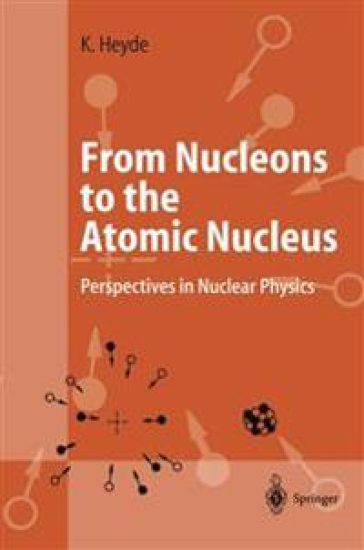
The present text grew out of a number of lecture courses for advanced under graduate and new graduate students in nuclear physics. They were given at summer schools in Leuven, Melbourne, and at study weeks for Dutch grad uate students which aimed to emphasize fundamental and topical aspects of nuclear physics. On occasion, part of the present text was presented to stu dents from a much wider field than just nuclear physics and also within a number of general physics colloquia, where, in addition to nuclear physicists, physicists from many other fields were present. In this respect, the intention is to present, in an amply illustrated form, the key quest ions that arise in nuclear physics. At the same time we try to show why a better understanding of the atomic nucleus is not only important in itself, but also yields essential insights into the many connections to other fields of physics. We thus concen trate on the unifying themes rather than addressing in great detail particular subfields of nuclear physics. The present project does not aim to be another comprehensive textbook on nuclear physics: Many of the detailed technical arguments that enter into the picture are not developed here as they would be in a more standard textbook. Instead they are presented using analogies, quite often with simple pictures and arguments that try to convey the general line of thinking and working in nuclear physics.
The present text grew out of a number of lecture courses for advanced under graduate and new graduate students in nuclear physics. They were given at summer schools in Leuven, Melbourne, and at study weeks for Dutch grad uate students which aimed to emphasize fundamental and topical aspects of nuclear physics. On occasion, part of the present text was presented to stu dents from a much wider field than just nuclear physics and also within a number of general physics colloquia, where, in addition to nuclear physicists, physicists from many other fields were present. In this respect, the intention is to present, in an amply illustrated form, the key quest ions that arise in nuclear physics. At the same time we try to show why a better understanding of the atomic nucleus is not only important in itself, but also yields essential insights into the many connections to other fields of physics. We thus concen trate on the unifying themes rather than addressing in great detail particular subfields of nuclear physics. The present project does not aim to be another comprehensive textbook on nuclear physics: Many of the detailed technical arguments that enter into the picture are not developed here as they would be in a more standard textbook. Instead they are presented using analogies, quite often with simple pictures and arguments that try to convey the general line of thinking and working in nuclear physics.