

Kirjailija
Kristian Kristiansen
Kirjat ja teokset yhdessä paikassa: 8 kirjaa, julkaisuja vuosilta 1998-2022, suosituimpien joukossa Kristiansen, K: Mystikkens Danmark. Bind 2. Vertaile teosten hintoja ja tarkista saatavuus suomalaisista kirjakaupoista.
8 kirjaa
Kirjojen julkaisuhaarukka 1998-2022.


Archaeology and the Genetic Revolution in European Prehistory
Kristian Kristiansen
Cambridge University Press
2022
pokkari
This Element was written to meet the theoretical and methodological challenge raised by the third science revolution and its implications for how to study and interpret European prehistory. The first section is therefore devoted to a historical and theoretical discussion of how to practice interdisciplinarity in this new age, and following from that, how to define some crucial, but undertheorized categories, such as culture, ethnicity and various forms of migration. The author thus integrates the new results from archaeogenetics into an archaeological frame of reference, to produce a new and theoretically informed historical narrative, one that also invites debate, but also one that identifies areas of uncertainty, where more research is needed.

Social Transformations in Archaeology explores the relevance of archaeology to the study of long-term change and to the understanding of our contemporary world. The articles are divided into: * broader theoretical issues * post-colonial issues in a wide range of contexts * archaeological examination of colonialism with case studies from the Mediterranean in the first millenium BC and historical Africa.

Centre and Periphery in the Ancient World
Michael J. Rowlands; Mogens Larsen; Kristian Kristiansen
Cambridge University Press
2009
pokkari
This collaborative volume is concerned with long-term social change. Envisaging individual societies as interlinked and interdependent parts of a global social system, the aim of the contributors is to determine the extent to which ancient societies were shaped over time by their incorporation in - or resistance to - the larger system. Their particular concern is the dependent relationship between technically and socially more developed societies with a strong state ideology at the centre and the simpler societies that functioned principally as sources of raw materials and manpower on the periphery of the system. The papers in the first part of the book are all concerned with political developments in the Ancient Near East and the notion of a regional system as a framework for analysis. Part 2 examines the problems of conceptualising local societies as discrete centres of development in the context of both the Near East and prehistoric Europe during the second millennium BC. Part 3 then presents a comprehensive analytical study of the Roman Empire as a single system showing how its component parts often relate to each other in uneven, even contradictory, ways.
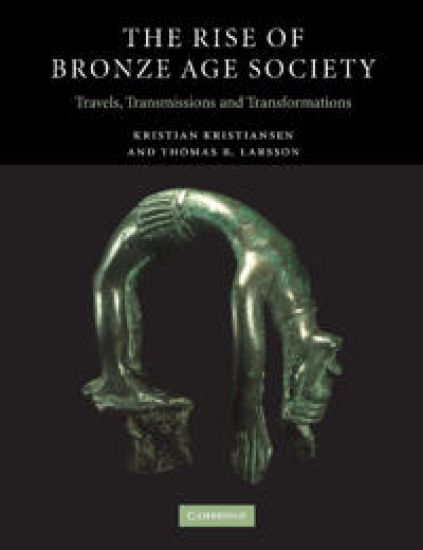
The Rise of Bronze Age Society
Kristian Kristiansen; Thomas B. Larsson
Cambridge University Press
2005
pokkari
Beginning with state formation and urbanization in the Near East c.3000 BC and ending in Central and Northern Europe c.1000–500 BC, the Bronze Age marks an heroic age of travels and transformations throughout Europe. In this 2005 book, Kristian Kristiansen and Thomas Larsson reconstruct the travel and transmission of knowledge that took place between the Near East, the Mediterranean and Europe. They explore how religious, political and social conceptions of Bronze Age people were informed by long-distance connections and alliances between local elites. The book integrates the hitherto separate research fields of European and Mediterranean (classical) archaeology and provides the reader with an alternative to the traditional approach of diffusionism. Examining data from across the region, the book presents an important new interpretation of social change in the Bronze Age, making it essential reading for students of archaeology, of anthropology and of the development of early European society.
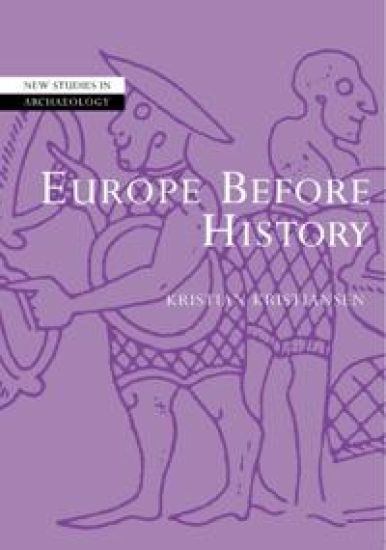
The societies of the European Bronze Age produced elaborate artifacts and were drawn into a wide trade network extending over the whole of Europe, even though they were economically and politically undiversified. Kristian Kristansen attempts to explain this paradox using a world-systems analysis, and in particular tries to acount for the absence of state formation. He presents his case with a powerful marshalling of the evidence across the whole of Europe and over two millennia. The result is the most coherent overview of this period of European prehistory since the writings of Gordon Childe and Christopher Hawkes. A great strength of this book is the broad European perspective, which allows the author to address some of the larger questions that have been raised in the study of the Bronze Age. It captures the complexity of a prehistorical world at different levels of integration and interaction from local to global.

Social Transformations in Archaeology explores the relevance of archaeology to the study of long-term change and to the understanding of our contemporary world. The articles are divided into: * broader theoretical issues * post-colonial issues in a wide range of contexts * archaeological examination of colonialism with case studies from the Mediterranean in the first millenium BC and historical Africa.