Kirjojen hintavertailu. Mukana 12 595 353 kirjaa ja 12 kauppaa.

Kirjailija

Kristin Ross

Kirjat ja teokset yhdessä paikassa: 8 kirjaa, julkaisuja vuosilta 1996-2024, suosituimpien joukossa Communal Luxury. Vertaile teosten hintoja ja tarkista saatavuus suomalaisista kirjakaupoista.

8 kirjaa

Kirjojen julkaisuhaarukka 1996-2024.

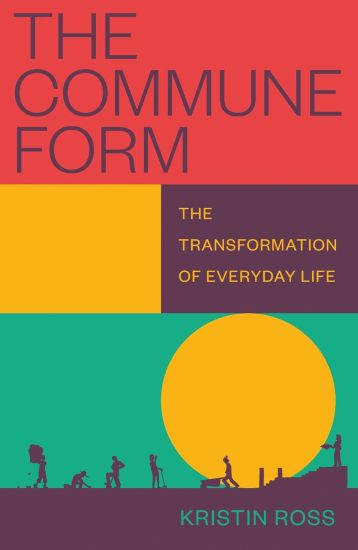
The Commune Form

The Commune Form

Kristin Ross

Verso Books
2024
nidottu
When the state recedes, the commune-form flourishes. This was as true in Paris in 1871 as it is now whenever ordinary people begin to manage their daily lives collectively. Contemporary struggles over land - from the zad at Notre-Dame-des-Landes to Cop City in Atlanta, from the pipeline battles in Canada to Soulèvements de la terre - have reinvented practices of appropriating lived space and time. This transforms dramatically our perception of the recent past. Rural struggles of the 1960s and 70s, like the "Nantes Commune," the Larzac, and Sanrizuka in Japan, appear now as the defining battles of our era. In the defense of threatened territories against all manners of privatization, hoarding, and infrastructures of disaster, new ways of producing and inhabiting are devised that side-step the state and that give rise to unprecedented kinds of solidarity built on pleasurable, fruitful collaborations. These are the crucial elements in the present-day reworking of an archaic form: the commune-form that Marx once called "the political form of social emancipation," and that Kropotkin deemed "the necessary setting for revolution and the means of bringing it about."
The Politics and Poetics of Everyday Life
The texts in this volume represent Kristin Ross's attempt to think the question of the everyday across a range of discourses, practices and knowledges, from philosophy to history, from the visual arts to popular fiction, all the way to the forms taken by collective political action in the territorial struggles of today. If everyday life is, as many have come to believe, the ideal vantage point for an analysis of the social, it is also the crucial first step in its transformation.The volume opens with a return to Henri Lefebvre's powerful attempt to think the everyday as both residue and resource, as the site of profound alienation and-by the same token-the site where all emancipatory initiatives and desires begin. The second section focuses on our attempts to represent our lived reality to ourselves in cultural forms, from painting and literature and film to an analysis of the contemporary transformations of the sub-genre most embedded in the deep superficiality of everyday life: detective fiction. The final section turns to present-day ecological occupations in the wake of the zad at Notre-Dame-des-Landes, and locates the everyday as a site for rich oppositional resources and immanent social creativity.
Communal Luxury

Communal Luxury

Kristin Ross

Verso Books
2016
nidottu
Kristin Ross's new work on the thought and culture of the Communard uprising of 1871 resonates with the motivations and actions of contemporary protest, which has found its most powerful expression in the reclamation of public space. Today's concerns-internationalism, education, the future of labor, the status of art, and ecological theory and practice-frame and inform her carefully researched restaging of the words and actions of individual Communards. This original analysis of an event and its centrifugal effects brings to life the workers in Paris who became revolutionaries, the significance they attributed to their struggle, and the elaboration and continuation of their thought in the encounters that transpired between the insurrection's survivors and supporters like Marx, Kropotkin, and William Morris.The Paris Commune was a laboratory of political invention, important simply and above all for, as Marx reminds us, its own 'working existence.' Communal Luxury allows readers to revisit the intricate workings of an extraordinary experiment.
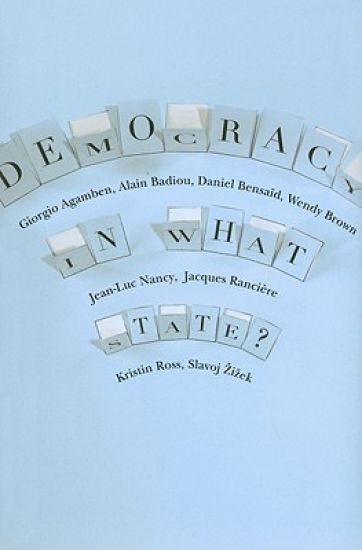
Democracy in What State?

Democracy in What State?

Giorgio Agamben; Alain Badiou; Daniel Bensaid; Wendy Brown; Jean-Luc Nancy; Jacques Rancière; Kristin Ross; Slavoj Žižek

Columbia University Press
2012
pokkari
"Is it meaningful to call oneself a democrat? And if so, how do you interpret the word?" In responding to this question, eight iconoclastic thinkers prove the rich potential of democracy, along with its critical weaknesses, and reconceive the practice to accommodate new political and cultural realities. Giorgio Agamben traces the tense history of constitutions and their coexistence with various governments. Alain Badiou contrasts current democratic practice with democratic communism. Daniel Bensaid ponders the institutionalization of democracy, while Wendy Brown discusses the democratization of society under neoliberalism. Jean-Luc Nancy measures the difference between democracy as a form of rule and as a human end, and Jacques Ranciere highlights its egalitarian nature. Kristin Ross identifies hierarchical relationships within democratic practice, and Slavoj Zizek complicates the distinction between those who desire to own the state and those who wish to do without it. Concentrating on the classical roots of democracy and its changing meaning over time and within different contexts, these essays uniquely defend what is left of the left-wing tradition after the fall of Soviet communism. They confront disincentives to active democratic participation that have caused voter turnout to decline in western countries, and they address electoral indifference by invoking and reviving the tradition of citizen involvement. Passionately written and theoretically rich, this collection speaks to all facets of modern political and democratic debate.
Democracy in What State?

Democracy in What State?

Giorgio Agamben; Alain Badiou; Daniel Bensaid; Wendy Brown; Jean-Luc Nancy; Jacques Rancière; Kristin Ross; Slavoj Žižek

Columbia University Press
2011
sidottu
"Is it meaningful to call oneself a democrat? And if so, how do you interpret the word?" In responding to this question, eight iconoclastic thinkers prove the rich potential of democracy, along with its critical weaknesses, and reconceive the practice to accommodate new political and cultural realities. Giorgio Agamben traces the tense history of constitutions and their coexistence with various governments. Alain Badiou contrasts current democratic practice with democratic communism. Daniel Bensaid ponders the institutionalization of democracy, while Wendy Brown discusses the democratization of society under neoliberalism. Jean-Luc Nancy measures the difference between democracy as a form of rule and as a human end, and Jacques Ranciere highlights its egalitarian nature. Kristin Ross identifies hierarchical relationships within democratic practice, and Slavoj Zizek complicates the distinction between those who desire to own the state and those who wish to do without it. Concentrating on the classical roots of democracy and its changing meaning over time and within different contexts, these essays uniquely defend what is left of the left-wing tradition after the fall of Soviet communism. They confront disincentives to active democratic participation that have caused voter turnout to decline in western countries, and they address electoral indifference by invoking and reviving the tradition of citizen involvement. Passionately written and theoretically rich, this collection speaks to all facets of modern political and democratic debate.
The Emergence of Social Space

The Emergence of Social Space

Kristin Ross; Terry Eagleton

Verso Books
2008
nidottu
The 1870s in France - Rimbaud's moment, and the subject of this book - is a decade virtually ignored in most standard histories in France. Yet it was the moment of two significant spatial events: France's expansion on a global scale, and, in the spring of 1871, the brief existence on the Paris Commune - the construction of the revolutionary urban space. Arguing that space, as a social fact, is always political and strategic, Kristin Ross has written a book that is at once a history and geography of the Commune's anarchist culture - its political language and social relations, its values, strategies, and stances.Central to her analysis of the Commune as a social space and oppositional culture is a close textual reading of Arthur Rimabaud's poetry. His poems - a common thread running through the book - are one set of documents among many in Ross's recreation of the Communard experience. Rimbaud, Paul Lafargue, and the social geographer Élisée Reclus serve as emblematic figures moving within and on the periphery of the Commune; in their resistance to the logic and economy of the capitalist conception of work, in their challenge to work itself as a term of identity, all three posed a threat to the existing order. Ross looks at these and other emancipatory notions as aspects of Communard life, each with an analogous strategy in Rimbaud's poetry. Applying contemporary theory, to a wealth of little-known archival material, she has written a fresh, persuasive, and original book.
May '68 and Its Afterlives

May '68 and Its Afterlives

Kristin Ross

University of Chicago Press
2004
nidottu
During May 1968, students and workers in France united in the biggest strike and the largest mass movement in French history. Protesting capitalism, American imperialism, and Gaullism, 9 million people from all walks of life, from shipbuilders to department store clerks, stopped working. The nation was paralyzed—no sector of the workplace was untouched. Yet, just thirty years later, the mainstream image of May '68 in France has become that of a mellow youth revolt, a cultural transformation stripped of its violence and profound sociopolitical implications.Kristin Ross shows how the current official memory of May '68 came to serve a political agenda antithetical to the movement's aspirations. She examines the roles played by sociologists, repentant ex-student leaders, and the mainstream media in giving what was a political event a predominantly cultural and ethical meaning. Recovering the political language of May '68 through the tracts, pamphlets, and documentary film footage of the era, Ross reveals how the original movement, concerned above all with the question of equality, gained a new and counterfeit history, one that erased police violence and the deaths of participants, removed workers from the picture, and eliminated all traces of anti-Americanism, anti-imperialism, and the influences of Algeria and Vietnam. May '68 and Its Afterlives is especially timely given the rise of a new mass political movement opposing global capitalism, from labor strikes and anti-McDonald's protests in France to the demonstrations against the World Trade Organization in Seattle.
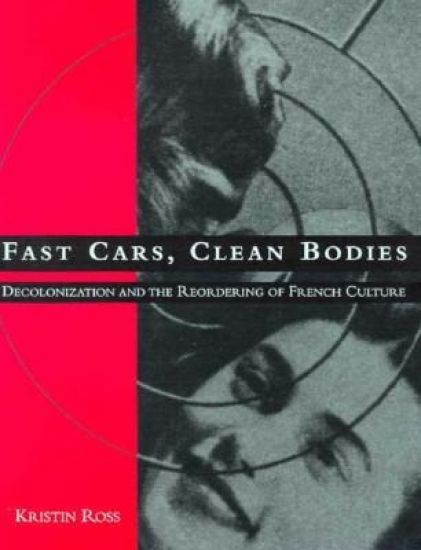
Fast Cars, Clean Bodies

Fast Cars, Clean Bodies

Kristin Ross

MIT Press
1996
pokkari
Fast Cars, Clean Bodies examines the crucial decade from Dien Bien Phu to the mid-1960s when France shifted rapidly from an agrarian, insular, and empire-oriented society to a decolonized, Americanized, and fully industrial one. In this analysis of a startling cultural transformation Kristin Ross finds the contradictions of the period embedded in its various commodities and cultural artifacts-automobiles, washing machines, women's magazines, film, popular fiction, even structuralism-as well as in the practices that shape, determine, and delimit their uses.In each of the book's four chapters, a central object of mythical image is refracted across a range of discursive and material spaces: social and private, textual and cinematic, national and international. The automobile, the new cult of cleanliness in the capital and the colonies, the waning of Sartre and de Beauvoir as the couple of national attention, and the emergence of reshaped, functionalist masculinities (revolutionary, corporate, and structural) become the key elements in this prehistory of postmodernism in France.Modernization ideology, Ross argues, offered the promise of limitless, even timeless, development. By situating the rise of "end of history" ideologies within the context of France's transition into mass culture and consumption, Ross returns the touted timelessness of modernization to history. She shows how the realist fiction and film of the period, as well as the work of social theorists such as Barthes, Lefebvre, and Morin who began at the time to conceptualize "everyday life," laid bare the disruptions and the social costs of events. And she argues that the logic of the racism prevalent in France today, focused on the figure of the immigrant worker, is itself the outcome of the French state's embrace of capitalist modernization ideology in the 1950s and 1960s.