Kirjojen hintavertailu. Mukana 12 595 353 kirjaa ja 12 kauppaa.

Kirjailija

Krzysztof R. Apt

Kirjat ja teokset yhdessä paikassa: 7 kirjaa, julkaisuja vuosilta 1994-2024, suosituimpien joukossa Programmverifikation. Vertaile teosten hintoja ja tarkista saatavuus suomalaisista kirjakaupoista.

Mukana myös kirjoitusasut: Krzysztof R Apt

7 kirjaa

Kirjojen julkaisuhaarukka 1994-2024.

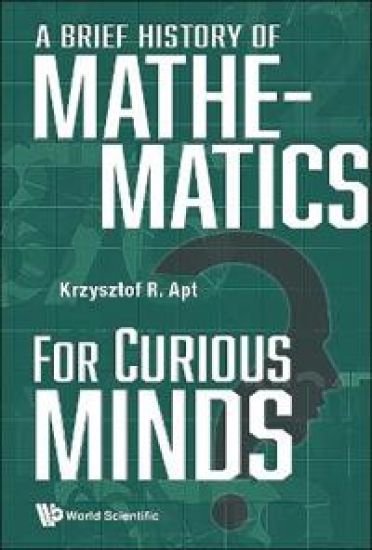
Brief History Of Mathematics For Curious Minds, A

Brief History Of Mathematics For Curious Minds, A

Krzysztof R Apt

WORLD SCIENTIFIC PUBLISHING CO PTE LTD
2024
sidottu
This book offers a short and accessible account of the history of mathematics, written for the intelligent layman to gain a better appreciation of its beauty, relevance, and place in history. It traces the development of the subject throughout the centuries, starting with the so-called Lebombo bone, the oldest known mathematical object that was estimated to be at least 43,000 years old, and ending with the 21st century.The presentation is informal, and no prior knowledge of mathematics is needed to enjoy the systematic chronological insights. A collection of appendices is included for more technical material — though still at the level of secondary school mathematics — and is concerned with the historically important proofs and concepts that can be explained in a simple way.
Brief History Of Mathematics For Curious Minds, A

Brief History Of Mathematics For Curious Minds, A

Krzysztof R Apt

WORLD SCIENTIFIC PUBLISHING CO PTE LTD
2024
nidottu
This book offers a short and accessible account of the history of mathematics, written for the intelligent layman to gain a better appreciation of its beauty, relevance, and place in history. It traces the development of the subject throughout the centuries, starting with the so-called Lebombo bone, the oldest known mathematical object that was estimated to be at least 43,000 years old, and ending with the 21st century.The presentation is informal, and no prior knowledge of mathematics is needed to enjoy the systematic chronological insights. A collection of appendices is included for more technical material — though still at the level of secondary school mathematics — and is concerned with the historically important proofs and concepts that can be explained in a simple way.
Edsger Wybe Dijkstra

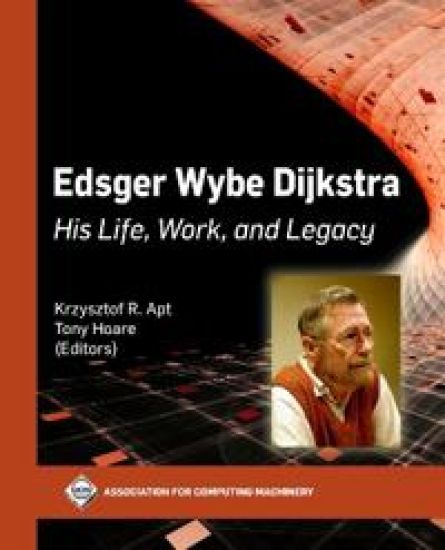
Edsger Wybe Dijkstra

Krzysztof R. Apt; Tony Hoare

Association of Computing Machinery,U.S.
2022
sidottu
Edsger Wybe Dijkstra (1930–2002) was one of the most influential researchers in the history of computer science, making fundamental contributions to both the theory and practice of computing. Early in his career, he proposed the single-source shortest path algorithm, now commonly referred to as Dijkstra's algorithm. He wrote (with Jaap Zonneveld) the first ALGOL 60 compiler, and designed and implemented with his colleagues the influential THE operating system. Dijkstra invented the field of concurrent algorithms, with concepts such as mutual exclusion, deadlock detection, and synchronization. A prolific writer and forceful proponent of the concept of structured programming, he convincingly argued against the use of the Go To statement. In 1972 he was awarded the ACM Turing Award for "fundamental contributions to programming as a high, intellectual challenge; for eloquent insistence and practical demonstration that programs should be composed correctly, not just debugged into correctness; for illuminating perception of problems at the foundations of program design." Subsequently he invented the concept of self-stabilization relevant to fault-tolerant computing. He also devised an elegant language for nondeterministic programming and its weakest precondition semantics, featured in his influential 1976 book A Discipline of Programming in which he advocated the development of programs in concert with their correctness proofs. In the later stages of his life, he devoted much attention to the development and presentation of mathematical proofs, providing further support to his long-held view that the programming process should be viewed as a mathematical activity.In this unique new book, 31 computer scientists, including five recipients of the Turing Award, present and discuss Dijkstra's numerous contributions to computing science and assess their impact. Several authors knew Dijkstra as a friend, teacher, lecturer, or colleague. Their biographical essays and tributes provide a fascinating multi-author picture of Dijkstra, from the early days of his career up to the end of his life.
Verification of Sequential and Concurrent Programs

Verification of Sequential and Concurrent Programs

Krzysztof R. Apt; Amir Pnueli; Frank S. de Boer; Ernst-Rüdiger Olderog

Springer London Ltd
2012
nidottu
HIS BOOK CONTAINS a most comprehensive text that presents syntax-directed and compositional methods for the formal veri?- T cation of programs. The approach is not language-bounded in the sense that it covers a large variety of programming models and features that appear in most modern programming languages. It covers the classes of - quential and parallel, deterministic and non-deterministic, distributed and object-oriented programs. For each of the classes it presents the various c- teria of correctness that are relevant for these classes, such as interference freedom, deadlock freedom, and appropriate notions of liveness for parallel programs. Also, special proof rules appropriate for each class of programs are presented. In spite of this diversity due to the rich program classes cons- ered, there exist a uniform underlying theory of veri?cation which is synt- oriented and promotes compositional approaches to veri?cation, leading to scalability of the methods. The text strikes the proper balance between mathematical rigor and - dactic introduction of increasingly complex rules in an incremental manner, adequately supported by state-of-the-art examples. As a result it can serve as a textbook for a variety of courses on di?erent levels and varying durations. It can also serve as a reference book for researchers in the theory of veri?- tion, in particular since it contains much material that never before appeared in book form. This is specially true for the treatment of object-oriented p- grams which is entirely novel and is strikingly elegant.
Verification of Sequential and Concurrent Programs

Verification of Sequential and Concurrent Programs

Krzysztof R. Apt; Amir Pnueli; Frank S. de Boer; Ernst-Rüdiger Olderog

Springer London Ltd
2009
sidottu
HIS BOOK CONTAINS a most comprehensive text that presents syntax-directed and compositional methods for the formal veri?- T cation of programs. The approach is not language-bounded in the sense that it covers a large variety of programming models and features that appear in most modern programming languages. It covers the classes of - quential and parallel, deterministic and non-deterministic, distributed and object-oriented programs. For each of the classes it presents the various c- teria of correctness that are relevant for these classes, such as interference freedom, deadlock freedom, and appropriate notions of liveness for parallel programs. Also, special proof rules appropriate for each class of programs are presented. In spite of this diversity due to the rich program classes cons- ered, there exist a uniform underlying theory of veri?cation which is synt- oriented and promotes compositional approaches to veri?cation, leading to scalability of the methods. The text strikes the proper balance between mathematical rigor and - dactic introduction of increasingly complex rules in an incremental manner, adequately supported by state-of-the-art examples. As a result it can serve as a textbook for a variety of courses on di?erent levels and varying durations. It can also serve as a reference book for researchers in the theory of veri?- tion, in particular since it contains much material that never before appeared in book form. This is specially true for the treatment of object-oriented p- grams which is entirely novel and is strikingly elegant.
Constraint Logic Programming using Eclipse

Constraint Logic Programming using Eclipse

Krzysztof R. Apt; Mark Wallace

Cambridge University Press
2006
sidottu
Constraint logic programming lies at the intersection of logic programming, optimisation and artificial intelligence. It has proved a successful tool in many areas including production planning, transportation scheduling, numerical analysis and bioinformatics. Eclipse is one of the leading software systems that realise its underlying methodology. Eclipse is exploited commercially by Cisco, and is freely available and used for teaching and research in over 500 universities. This book has a two-fold purpose. It's an introduction to constraint programming, appropriate for one-semester courses for upper undergraduate or graduate students in computer science or for programmers wishing to master the practical aspects of constraint programming. By the end of the book, the reader will be able to understand and write constraint programs that solve complex problems. Second, it provides a systematic introduction to the Eclipse system through carefully-chosen examples that guide the reader through the language and illustrate its power, versatility and utility.
Programmverifikation

Programmverifikation

Krzysztof R. Apt; Ernst-Rüdiger Olderog

Springer-Verlag Berlin and Heidelberg GmbH Co. K
1994
nidottu
Dieses Buch bietet als erstes Lehrbuch eine systematische Einf}hrung in die Programmverifikation. Sequentielle, parallele und verteilte Programme werdenin einheitlicher Weise behandelt. In den einzelnen Kapiteln des Buches werden deterministische und nichtdeterministische Programme, Programme mit gemeinsamen Variablen und verteilte Programme mit Kommunikation }berBotschaftenaustausch behandelt. F}r jede dieser Programmklassen werden eine operationelle Semantik, Syntax-gerichtete Verifikationsregeln mitsamt Korrektheitsbeweis und ein gr eres Verifikationsbeispiel vorgestellt. Insbesondere werden Programme zur Lsung der klassischen Probleme Erzeuger-Verbraucher, wechselweiser Ausschlu und verteilte Terminierung diskutiert und verifiziert. Eine Besonderheit desBuches ist die einheitliche Behandlung von Fairne -Annahmen und die Benutzung von Programmtransformationen. Das Buch eignet sich f}r ein- oder zweisemestrige Vorlesungen }ber Programmverifikation. Die Kapitel sind einheitlich strukturiert und enthalten eine Reihe von ]bungsaufgaben und bibliographischen Hinweisen. Das Buch f}hrt auch an aktuelle Themen der Forschung heran.