Kirjojen hintavertailu. Mukana 12 595 353 kirjaa ja 12 kauppaa.

Kirjailija

Kurt C. Schlichting

Kirjat ja teokset yhdessä paikassa: 4 kirjaa, julkaisuja vuosilta 2001-2018, suosituimpien joukossa Grand Central Terminal. Vertaile teosten hintoja ja tarkista saatavuus suomalaisista kirjakaupoista.

4 kirjaa

Kirjojen julkaisuhaarukka 2001-2018.

Waterfront Manhattan

Waterfront Manhattan

Kurt C. Schlichting

Johns Hopkins University Press
2018
sidottu
The waterfront was the key to New York City’s growth and prosperity.For hundreds of years, the shorefront of Manhattan Island served as the country’s center of trade, shipping, and commerce. With its maritime links across the oceans, along the Atlantic coast, and inland to the Midwest and New England, Manhattan became a global city and home to the world’s busiest port. It was a world of docks, ships, tugboats, and ferries, filled with cargo and freight, a place where millions of immigrants entered the Promised Land. In Waterfront Manhattan, Kurt C. Schlichting tells the story of the Manhattan waterfront as a struggle between public and private control of New York’s priceless asset. Nature provided New York with a sheltered harbor but presented the city with a challenge: to find the necessary capital to build and expand the maritime infrastructure. From colonial times until after the Civil War, the city ceded control of the waterfront to private interests, excluding the public entirely and sparking a battle between shipping companies, the railroads, and ferries for access to the waterfront. In the second half of the nineteenth century, the City of New York regained control of the waterfront, but a whirlwind of forces beyond the control of either public or private interests—technological change in the form of the shipping container and the jet airplane—devastated the city’s maritime world. The city slowly and painfully recovered. Visionaries reimagined the waterfront, and today the island is almost completely surrounded by parkland, the world of piers and longshoremen gone, replaced by luxury housing and tourist attractions.Waterfront Manhattan is a wide-ranging history that will dazzle anyone who is fascinated by New York.
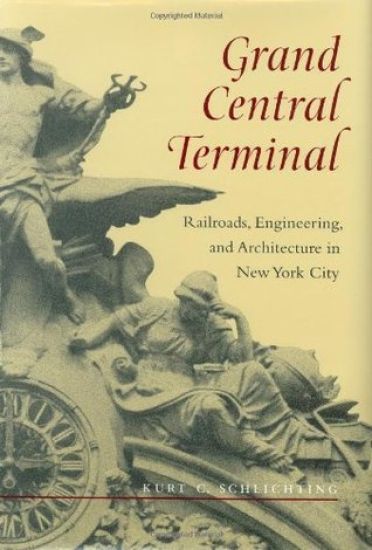
Grand Central Terminal

Grand Central Terminal

Kurt C. Schlichting

Johns Hopkins University Press
2013
pokkari
Grand Central Terminal, one of New York City's preeminent buildings, stands as a magnificent Beaux-Arts monument to America's Railway Age, and it remains a vital part of city life today. Completed in 1913 after ten years of construction, the terminal became the city's most important transportation hub, linking long-distance and commuter trains to New York's network of subways, elevated trains, and streetcars. Its soaring Grand Concourse still offers passengers a majestic gateway to the wonders beyond 42nd Street. In Grand Central Terminal, Kurt C. Schlichting traces the history of this spectacular building, detailing the colorful personalities, bitter conflicts, and Herculean feats of engineering that lie behind its construction. Schlichting begins with Cornelius Vanderbilt - "The Commodore" - whose railroad empire demanded an appropriately palatial passenger terminal in the heart of New York City. Completed in 1871, the first Grand Central was the largest rail facility in the world and yet-cramped and overburdened - soon proved thoroughly inadequate for the needs of this rapidly expanding city. William Wilgus, chief engineer of the New York Central Railroad, conceived of a new Grand Central Terminal, one that would fully meet the needs of the New York Central line. Grand Central became a monument to the creativity and daring of a remarkable age. The terminal's construction proved to be a massive undertaking. Before construction could begin, more than 3 million cubic yards of rock and earth had to be removed and some 200 buildings demolished. Manhattan's exorbitant real estate prices necessitated a vast, two-story underground train yard, which in turn required a new, smoke-free electrified rail system. The project consumed nearly 30,000 tons of steel, three times more than that in the Eiffel Tower, and two power plants were built. The terminal building alone cost number 43 million in 1913, the equivalent of nearly number 750 million today. Some of these costs were offset by an ambitious redevelopment project on property above the New York Central's underground tracks. Schlichting writes about the economic and cultural impact of the terminal on midtown Manhattan, from building of the Biltmore and Waldorf-Astoria Hotels to the transformation of Park Avenue. Schlichting concludes with an account of the New York Central's decline; the public outcry that prevented Grand Central's new owner, Penn Central, from following through with its 1969 plan to demolish or drastically alter the terminal; the rise of Metro-North Railroad; and the meticulous 1990s restoration project that returned Grand Central Terminal to its original splendor. More than a history of a train station, this book is the story of a city and an age as reflected in a building aptly described as a secular cathedral.
Grand Central's Engineer

Grand Central's Engineer

Kurt C. Schlichting

Johns Hopkins University Press
2013
pokkari
Few people have had as profound an impact on the history of New York City as William J. Wilgus. As chief engineer of the New York Central Railroad, Wilgus conceived the Grand Central Terminal, the city's magnificent monument to America's Railway Age. Kurt C. Schlichting here examines the remarkable career of this innovator, revealing how his tireless work moving people and goods over and under Manhattan Island's surrounding waterways forever changed New York's bustling transportation system. After his herculean efforts on behalf of Grand Central, the most complicated construction project in New York's history, Wilgus turned to solving the city's transportation quandary: Manhattan-the financial, commercial, and cultural hub of the United States in the twentieth century-was separated from the mainland by two major rivers to the west and east, a deep-water estuary to the south, and the Harlem River to the north. Wilgus believed that railroads and mass transportation provided the answer to New York City's complicated geography. His ingenious ideas included a freight subway linking rail facilities in New Jersey with manufacturers and shippers in Manhattan, a freight and passenger tunnel connecting Staten Island and Brooklyn, and a belt railway interconnecting sixteen private railroads serving the metropolitan area. Schlichting's deep passion for Wilgus and his engineering achievements are evident in the pages of this fascinating work. Wilgus was a true pioneer, and Schlichting ensures that his brilliant contributions to New York City's transportation system will not be forgotten. Praise for Schlichting's Grand Central Terminal: "Grand Central Terminal is celebrated for its Beaux-Arts style, but Kurt C. Schlichting looks behind the facade to see the hidden engineering marvels." (New York Times Book Review). "His study peels away our contemporary expectations and experiences and reveals the layers of history and acts of men that served as the foundation for this great structure." (H-Urban, H-Net Review). "The most detailed account yet of one of the most important events in the history of 20th-century architecture, railroad development, and city building." (Choice). "In his detailed accounts of the fiscal, stylistic, and engineering decisions that went into the creation of...Grand Central Terminal, Schlichting clearly shows both how energetic and talented all of the people involved were and how dramatically they altered this central portion of New York City." (Journal of the Society of Architectural Historians). "Ably tells the story of the New York rail system's most active and visible symbol: the architectural and engineering masterpiece, with its grand public concourse, in the heart of Midtown." (New Scientist).
Grand Central Terminal

Grand Central Terminal

Kurt C. Schlichting

Johns Hopkins University Press
2001
sidottu
Grand Central Terminal, one of New York City's preeminent buildings, stands as a magnificent Beaux-Arts monument to America's Railway Age, and it remains a vital part of city life today. Completed in 1913 after ten years of construction, the terminal became the city's most important transportation hub, linking long-distance and commuter trains to New York's network of subways, elevated trains, and streetcars. Its soaring Grand Concourse still offers passengers a majestic gateway to the wonders beyond 42nd Street. In Grand Central Terminal, Kurt C. Schlichting traces the history of this spectacular building, detailing the colorful personalities, bitter conflicts, and Herculean feats of engineering that lie behind its construction. Schlichting begins with Cornelius Vanderbilt-"The Commodore"-whose railroad empire demanded an appropriately palatial passenger terminal in the heart of New York City. Completed in 1871, the first Grand Central was the largest rail facility in the world and yet-cramped and overburdened-soon proved thoroughly inadequate for the needs of this rapidly expanding city. William Wilgus, chief engineer of the New York Central Railroad, conceived of a new Grand Central Terminal, one that would fully meet the needs of the New York Central line. Grand Central became a monument to the creativity and daring of a remarkable age. The terminal's construction proved to be a massive undertaking. Before construction could begin, more than 3 million cubic yards of rock and earth had to be removed and some 200 buildings demolished. Manhattan's exorbitant real estate prices necessitated a vast, two-story underground train yard, which in turn required a new, smoke-free electrified rail system. The project consumed nearly 30,000 tons of steel, three times more than that in the Eiffel Tower, and two power plants were built. The terminal building alone cost 43 million in 1913, the equivalent of nearly 750 million today. Some of these costs were offset by an ambitious redevelopment project on property above the New York Central's underground tracks. Schlichting writes about the economic and cultural impact of the terminal on midtown Manhattan, from building of the Biltmore and Waldorf-Astoria Hotels to the transformation of Park Avenue. Schlichting concludes with an account of the New York Central's decline; the public outcry that prevented Grand Central's new owner, Penn Central, from following through with its 1969 plan to demolish or drastically alter the terminal; the rise of Metro-North Railroad; and the meticulous 1990s restoration project that returned Grand Central Terminal to its original splendor. More than a history of a train station, this book is the story of a city and an age as reflected in a building aptly described as a secular cathedral.