Kirjojen hintavertailu. Mukana 12 242 936 kirjaa ja 12 kauppaa.

Kirjailija

Kurt Gödel

Kirjat ja teokset yhdessä paikassa: 23 kirjaa, julkaisuja vuosilta 1940-2026, suosituimpien joukossa Kurt Gödel: Collected Works: Volume II. Vertaile teosten hintoja ja tarkista saatavuus suomalaisista kirjakaupoista.

Mukana myös kirjoitusasut: Kurt Godel

23 kirjaa

Kirjojen julkaisuhaarukka 1940-2026.

Kurt Gödel: Collected Works: Volume IV

Kurt Gödel: Collected Works: Volume IV

Kurt Gödel

Oxford University Press
2014
nidottu
Kurt Gödel (1906 - 1978) was the most outstanding logician of the twentieth century, famous for his hallmark works on the completeness of logic, the incompleteness of number theory, and the consistency of the axiom of choice and the continuum hypothesis. He is also noted for his work on constructivity, the decision problem, and the foundations of computability theory, as well as for the strong individuality of his writings on the philosophy of mathematics. He is less well known for his discovery of unusual cosmological models for Einstein's equations, in theory permitting time travel into the past. The Collected Works is a landmark resource that draws together a lifetime of creative thought and accomplishment. The first two volumes were devoted to Gödel's publications in full (both in original and translation), and the third volume featured a wide selection of unpublished articles and lecture texts found in Gödel's Nachlass. The final two volumes contain Gödel's correspondence of logical, philosophical, and scientific interest. Volume IV, published for the first time in paperback, covers A to G, with H to Z in volume V; in addition, Volume V contains a full inventory of Gödel's Nachlass. All volumes include introductory notes that provide extensive explanatory and historical commentary on each body of work, English translations of material originally written in German (some transcribed from the Gabelsberger shorthand), and a complete bibliography of all works cited. Kurt Gödel: Collected Works is designed to be useful and accessible to as wide an audience as possible without sacrificing scientific or historical accuracy. The only comprehensive edition of Gödel's work available, it will be an essential part of the working library of professionals and students in logic, mathematics, philosophy, history of science, and computer science and all others who wish to be acquainted with one of the great minds of the twentieth century.
Kurt Gödel: Collected Works

Kurt Gödel: Collected Works

Kurt Gödel

Oxford University Press Inc
2001
nidottu
Kurt Gödel (1906 - 1978) was the most outstanding logician of the twentieth century, famous for his hallmark works on the completeness of logic, the incompleteness of number theory, and the consistency of the axiom of choice and the continuum hypothesis. He is also noted for his work on constructivity, the decision problem, and the foundations of computability theory, as well as for the strong individuality of his writings on the philosophy of mathematics. He is less well known for his discovery of unusual cosmological models for Einstein's equations, in theory permitting time travel into the past. The Collected Works is a landmark resource that draws together a lifetime of creative thought and accomplishment. The first two volumes were devoted to Gödel's publications in full (both in original and translation), and the third volume featured a wide selection of unpublished articles and lecture texts found in Gödel's Nachlass. These long-awaited final two volumes contain Gödel's correspondence of logical, philosophical, and scientific interest. Volume IV covers A to G, with H to Z in volume V; in addition, Volume V contains a full inventory of Gödel's Nachlass. All volumes include introductory notes that provide extensive explanatory and historical commentary on each body of work, English translations of material originally written in German (some transcribed from the Gabelsberger shorthand), and a complete bibliography of all works cited. Kurt Gödel: Collected Works is designed to be useful and accessible to as wide an audience as possible without sacrificing scientific or historical accuracy. The only comprehensive edition of Gödel's work available, it will be an essential part of the working library of professionals and students in logic, mathematics, philosophy, history of science, and computer science and all others who wish to be acquainted with one of the great minds of the twentieth century.
Kurt Gödel: Collected Works: Volume III

Kurt Gödel: Collected Works: Volume III

Kurt Gödel

Oxford University Press Inc
2001
nidottu
Kurt Gödel (1906 - 1978) was the most outstanding logician of the twentieth century, famous for his hallmark works on the completeness of logic, the incompleteness of number theory, and the consistency of the axiom of choice and the continuum hypothesis. He is also noted for his work on constructivity, the decision problem, and the foundations of computability theory, as well as for the strong individuality of his writings on the philosophy of mathematics. He is less well known for his discovery of unusual cosmological models for Einstein's equations, in theory permitting time travel into the past. The Collected Works is a landmark resource that draws together a lifetime of creative thought and accomplishment. The first two volumes were devoted to Gödel's publications in full (both in original and translation), and the third volume featured a wide selection of unpublished articles and lecture texts found in Gödel's Nachlass. These long-awaited final two volumes contain Gödel's correspondence of logical, philosophical, and scientific interest. Volume IV covers A to G, with H to Z in volume V; in addition, Volume V contains a full inventory of Gödel's Nachlass. All volumes include introductory notes that provide extensive explanatory and historical commentary on each body of work, English translations of material originally written in German (some transcribed from the Gabelsberger shorthand), and a complete bibliography of all works cited. Kurt Gödel: Collected Works is designed to be useful and accessible to as wide an audience as possible without sacrificing scientific or historical accuracy. The only comprehensive edition of Gödel's work available, it will be an essential part of the working library of professionals and students in logic, mathematics, philosophy, history of science, and computer science and all others who wish to be acquainted with one of the great minds of the twentieth century.
Kurt Gödel: Collected Works: Volume III

Kurt Gödel: Collected Works: Volume III

Kurt Gödel

Oxford University Press Inc
1995
sidottu
Kurt Gödel (1906 - 1978) was the most outstanding logician of the twentieth century, famous for his hallmark works on the completeness of logic, the incompleteness of number theory, and the consistency of the axiom of choice and the continuum hypothesis. He is also noted for his work on constructivity, the decision problem, and the foundations of computability theory, as well as for the strong individuality of his writings on the philosophy of mathematics. He is less well known for his discovery of unusual cosmological models for Einstein's equations, in theory permitting time travel into the past. The Collected Works is a landmark resource that draws together a lifetime of creative thought and accomplishment. The first two volumes were devoted to Gödel's publications in full (both in original and translation), and the third volume featured a wide selection of unpublished articles and lecture texts found in Gödel's Nachlass. These long-awaited final two volumes contain Gödel's correspondence of logical, philosophical, and scientific interest. Volume IV covers A to G, with H to Z in volume V; in addition, Volume V contains a full inventory of Gödel's Nachlass. All volumes include introductory notes that provide extensive explanatory and historical commentary on each body of work, English translations of material originally written in German (some transcribed from the Gabelsberger shorthand), and a complete bibliography of all works cited. Kurt Gödel: Collected Works is designed to be useful and accessible to as wide an audience as possible without sacrificing scientific or historical accuracy. The only comprehensive edition of Gödel's work available, it will be an essential part of the working library of professionals and students in logic, mathematics, philosophy, history of science, and computer science and all others who wish to be acquainted with one of the great minds of the twentieth century.
Kurt Gödel: Collected Works: Volume II

Kurt Gödel: Collected Works: Volume II

Kurt Gödel

Oxford University Press Inc
1990
sidottu
Kurt Gödel (1906 - 1978) was the most outstanding logician of the twentieth century, famous for his hallmark works on the completeness of logic, the incompleteness of number theory, and the consistency of the axiom of choice and the continuum hypothesis. He is also noted for his work on constructivity, the decision problem, and the foundations of computability theory, as well as for the strong individuality of his writings on the philosophy of mathematics. He is less well known for his discovery of unusual cosmological models for Einstein's equations, in theory permitting time travel into the past. The Collected Works is a landmark resource that draws together a lifetime of creative thought and accomplishment. The first two volumes were devoted to Gödel's publications in full (both in original and translation), and the third volume featured a wide selection of unpublished articles and lecture texts found in Gödel's Nachlass. These long-awaited final two volumes contain Gödel's correspondence of logical, philosophical, and scientific interest. Volume IV covers A to G, with H to Z in volume V; in addition, Volume V contains a full inventory of Gödel's Nachlass. All volumes include introductory notes that provide extensive explanatory and historical commentary on each body of work, English translations of material originally written in German (some transcribed from the Gabelsberger shorthand), and a complete bibliography of all works cited. Kurt Gödel: Collected Works is designed to be useful and accessible to as wide an audience as possible without sacrificing scientific or historical accuracy. The only comprehensive edition of Gödel's work available, it will be an essential part of the working library of professionals and students in logic, mathematics, philosophy, history of science, and computer science and all others who wish to be acquainted with one of the great minds of the twentieth century.
Kurt Gödel: Collected Works: Volume IV

Kurt Gödel: Collected Works: Volume IV

Kurt Gödel

Clarendon Press
2003
sidottu
Kurt Gödel (1906 - 1978) was the most outstanding logician of the twentieth century, famous for his hallmark works on the completeness of logic, the incompleteness of number theory, and the consistency of the axiom of choice and the continuum hypothesis. He is also noted for his work on constructivity, the decision problem, and the foundations of computability theory, as well as for the strong individuality of his writings on the philosophy of mathematics. He is less well known for his discovery of unusual cosmological models for Einstein's equations, in theory permitting time travel into the past. The Collected Works is a landmark resource that draws together a lifetime of creative thought and accomplishment. The first two volumes were devoted to Gödel's publications in full (both in original and translation), and the third volume featured a wide selection of unpublished articles and lecture texts found in Gödel's Nachlass. These long-awaited final two volumes contain Gödel's correspondence of logical, philosophical, and scientific interest. Volume IV covers A to G, with H to Z in volume V; in addition, Volume V contains a full inventory of Gödel's Nachlass. All volumes include introductory notes that provide extensive explanatory and historical commentary on each body of work, English translations of material originally written in German (some transcribed from the Gabelsberger shorthand), and a complete bibliography of all works cited. Kurt Gödel: Collected Works is designed to be useful and accessible to as wide an audience as possible without sacrificing scientific or historical accuracy. The only comprehensive edition of Gödel's work available, it will be an essential part of the working library of professionals and students in logic, mathematics, philosophy, history of science, and computer science and all others who wish to be acquainted with one of the great minds of the twentieth century.
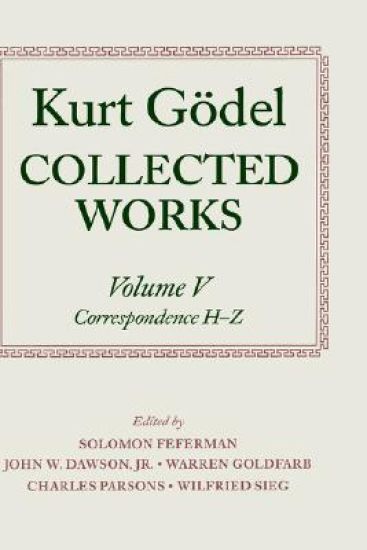
Kurt Gödel: Collected Works: Volume V

Kurt Gödel: Collected Works: Volume V

Kurt Gödel

Clarendon Press
2003
sidottu
Kurt Gödel (1906 - 1978) was the most outstanding logician of the twentieth century, famous for his hallmark works on the completeness of logic, the incompleteness of number theory, and the consistency of the axiom of choice and the continuum hypothesis. He is also noted for his work on constructivity, the decision problem, and the foundations of computability theory, as well as for the strong individuality of his writings on the philosophy of mathematics. He is less well known for his discovery of unusual cosmological models for Einstein's equations, in theory permitting time travel into the past. The Collected Works is a landmark resource that draws together a lifetime of creative thought and accomplishment. The first two volumes were devoted to Gödel's publications in full (both in original and translation), and the third volume featured a wide selection of unpublished articles and lecture texts found in Gödel's Nachlass. These long-awaited final two volumes contain Gödel's correspondence of logical, philosophical, and scientific interest. Volume IV covers A to G, with H to Z in volume V; in addition, Volume V contains a full inventory of Gödel's Nachlass. All volumes include introductory notes that provide extensive explanatory and historical commentary on each body of work, English translations of material originally written in German (some transcribed from the Gabelsberger shorthand), and a complete bibliography of all works cited. Kurt Gödel: Collected Works is designed to be useful and accessible to as wide an audience as possible without sacrificing scientific or historical accuracy. The only comprehensive edition of Gödel's work available, it will be an essential part of the working library of professionals and students in logic, mathematics, philosophy, history of science, and computer science and all others who wish to be acquainted with one of the great minds of the twentieth century.
Kurt Gödel: Collected Works: Volume II

Kurt Gödel: Collected Works: Volume II

Kurt Gödel

Oxford University Press Inc
2001
nidottu
Kurt Gödel (1906 - 1978) was the most outstanding logician of the twentieth century, famous for his hallmark works on the completeness of logic, the incompleteness of number theory, and the consistency of the axiom of choice and the continuum hypothesis. He is also noted for his work on constructivity, the decision problem, and the foundations of computability theory, as well as for the strong individuality of his writings on the philosophy of mathematics. He is less well known for his discovery of unusual cosmological models for Einstein's equations, in theory permitting time travel into the past. The Collected Works is a landmark resource that draws together a lifetime of creative thought and accomplishment. The first two volumes were devoted to Gödel's publications in full (both in original and translation), and the third volume featured a wide selection of unpublished articles and lecture texts found in Gödel's Nachlass. These long-awaited final two volumes contain Gödel's correspondence of logical, philosophical, and scientific interest. Volume IV covers A to G, with H to Z in volume V; in addition, Volume V contains a full inventory of Gödel's Nachlass. All volumes include introductory notes that provide extensive explanatory and historical commentary on each body of work, English translations of material originally written in German (some transcribed from the Gabelsberger shorthand), and a complete bibliography of all works cited. Kurt Gödel: Collected Works is designed to be useful and accessible to as wide an audience as possible without sacrificing scientific or historical accuracy. The only comprehensive edition of Gödel's work available, it will be an essential part of the working library of professionals and students in logic, mathematics, philosophy, history of science, and computer science and all others who wish to be acquainted with one of the great minds of the twentieth century.
Kurt Gödel: Collected Works: Volume I

Kurt Gödel: Collected Works: Volume I

Kurt Gödel

Oxford University Press Inc
1986
sidottu
Kurt Gödel (1906 - 1978) was the most outstanding logician of the twentieth century, famous for his hallmark works on the completeness of logic, the incompleteness of number theory, and the consistency of the axiom of choice and the continuum hypothesis. He is also noted for his work on constructivity, the decision problem, and the foundations of computability theory, as well as for the strong individuality of his writings on the philosophy of mathematics. He is less well known for his discovery of unusual cosmological models for Einstein's equations, in theory permitting time travel into the past. The Collected Works is a landmark resource that draws together a lifetime of creative thought and accomplishment. The first two volumes were devoted to Gödel's publications in full (both in original and translation), and the third volume featured a wide selection of unpublished articles and lecture texts found in Gödel's Nachlass. These long-awaited final two volumes contain Gödel's correspondence of logical, philosophical, and scientific interest. Volume IV covers A to G, with H to Z in volume V; in addition, Volume V contains a full inventory of Gödel's Nachlass. All volumes include introductory notes that provide extensive explanatory and historical commentary on each body of work, English translations of material originally written in German (some transcribed from the Gabelsberger shorthand), and a complete bibliography of all works cited. Kurt Gödel: Collected Works is designed to be useful and accessible to as wide an audience as possible without sacrificing scientific or historical accuracy. The only comprehensive edition of Gödel's work available, it will be an essential part of the working library of professionals and students in logic, mathematics, philosophy, history of science, and computer science and all others who wish to be acquainted with one of the great minds of the twentieth century.
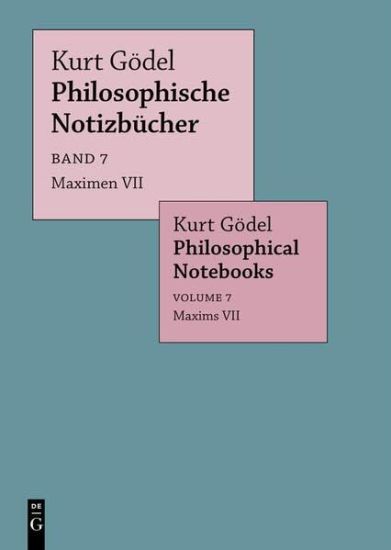
Maximen VII / Maxims VII

Maximen VII / Maxims VII

Kurt Gödel

De Gruyter
2025
sidottu
Der Mathematiker Kurt G del hat ber einen Zeitraum von 22 Jahren (1934-1955) philosophische Bemerkungen, die so genannten Maximen Philosophie (Max Phil), niedergeschrieben. Sie sind in 15 Notizb chern in der Kurzschrift Gabelsberger berliefert. Erstmals wird nun an der Kurt-G del-Forschungsstelle der Berlin-Brandenburgischen Akademie der Wissenschaften eine vollst ndige, historisch-kritische Edition von G dels Philosophischen Notizb chern vorgelegt. Im Rahmen dieser Edition erscheint j hrlich ein Band. In Band 7 befasst sich G del mit dem Thema >Sprache Die Verschiedenheit des Zugangs eines wissenschaftlichen und eines theologischen Weltbildes zur Welt und zum Leben stellt einen weiteren Schwerpunkt dieses Buches dar. Daneben setzt G del unter anderem seine berlegungen dazu fort, wie der Mensch die Welt wahrnimmt und erfasst.
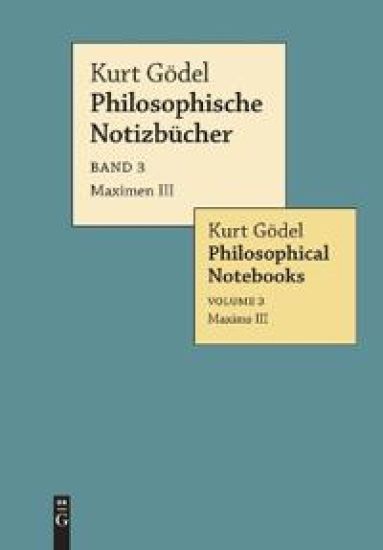
Maximen III / Maxims III

Maximen III / Maxims III

Kurt Gödel

De Gruyter
2025
nidottu
Over a period of 22 years (1934-1955), mathematician Kurt G del put down a series of philosophical remarks - the so-called Philosophical Maxims (Max Phil) - in writing. They have been passed down in 15 notebooks written in Gabelsberger shorthand. The first notebook contains general philosophical reflections, while the second and third notebooks consist of G del's applied individual ethics. The notebooks that follow show that G del developed a philosophy of science in which he placed his considerations of physics, psychology, biology, mathematics, language, theology, and history within the context of a particular metaphysics. Now for the first time ever, a complete, historical-critical edition of G del's philosophical notebooks is being prepared by the Kurt G del Research Center of the Berlin-Brandenburg Academy of Sciences and Humanities. One volume will be published yearly as part of this series. With the notebook "Maxims III," a new section of G del's philosophical notebooks begins. This notebook sheds light on the relationship between various disciplines - in particular psychology, mathematics (specifically logic), and theology - and their respective significance for both the thinking and working scholar and for the knowledge system. It also contains considerations on heuristics and scholarly methods. The role of fundamental or simple concepts in thinking also becomes apparent.
Zeiteinteilung (Maximen) I Und II / Time Management (Maxims) I and II
Over a period of 22 years (1934-1955), mathematician Kurt G del put down a series of philosophical remarks - the so-called Philosophical Maxims (Max Phil) - in writing. They have been passed down in 15 notebooks written in Gabelsberger shorthand. The first notebook contains general philosophical reflections, while the second and third notebooks consist of G del's applied individual ethics. The notebooks that follow show that G del developed a philosophy of science in which he placed his considerations of physics, psychology, biology, mathematics, language, theology, and history within the context of a particular metaphysics. Now for the first time ever, a complete, historical-critical edition of G del's philosophical notebooks is being prepared by the Kurt G del Research Center of the Berlin-Brandenburg Academy of Sciences and Humanities. One volume will be published yearly as part of this series. Volume 2 contains both notebooks of "Time Management (Max) I and II" and thereby G del's applied individual ethics, which he received among others through his teacher Heinrich Gomperz. G del thus incorporates the ethical ideal of self-perfection into his opus. The volume is prefaced by an introduction to relevant considerations from the ethics of the Stoics as well as ancient dietetics, which provide the philosophical background to understand G del's approach. In addition, editor Eva-Maria Engelen presents how this fits into the context of G del's Philosophical Notebooks.
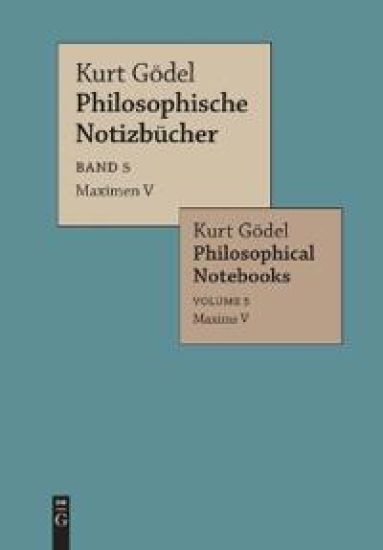
Maximen V / Maxims V

Maximen V / Maxims V

Kurt Gödel

De Gruyter
2025
nidottu
Over a period of 22 years (1934-1955), the mathematician Kurt G del wrote down philosophical remarks, the so-called Maximen Philosophie (Max Phil). They are preserved in 15 notebooks in Gabelsberger shorthand. The first booklet contains general philosophical considerations, booklets two and three consist of G del's individual ethics. The following books show that G del developed a philosophy of science in which he places his discussions on physics, psychology, biology, mathematics, language, theology and history in the context of a metaphysics. A complete, historical-critical edition of G del's Philosophical Notebooks is now being prepared for the first time at the Kurt G del Research Centre of the Berlin-Brandenburg Academy of Sciences and Humanities. One volume will be published each year as part of this edition. Volume 5 is particularly interesting because G del reveals his satisfaction with it at the beginning of 'Maximen V'. He states that he has arrived at independent thought here, which has not primarily come about through discussion with other authors. Furthermore, in addition to numerous remarkable philosophical considerations, there is a previously unknown interpretation of his (second) incompleteness theorem that goes beyond the mathematical one.
Mathematical Logic in Vienna

Mathematical Logic in Vienna

Kurt Gödel; Hans Hahn

Springer International Publishing AG
2025
sidottu
This book is a record of a seminar on mathematical logic Kurt Gödel and Hans Hahn held in Vienna in 1931-32. The seminar proceedings, given in English translation, are a unique witness of the state of research in logic and foundations of mathematics right after Gödel had published his celebrated incompleteness theorems. The seminars explain Gödel's results in logic in detail, in contrast to his publications of the time that often were quite laconic and extremely short. This book also contains Gödel's trial lecture on intuitionistic logic held in Vienna in 1933. The manuscript, recently found among the Gödel papers kept in Princeton, is preserved in Gödel's forgotten German shorthand and published here in an English translation. The book also adds an important aspect to the intellectual history of Vienna, as both Gödel and Hahn were members of the Vienna Circle group of philosophers and scientists.
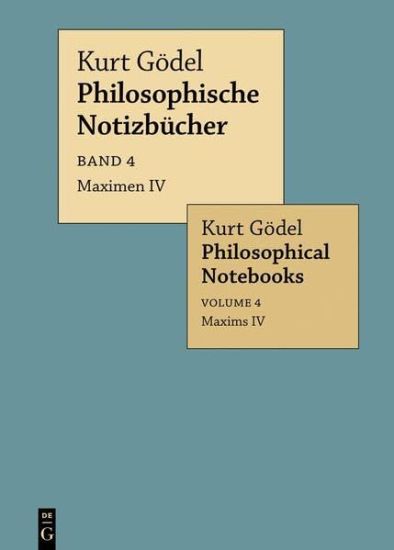
Maximen IV / Maxims IV

Maximen IV / Maxims IV

Kurt Gödel

De Gruyter
2024
nidottu
Over a period of 22 years (1934-1955), the mathematician Kurt G del wrote down philosophical remarks, the so-called Maximen Philosophie (Max Phil). They are preserved in 15 notebooks in Gabelsberger shorthand. The first booklet contains general philosophical considerations, booklets two and three consist of G del's individual ethics. The following volumes show that G del developed a philosophy of science in which he places his discussions on physics, psychology, biology, mathematics, language, theology and history in the context of a metaphysics. A complete, historical-critical edition of G del's Philosophical Notebooks is now being prepared for the first time at the Kurt G del Research Centre of the Berlin-Brandenburg Academy of Sciences and Humanities. One volume will be published each year as part of this edition. In volume 4, G del deals with fundamental questions of mathematics and logic as well as the philosophy of mathematics. In addition, the relationship between different scientific disciplines and their specific questions are at the centre of his considerations. These include, in particular, philosophy, psychology and theology.
Philosophie I Maximen 0 / Philosophy I Maxims 0

Philosophie I Maximen 0 / Philosophy I Maxims 0

Kurt Gödel

De Gruyter
2022
isokokoinen pokkari
Over a period of 22 years (1934-1955), the mathematician Kurt Gödel wrote down a series of philosophical reflections, the so-called Philosophical Remarks (Max Phil). They have been handed down in 15 notebooks written in Gabelsberg shorthand. The first notebook contains general philosophical reflections. Notebooks two and three consist of Gödel's individual ethics. The notebooks that follow clearly show that Gödel had designed a philosophy of science in which he placed his discussions of physics, psychology, biology, mathematics, language, theology, and history within the context of a particular metaphysics. For the first time, the Kurt Gödel Research Center of the Berlin-Brandenburg Academy of Sciences is preparing a complete, historical-critical edition of Gödel's philosophical notebooks. A volume will published each year as a part of this edition. Volume 1, which Gödel entitled "Philosophy I Max 0," covers Gödel´s own philosophical reflections as well as those of other authors that were important to him. These were placed by Gödel at the beginning of his overall philosophical project. The introduction of the editor Eva-Maria Engelen provides an overview of this particular body of work.
Maximen III / Maxims III

Maximen III / Maxims III

Kurt Gödel

De Gruyter
2021
sidottu
Over a period of 22 years (1934–1955), mathematician Kurt Gödel put down a series of philosophical remarks – the so-called Philosophical Maxims (Max Phil) – in writing. They have been passed down in 15 notebooks written in Gabelsberger shorthand. The first notebook contains general philosophical reflections, while the second and third notebooks consist of Gödel’s applied individual ethics. The notebooks that follow show that Gödel developed a philosophy of science in which he placed his considerations of physics, psychology, biology, mathematics, language, theology, and history within the context of a particular metaphysics. Now for the first time ever, a complete, historical-critical edition of Gödel’s philosophical notebooks is being prepared by the Kurt Gödel Research Center of the Berlin-Brandenburg Academy of Sciences and Humanities. One volume will be published yearly as part of this series. With the notebook "Maxims III," a new section of Gödel’s philosophical notebooks begins. This notebook sheds light on the relationship between various disciplines – in particular psychology, mathematics (specifically logic), and theology – and their respective significance for both the thinking and working scholar and for the knowledge system. It also contains considerations on heuristics and scholarly methods. The role of fundamental or simple concepts in thinking also becomes apparent.
Zeiteinteilung (Maximen) I und II / Time Management (Maxims) I and II
Over a period of 22 years (1934–1955), mathematician Kurt Gödel put down a series of philosophical remarks – the so-called Philosophical Maxims (Max Phil) – in writing. They have been passed down in 15 notebooks written in Gabelsberger shorthand. The first notebook contains general philosophical reflections, while the second and third notebooks consist of Gödel’s applied individual ethics. The notebooks that follow show that Gödel developed a philosophy of science in which he placed his considerations of physics, psychology, biology, mathematics, language, theology, and history within the context of a particular metaphysics. Now for the first time ever, a complete, historical-critical edition of Gödel’s philosophical notebooks is being prepared by the Kurt Gödel Research Center of the Berlin-Brandenburg Academy of Sciences and Humanities. One volume will be published yearly as part of this series. Volume 2 contains both notebooks of "Time Management (Max) I and II" and thereby Gödel’s applied individual ethics, which he received among others through his teacher Heinrich Gomperz. Gödel thus incorporates the ethical ideal of self-perfection into his opus. The volume is prefaced by an introduction to relevant considerations from the ethics of the Stoics as well as ancient dietetics, which provide the philosophical background to understand Gödel’s approach. In addition, editor Eva-Maria Engelen presents how this fits into the context of Gödel’s Philosophical Notebooks.