Kirjojen hintavertailu. Mukana 12 595 353 kirjaa ja 12 kauppaa.

Kirjailija

L. Ashok Kumar

Kirjat ja teokset yhdessä paikassa: 26 kirjaa, julkaisuja vuosilta 2015-2025, suosituimpien joukossa Automation in Textile Machinery. Vertaile teosten hintoja ja tarkista saatavuus suomalaisista kirjakaupoista.

Mukana myös kirjoitusasut: L Ashok Kumar

26 kirjaa

Kirjojen julkaisuhaarukka 2015-2025.

Computational Paradigm Techniques for Enhancing Electric Power Quality
This book focusses on power quality improvement and enhancement techniques with aid of intelligent controllers and experimental results. It covers topics ranging from the fundamentals of power quality indices, mitigation methods, advanced controller design and its step by step approach, simulation of the proposed controllers for real time applications and its corresponding experimental results, performance improvement paradigms and its overall analysis, which helps readers understand power quality from its fundamental to experimental implementations. The book also covers implementation of power quality improvement practices.Key Features Provides solution for the power quality improvement with intelligent techniques Incorporated and Illustrated with simulation and experimental results Discusses renewable energy integration and multiple case studies pertaining to various loads Combines the power quality literature with power electronics based solutions Includes implementation examples, datasets, experimental and simulation procedures
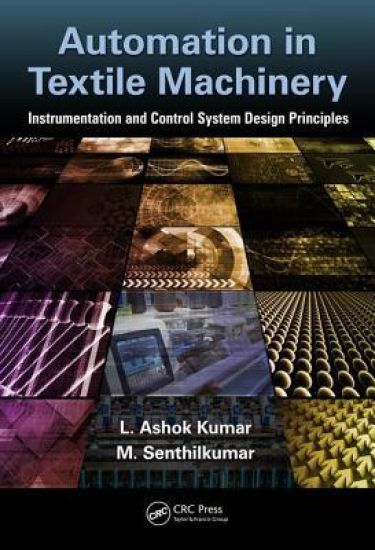
Automation in Textile Machinery

Automation in Textile Machinery

L. Ashok Kumar; M Senthil kumar

Productivity Press
2018
sidottu
Automation is the use of various control systems for operating equipment such as machinery and processes. In line, this book deals with comprehensive analysis of the trends and technologies in automation and control systems used in textile engineering. The control systems descript in all chapters is to dissect the important components of an integrated control system in spinning, weaving, knitting, chemical processing and garment industries, and then to determine if and how the components are converging to provide manageable and reliable systems throughout the chain from fiber to the ultimate customer.Key Features:• Describes the design features of machinery for operating various textile machineries in product manufacturing• Covers the fundamentals of the instrumentation and control engineering used in textile machineries• Illustrates sensors and basic elements for textile automation• Highlights the need of robotics in textile engineering• Reviews the overall idea and scope of research in designing textile machineries
Power Electronics with MATLAB

Power Electronics with MATLAB

L. Ashok Kumar; A. Kalaiarasi; Y. Uma Maheswari

Cambridge University Press
2017
pokkari
This practically-oriented, all-inclusive guide covers the essential concepts of power electronics through MATLAB® examples and simulations. In-depth explanation of important topics including digital control, power electronic applications, and electrical drives make it a valuable reference for readers. The experiments and applications based on MATLAB® models using fuzzy logic and neural networks are included for better understanding. Engrossing discussion of concepts such as diac, light-emitting diode, thyristors, power MOSFET and static induction transistor, offers an enlightening experience to readers. With numerous solved examples, exercises, review questions, and GATE questions, the undergraduate and graduate students of electrical and electronics engineering will find this text useful.
Computational Intelligence Paradigms for Optimization Problems Using MATLAB®/SIMULINK®
Considered one of the most innovative research directions, computational intelligence (CI) embraces techniques that use global search optimization, machine learning, approximate reasoning, and connectionist systems to develop efficient, robust, and easy-to-use solutions amidst multiple decision variables, complex constraints, and tumultuous environments. CI techniques involve a combination of learning, adaptation, and evolution used for intelligent applications. Computational Intelligence Paradigms for Optimization Problems Using MATLAB®/ Simulink® explores the performance of CI in terms of knowledge representation, adaptability, optimality, and processing speed for different real-world optimization problems.Focusing on the practical implementation of CI techniques, this book: Discusses the role of CI paradigms in engineering applications such as unit commitment and economic load dispatch, harmonic reduction, load frequency control and automatic voltage regulation, job shop scheduling, multidepot vehicle routing, and digital image watermarkingExplains the impact of CI on power systems, control systems, industrial automation, and image processing through the above-mentioned applicationsShows how to apply CI algorithms to constraint-based optimization problems using MATLAB® m-files and Simulink® modelsIncludes experimental analyses and results of test systemsComputational Intelligence Paradigms for Optimization Problems Using MATLAB®/ Simulink® provides a valuable reference for industry professionals and advanced undergraduate, postgraduate, and research students.
Computational Intelligence Paradigms for Optimization Problems Using MATLAB®/SIMULINK®
Considered one of the most innovative research directions, computational intelligence (CI) embraces techniques that use global search optimization, machine learning, approximate reasoning, and connectionist systems to develop efficient, robust, and easy-to-use solutions amidst multiple decision variables, complex constraints, and tumultuous environments. CI techniques involve a combination of learning, adaptation, and evolution used for intelligent applications. Computational Intelligence Paradigms for Optimization Problems Using MATLAB®/ Simulink® explores the performance of CI in terms of knowledge representation, adaptability, optimality, and processing speed for different real-world optimization problems.Focusing on the practical implementation of CI techniques, this book: Discusses the role of CI paradigms in engineering applications such as unit commitment and economic load dispatch, harmonic reduction, load frequency control and automatic voltage regulation, job shop scheduling, multidepot vehicle routing, and digital image watermarkingExplains the impact of CI on power systems, control systems, industrial automation, and image processing through the above-mentioned applicationsShows how to apply CI algorithms to constraint-based optimization problems using MATLAB® m-files and Simulink® modelsIncludes experimental analyses and results of test systemsComputational Intelligence Paradigms for Optimization Problems Using MATLAB®/ Simulink® provides a valuable reference for industry professionals and advanced undergraduate, postgraduate, and research students.
Electronics in Textiles and Clothing

Electronics in Textiles and Clothing

L. Ashok Kumar; C. Vigneswaran

Productivity Press
2015
sidottu
Electronics in Textiles and Clothing: Design, Products and Applications covers the fundamentals of electronics and their applications in textiles and clothing product development. The book emphasizes the interface between electronics and textile materials, detailing diverse methods and techniques used in industrial practice. It explores ways to integrate textile materials with electronics for communicating/signal transferring applications. It also discusses wearable electronic products for industrial applications based on functional properties and end users in sectors such as defense, medicine, health monitoring, and security.The book details the application of wearable electronics and outlines the textile fibres used for wearable electronics. It includes coverage of different yarn types and fabric production techniques and modifications needed on conventional machines for developing fabrics using specialty yarns. The coverage includes problems faced during the production processes and their solutions. Novel sensors, specialty yarns, Body Sensor Networks (BSN), and the development of flexible solar tents used for power generation round out the coverage. The book then concludes with discussions of the development of fabric-integrated wearable electronic products for use in mobihealth care systems, smart cloth for ambulatory remote monitoring, electronic jerkin, heating gloves, and pneumatic gloves.Based mainly on the authors’ projects and field work, the book takes a practical approach to the issues involved in designing electronic circuits and their possibilities for signals, giving you an understanding of problems that can occur when executing the work. It also describes the future scope of e-textiles using conductive materials for medical, healthcare textile product development, and safety aspects. The text provides guidelines for the development of wearable textiles, giving a new meaning to the term human-machine symbiosis in the context of pervasive/invisible computing.