Kirjojen hintavertailu. Mukana 12 595 353 kirjaa ja 12 kauppaa.

Kirjailija

Lance Taylor

Kirjat ja teokset yhdessä paikassa: 14 kirjaa, julkaisuja vuosilta 1998-2023, suosituimpien joukossa S: Development Economics. Vertaile teosten hintoja ja tarkista saatavuus suomalaisista kirjakaupoista.

14 kirjaa

Kirjojen julkaisuhaarukka 1998-2023.

Opportunities in Solution-Focused Interviewing

Opportunities in Solution-Focused Interviewing

Joel K. Simon; Lance Taylor

TAYLOR FRANCIS LTD
2023
sidottu
Written by the developers of the microanalysis of opportunities approach, this book describes how clinicians can use this model when listening and responding to clients in solution-focused therapy, training, coaching, and supervision.Joel K. Simon and Lance Taylor begin by reviewing the evolution, philosophical foundations, and intervention tools of solution-focused brief therapy, sharing how their practice has evolved over time from their clinical experience with clients, trainees, supervisees, and colleagues. Moving from theory to practice, the book then explores microanalysis of opportunities, beginning with how the authors developed the approach and created the process. Replete with actual examples of conversations between clients and therapists, and between trainer and trainee, the book demonstrates how the model can be applied in practice with analyses and discussions about analyzed material throughout. It displays the application of the approach to coaching, supervision, and training.This valuable book will not only be useful to therapists new to solution-focused brief therapy, but also to those who are experienced solution-focused practitioners. Psychotherapists, clinical social workers, counselors, and other mental health professionals will find this an illuminating read.
Opportunities in Solution-Focused Interviewing

Opportunities in Solution-Focused Interviewing

Joel K. Simon; Lance Taylor

TAYLOR FRANCIS LTD
2023
nidottu
Written by the developers of the microanalysis of opportunities approach, this book describes how clinicians can use this model when listening and responding to clients in solution-focused therapy, training, coaching, and supervision.Joel K. Simon and Lance Taylor begin by reviewing the evolution, philosophical foundations, and intervention tools of solution-focused brief therapy, sharing how their practice has evolved over time from their clinical experience with clients, trainees, supervisees, and colleagues. Moving from theory to practice, the book then explores microanalysis of opportunities, beginning with how the authors developed the approach and created the process. Replete with actual examples of conversations between clients and therapists, and between trainer and trainee, the book demonstrates how the model can be applied in practice with analyses and discussions about analyzed material throughout. It displays the application of the approach to coaching, supervision, and training.This valuable book will not only be useful to therapists new to solution-focused brief therapy, but also to those who are experienced solution-focused practitioners. Psychotherapists, clinical social workers, counselors, and other mental health professionals will find this an illuminating read.

Macroeconomic Inequality from Reagan to Trump

Macroeconomic Inequality from Reagan to Trump

Lance Taylor

Cambridge University Press
2020
pokkari
For five decades, rising US income and wealth inequality has been driven by wage repression and production realignments benefitting the top one percent of households. In this inaugural book for Cambridge Studies in New Economic Thinking, Professor Lance Taylor takes an innovative approach to measuring inequality, providing the first and only full integration of distributional and macro level data for the US. While work by Thomas Piketty and colleagues pursues integration from the income side, Professor Taylor uses data of distributions by size of income and wealth combined with the cost and demand sides, flows of funds, and full balance sheet accounting of real capital and financial claims. This blends measures of inequality with national income and product accounts to show the relationship between productivity and wages at the industry sector level. Taylor assesses the scope and nature of various interventions to reduce income and wealth inequalities using his simulation model, disentangling wage growth and productivity while challenging mainstream models.
Macroeconomic Inequality from Reagan to Trump

Macroeconomic Inequality from Reagan to Trump

Lance Taylor

Cambridge University Press
2020
sidottu
For five decades, rising US income and wealth inequality has been driven by wage repression and production realignments benefitting the top one percent of households. In this inaugural book for Cambridge Studies in New Economic Thinking, Professor Lance Taylor takes an innovative approach to measuring inequality, providing the first and only full integration of distributional and macro level data for the US. While work by Thomas Piketty and colleagues pursues integration from the income side, Professor Taylor uses data of distributions by size of income and wealth combined with the cost and demand sides, flows of funds, and full balance sheet accounting of real capital and financial claims. This blends measures of inequality with national income and product accounts to show the relationship between productivity and wages at the industry sector level. Taylor assesses the scope and nature of various interventions to reduce income and wealth inequalities using his simulation model, disentangling wage growth and productivity while challenging mainstream models.
Maynard's Revenge

Maynard's Revenge

Lance Taylor

Harvard University Press
2011
sidottu
It is now widely agreed that mainstream macroeconomics is irrelevant and that there is need for a more useful and realistic economic analysis that can provide a better understanding of the ongoing global financial and economic crisis. Lance Taylor’s book exposes the unrealistic assumptions of the rational expectations and real business cycle approaches and of mainstream finance theory. It argues that in separating monetary and financial behavior from real behavior, they do not address the ways that consumption, accumulation, and the government play in the workings of the economy. Taylor argues that the ideas of J. M. Keynes and others provide a more useful framework both for understanding the crisis and for dealing with it effectively. Keynes’s basic points were fundamental uncertainty and the absence of Say’s Law. He set up machinery to analyze the macro economy under such circumstances, including the principle of effective demand, liquidity preference, different rules for determining commodity and asset prices, distinct behavioral patterns of different collective actors, and the importance of thinking in terms of complete macro accounting schemes. Economists working in this tradition also worked out growth and cycle models. Employing these ideas throughout Maynard’s Revenge, Taylor provides an analytical narrative about the causes of the crisis, and suggestions for dealing with it.
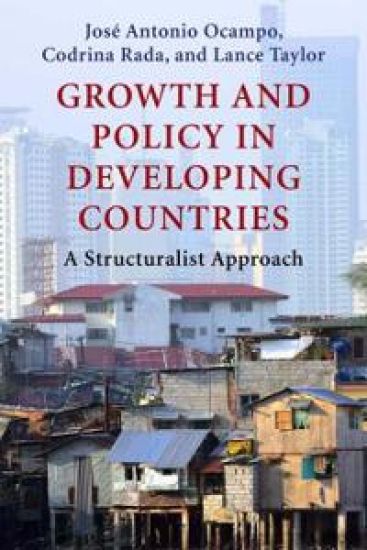
Growth and Policy in Developing Countries

Growth and Policy in Developing Countries

Jose Antonio Ocampo; Codrina Rada; Lance Taylor

Columbia University Press
2009
sidottu
Economic structuralists use a broad, systemwide approach to understanding development, and this textbook assumes a structuralist perspective in its investigation of why a host of developing countries have failed to grow at 2 percent or more since 1960. Sensitive to the wide range of factors that affect an economy's strength and stability, the authors identify the problems that have long frustrated growth in many parts of the developing world while suggesting new strategies and policies to help improve standards of living. After a survey of structuralist methods and post-World War II trends of global economic growth, the authors discuss the role that patterns in productivity, production structures, and capital accumulation play in the growth dynamics of developing countries. Next, it outlines the evolution of trade patterns and the effect of the terms of trade on economic performance, especially for countries that depend on commodity exports. The authors acknowledge the structural limits of macroeconomic policy, highlighting the negative effects of financial volatility and certain financial structures while recommending policies to better manage external shocks. These policies are then further developed through a discussion of growth and structural improvements, and are evaluated according to which policy options-macro, industrial, or commercial--best fit within different kinds of developing economies.
Modelling the Impact of Trade Liberalisation

Modelling the Impact of Trade Liberalisation

Lance Taylor

Oxfam Professional
2006
nidottu
This hard-hitting research report presents a rigorous critique of the most widely used trade models based on computable general equilibrium (or CGE) models. The authors present concise analytical arguments explaining the fundamental weaknesses of typical CGE models. They show that these models tend to make unrealistic assumptions about the macro-economy and do not allow an accurate estimation of the welfare gains that trade liberalisation is supposed to induce. The report appeals for honest simulation strategies showing a variety of possible outcomes, which would enable policy-makers to assess the different scenarios for themselves.
Reconstructing Macroeconomics

Reconstructing Macroeconomics

Lance Taylor

Harvard University Press
2004
sidottu
Macroeconomics is in disarray. No one approach is dominant, and an increasing divide between theory and empirics is evident. This book presents both a critique of mainstream macroeconomics from a structuralist perspective and an exposition of modern structuralist approaches. The fundamental assumption of structuralism is that it is impossible to understand a macroeconomy without understanding its major institutions and distributive relationships across productive sectors and social groups. Lance Taylor focuses his critique on mainstream monetarist, new classical, new Keynesian, and growth models. He examines them from a historical perspective, tracing monetarism from its eighteenth-century roots and comparing current monetarist and new classical models with those of the post-Wicksellian, pre-Keynesian generation of macroeconomists. He contrasts the new Keynesian vision with Keynes's General Theory, and analyzes contemporary growth theories against long traditions of thought about economic development and structural change.
Power, Employment and Accumulation

Power, Employment and Accumulation

Jim Stanford; Lance Taylor; Brant Houston

Routledge
2001
nidottu
This book provides an interesting and refreshing collection of economic research conducted in the broadly heterodox tradition. A variety of topical issues are addressed, including labor market inequalities, welfare reform, interest rate policies, international trade, and global financial instability. What unites these diverse essays is their common perspective that social institutions and structures "matter" to the performance of economies, and hence should receive more attention from economists. Conventional economic thought focuses unduly on the functioning of so-called "free-markets." The persistent influence of social structures, institutions and practices - and the unequal extent to which differing social constituencies are able to exert power through those structures - often receives short shrift in this traditional research. However, this volume makes a significant contribution by helping to reverse this trend. The chapters, all written by top economists from around North America, address a range of topical issues, utilizing a rich variety of methodological techniques from empirical investigations to game theory and opinion surveys. Furthermore, the book, which is dedicated to the memory of David M. Gordon, has as its unifying theme the incorporation of structural analysis into economic science - an important goal for academics and students alike.
Global Finance at Risk

Global Finance at Risk

John Eatwell; Lance Taylor

The New Press
2001
nidottu
In Global Finance at Risk, two economists whom John Kenneth Galbraith has hailed as "accomplished scholars of the first rank" propose a bold solution to the financial crises that threaten us all: a World Financial Authority with powers to establish worldwide best-practice financial regulation and risk management. Expansion of finance in industrialized economies, including that of the nineteenth-century United States, was accompanied by the same kind of turbulence now afflicting Asia, Russia, and Latin America. Then, the solution was to establish national banking and securities regulators, create deposit insurance, and empower lenders of last resort. But in our increasingly globalized times, an account opened at a local bank can be based on bad debt from anywhere in the world, including places outside the jurisdiction of those national agencies. And when banks fail, it is not only their account holders who suffer, but all of us. This is why, argue John Eatwell and Lance Taylor in this timely and urgent book, effective regulation of international finance is crucial to the economic health of all nations. Global Finance at Risk casts a welcome light on the deepening intricacies of world financial systems.
Power, Employment and Accumulation

Power, Employment and Accumulation

Jim Stanford; Lance Taylor; Brant Houston

Routledge
2001
sidottu
This book provides an interesting and refreshing collection of economic research conducted in the broadly heterodox tradition. A variety of topical issues are addressed, including labor market inequalities, welfare reform, interest rate policies, international trade, and global financial instability. What unites these diverse essays is their common perspective that social institutions and structures "matter" to the performance of economies, and hence should receive more attention from economists. Conventional economic thought focuses unduly on the functioning of so-called "free-markets." The persistent influence of social structures, institutions and practices - and the unequal extent to which differing social constituencies are able to exert power through those structures - often receives short shrift in this traditional research. However, this volume makes a significant contribution by helping to reverse this trend. The chapters, all written by top economists from around North America, address a range of topical issues, utilizing a rich variety of methodological techniques from empirical investigations to game theory and opinion surveys. Furthermore, the book, which is dedicated to the memory of David M. Gordon, has as its unifying theme the incorporation of structural analysis into economic science - an important goal for academics and students alike.
Global Finance at Risk

Global Finance at Risk

John Eatwell; Lance Taylor

Polity Press
2000
sidottu
In Global Finance at Risk, two acclaimed economists propose a bold and necessary solution to the financial crises that threaten us all: a World Financial Authority with powers to establish best-practice financial regulation and risk management everywhere. The expansion of finance in industrialized economies, including nineteenth-century Britain and the United States, saw exactly the same kind of turbulence now afflicting Asia, Russia and Latin America. Then, the solution was to establish national banking and securities regulators, deposit insurance and lenders of last resort. But in our increasingly globalized world, the savings account you open at your local bank can be based on bad debt from anywhere in the world, including places outside the jurisdiction of those national agencies. And when banks fail, it is not just their account-holders who suffer, but all of us. This is why, argue John Eatwell and Lance Taylor in this timely and urgent book, effective regulation of the international financial system is crucial for the economic health of all nations. Global Finance at Risk presents a compelling case for the international regulation of world financial systems. Written in a clear and accessible style and addressing one of the most critical issues in the world today, this is a book which deserves to be widely read and discussed.
The Market Meets Its Match

The Market Meets Its Match

Alice Amsden; Jacek Kochanowicz; Lance Taylor

Harvard University Press
1998
nidottu
Under free-market shock therapy, the economies of Eastern Europe have plunged into crisis. Shortages may have disappeared, but so have social services, a living wage, and equitable income distribution. Political unrest increases apace as output plummets. Why so much stagnation, inflation, and de-industrialization, and what can be done to turn this risky state of affairs around? This book, the first critique of the free-market economic policies that have jolted Eastern Europe, addresses these questions in penetrating detail. The authors also propose a sensible approach to reform, including a restructuring of the state itself so that it can play a more positive role in this difficult transition. With close attention to the history and institutional realities of the region, The Market Meets Its Match explains the failure of the simplistic market medicine administered in the first five years of transition. Merely “getting the prices right”—lowering wages and raising interest rates and energy prices—won't improve competitiveness, the authors argue, as long as nonlabor costs such as the quality of goods, product design, outmoded technology, and inefficient distribution channels remain problems. Easing these bottlenecks requires long-term capital accumulation and profit maximization. The institutions necessary for such growth have not developed under Eastern Europe's new “pseudo-capitalism,” as the authors demonstrate, and “pseudo-privatization,” while distributing state property to citizens, has not provided them with the capital and technology they need to succeed. This book shows that the market mechanism alone will not transform Eastern Europe's potentially productive enterprises into international competitors without careful government coordination and support.