Kirjojen hintavertailu. Mukana 12 595 353 kirjaa ja 12 kauppaa.
Kirjailija
Larry E. Beutler
Kirjat ja teokset yhdessä paikassa: 7 kirjaa, julkaisuja vuosilta 1990-2014, suosituimpien joukossa Prescriptive Psychotherapy. Vertaile teosten hintoja ja tarkista saatavuus suomalaisista kirjakaupoista.
A brief reference book for professional psychotherapists. It is inteneded to help practising clinicians select the appropriate therapeutic procedure for various patients.
With over 400 types of psychotherapy available, ranging from the highly effective to the highly questionable to the downright fraudulent, the task of choosing a therapist can be daunting. Now, Am I Crazy Or Is My Shrink? gives you all the information you need to get the most effective help and to know when your therapy is working--or when it's time for a change. Drawing on years of practical experience and the most up-to-date research, the authors give you expert guidance on all the issues you should consider, whether you're seeking therapy or uncertain about the therapy you're receiving: What questions should I ask my therapist about a recommended treatment? What personal qualities and professional qualifications should I look for in a therapist? What do research studies say about the effectiveness of a particular therapy? How do I recognize when a therapist is not right for me? How can I tell when my therapist's behavior is unethical or unprofessional? What strategies can I use to evaluate my progress? The authors also provide an overview of the main branches of psychotherapy and suggest which approaches are best suited to the most commonly occurring problems, such as depression, anxiety, obsessive-compulsive disorders, eating disorders, relationship and sexual difficulties, and many others. Finally, the authors stress that because therapies don't come with warning labels, and because a therapist will typically apply his or her theory to whoever walks through the door, regardless of their unique symptoms and circumstances, it is essential to choose your therapist wisely, with as much forethought as possible. Am I Crazy Or Is My Shrink? empowers you to make that choice with confidence and to be a knowledgeable participant in your own treatment.
A complete, thorough, and pragmatic guide to clinical assessment, this authoritative book meets a key need for both students and practitioners. T. Mark Harwood, Larry E. Beutler, Gary Groth-Marnat, and their associates describe how to construct a "moving picture" of each patient by integrating data from a variety of sources. Included are detailed, systematic reviews of widely used instruments together with strategies for selecting the best methods for particular referral questions. Readers learn to conduct integrated assessments that take the complexities of the individual personality into account, serve as the basis for developing an effective treatment plan, and facilitate meaningful reporting and client feedback.New to This Edition*Incorporates the latest research findings and assessment/treatment planning tools.*Chapters on the Personality Assessment Inventory and the NEO-PI-R and NEO-PI-3.*A new extended case example runs throughout the chapters.*Critically evaluates the recently published MMPI-2-RF.
From initial consultation to termination of treatment, psychologists and other mental health practitioners make a series of crucial decisions to determine the progress and therapy of the patient. These decisions have varied implications such as the clinical course of the patient, the efficacy and efficiency of the treatment, and the cost of the sessions. Thus, the decisions made by mental health professionals need to be accurate and consistent, respecting a series of guidelines that will ultimately benefit the patient. This is the first in a series of guidebooks that is designed to do just that by providing practitioners with some structure in the development of treatment programmes. Previous guidelines have been based on consensus panels of experts or on the opinions of membership groups, causing guidelines to be very far off from the findings of empirical research. Here, guidelines are presented in terms of treatment principles rather than in terms of specific treatment models or theories, and they do not favour one theory of psychotherapy over another. Instead, they define strategies and considerations that can be woven into comprehensive treatment programmes. The entire series of guidebooks will cover numerous topics, including anxiety disorders, drug abuse, alcohol abuse, and treatment of serious mental disorders. This volume will cover in detail the nature of depression, issues in treatment research, contemporary treatments, and implications for education and training. It is ideal for postgraduates and professionals in the mental health field and is intended to provide important background on treatment of non-bipolar depressive disorders.
This essential guide to the prescriptive selection of psychosocial interventions is founded on a research?based model that sequentially considers patient dimensions, environments, settings, therapists, and therapies. It covers the development of a prescriptive decision model, patient predisposing variables, and more.
This essential guide to the prescriptive selection of psychosocial interventions is founded on a research?based model that sequentially considers patient dimensions, environments, settings, therapists, and therapies. It covers the development of a prescriptive decision model, patient predisposing variables, and more.
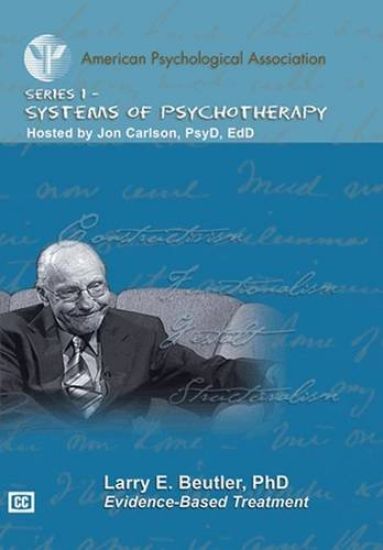
In ""Evidence-Based Treatment"", Larry E. Beutler demonstrates his research-directed approach to therapy. Dr. Beutler uses data gathered in a presession assessment to tailor his approach to working with the client. The principles on which this method is based have been proven to make therapy more targeted and therefore more effective. In this session, Dr. Beutler works with a young man suffering with depression who wants to be able to enjoy life again. Dr. Beutler looks for relationship themes and at the client's family systems for insight into the sources of the client's depression and passivity, and helps to increase the client's self-esteem and sense of control over his own life.