Kirjojen hintavertailu. Mukana 12 595 353 kirjaa ja 12 kauppaa.

Kirjailija

Larry L. Rasmussen

Kirjat ja teokset yhdessä paikassa: 10 kirjaa, julkaisuja vuosilta 1978-2022, suosituimpien joukossa The Planet You Inherit. Vertaile teosten hintoja ja tarkista saatavuus suomalaisista kirjakaupoista.

10 kirjaa

Kirjojen julkaisuhaarukka 1978-2022.

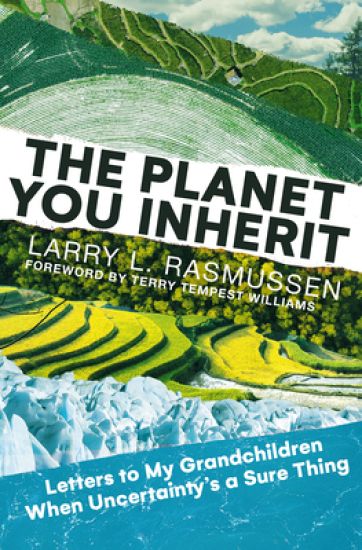
The Planet You Inherit

The Planet You Inherit

Larry L. Rasmussen; Terry Tempest Williams

AUGSBURG FORTRESS PUBLISHERS
2022
sidottu
For the first time in history, letters from one geological epoch to another. Our children's and grandchildren's generation will face a different world, one affected by climate instability, mass uncertainty, and breathtaking extinction. In fact, the next generation will face the reality that human activity is changing the planet from one geological epoch to another. From this vantage point--two generations across two geological epochs facing a fundamentally changing planet--Larry Rasmussen writes to his grandchildren. As a grandfather invested in a green earth and climate justice as well as a scholar of faith-based earth ethics, Rasmussen bridges this gap between generations to write to the future about climate change, global citizenship, democracy, and legacy. In topics ranging from A Viable Way of Life and Democracy to Where We've Come From and Who We Are Now, Rasmussen explores the large questions of justice, meaning, and faith, encouraging us to speak to and look to the future generation and their future world.

Bible and Ethics in the Christian Life

Bible and Ethics in the Christian Life

Bruce C. Birch; Jacqueline E. Lapsley; Cynthia D. Moe-Lobeda; Larry L. Rasmussen

Fortress Press,U.S.
2018
nidottu
Earth is changing in ways it hasn't for hundreds of thousands of years. At the same time, Christianity is breaking away from its millennium-long geographical and cultural center in the Euro-West. Its growth is in Asia, Africa, and Latin America, primarily in Pentecostal, evangelical, and independent churches. These dramatically changed planetary and ecclesial landscapes have led many to conclude that we need a new way of thinking about our collective existence: who are we and what is the nature of our responsibility in this deeply altered world? To address that question, biblical scholars Bruce C. Birch and Jacqueline E. Lapsley and Christian ethicists Larry L. Rasmussen and Cynthia Moe-Lobeda carry on "a new conversation" that engages how Christians are to understand the authority and use of Scripture, the basic elements of any full-bodied Christian ethic attuned to our circumstances, and the nature of our responsibility to our planetary neighbors and creation itself.
Earth-honoring Faith

Earth-honoring Faith

Larry L. Rasmussen

Oxford University Press Inc
2015
nidottu
Thoughtful observers agree that the planetary crisis we now face-climate change; species extinction; the destruction of entire ecosystems; the urgent need for a more just economic-political order-is pushing human civilization to a radical turning point: change or perish. But precisely how to change remains an open question. In Earth-honoring Faith, Larry Rasmussen answers that question with a dramatically new way of thinking about human society, ethics, and the ongoing health of our planet. Rejecting the modern assumption that morality applies to human society alone, Rasmussen insists that we must derive a spiritual and ecological ethic that accounts for the well-being of all creation, as well as the primal elements upon which it depends: earth, air, fire, water, and sunlight. He argues that good science, necessary as it is, will not be enough to inspire fundamental change. We must draw on religious resources as well to make the difficult transition from an industrial-technological age obsessed with consumption to an ecological age that restores wise stewardship of all life. Earth-honoring Faith advocates an alliance of spirituality and ecology, in which the material requirements for planetary life are reconciled with deep traditions of spirituality across religions, traditions that include mysticism, sacramentalism, prophetic practices, asceticism, and the cultivation of wisdom. It is these shared spiritual practices that can produce a chorus of world faiths to counter the consumerism, utilitarianism, alienation, oppression, and folly that have pushed us to the brink. Written with passionate commitment and deep insight, Earth-honoring Faith reminds us that we must live in the present with the knowledge that the eyes of future generations will look back at us.
Earth-honoring Faith

Earth-honoring Faith

Larry L. Rasmussen

Oxford University Press Inc
2012
sidottu
Larry L. Rasmussen offers a dramatic new way of thinking about human society, ethics, and the health of our planet. Rejecting the modern ethical assumption that morality applies to human society alone, Earth-honoring Faith argues that we must derive a system of ethics and morality that accounts for the wellbeing of all creation on Earth, as well as the primal elements upon which it depends: earth, air, fire, water, and sunlight. Rasmussen shows that religious resources are essential in the difficult transition from an industrial-technological age to an ecological one. He advocates an alliance of spirituality and ecology, in which the requirements for planetary life are reconciled with the deep traditions of spirituality across religions -- mysticism, sacramentalism, asceticism, prophetic/liberative practices, and wisdom. These millennial, cross-cultural traditions are in need of their own conversion, however, if they are to be Earth-healing. Rasmussen poses critical questions: Are moral-spiritual traditions as we know them Earth-honoring or not? If not, how might they be? How might religious imagination expand the measure of the mind and heart in the service of planetary health? Who is leading the way? Rasmussen shows that by seeking to answer these questions, we can cease confining our moral views and daily habits to human society, instead placing them in the full community of earthly life. Joined to science and technology, religious ethics can find a new key for a new geological age: the Anthropocene. As Rasmussen demonstrates, fidelity to God can be lived more fully as fidelity to God and Earth.
Berlin

Berlin

Isabel Best; Dietrich Bonhoeffer; David Higgins; Larry L. Rasmussen; Douglas W. Stott

Augsburg Fortress
2009
sidottu
"Then came the crisis of 1933." This is Bonhoeffer's own phrase in a letter that documents a turning point in his own life as well as that of the nation. Of Bonhoeffer's own life at this time, his biographer writes, "The period of learning and roaming" from 1928 until 1931 "had come to an end" as the young lecturer, age 26, began to teach "on a faculty whose theology he did not share" and to preach "in a church whose self-confidence he regarded as unfounded." Bonhoeffer was becoming part of a society "that was moving toward political, social, and economic chaos."Events moved quickly at the onset of 1933 in Berlin. In only one hundred days the path was cleared by the German Parliament and the Nazi Party for the establishment of the fascist dictatorship. These one hundred days, as well as the preceding and succeeding months, are reflected in the materials in this volume: in letters, in sermons, in Bonhoeffer's university teaching, in manifestos and a church confession, and in his proactive engagement in the developing church struggle. The vast majority of these are translated here for the first time.
Dietrich Bonhoeffer

Dietrich Bonhoeffer

Larry L. Rasmussen

Westminster/John Knox Press,U.S.
2005
nidottu
What led Dietrich Bonhoeffer to his momentous decision to be involved in the plot to assassinate Adolf Hitler on July 20, 1944? What is the relation between his resistance activities and his theological and ethical reflections? Exploring these and other intriguing and complex relationships in Bonhoeffer's life and throughout the turbulent 1930s and 1940s, Larry Rasmussen characterizes Bonhoeffer's resistance as an enactment of his Christology lived out with utter seriousness. Originally published in 1972 and now updated with a new introduction by the author, Dietrich Bonhoeffer remains the defining study of Bonhoeffer's views of Jesus Christ, his ethics, and his resistance against Hitler and the Nazi regime.
Ethics for a Small Planet

Ethics for a Small Planet

Daniel C. Maguire; Larry L. Rasmussen

State University of New York Press
1998
pokkari
A radical new look at the religious, economic, and political roots of terracide and how things can change for the better.This book offers an original assessment of the crisis caused by the combined impact of overpopulation, overconsumption, and economic and political injustice. It summons religious scholarship into urgent dialogue with the other disciplines and with the world's policymakers. The authors seek a new understanding of religion and its power since, for good or for ill, the world's religions will be players in the crises relating to population and the threat of ecocide. Two-thirds of the world's people affiliate with these religions and the other third cannot escape the influence of these symbol-filled cultural powerhouses.Ethics for a Small Planet offers complementary studies by two major social ethicists on these issues. Daniel C. Maguire indicts our male-dominated religions for the problems they have caused for our ecology and reproductive ethics. He raises the controversial questions of whether the very concept of God is a problem and whether Christianity's notions of afterlife and a divinized male have done more harm than good. Larry L. Rasmussen also recognizes that the problems of our planet are largely male-made and rich-dominated. He writes that Europeans packaged a form of earth-unfriendly capitalism and shipped it all over the world with missionary zeal. He ably scans the long history that led to the current manic rush to push the earth beyond its limits, and goes on to suggest moral norms and policy guidelines for sustainable communities and genuinely shared power.Both authors argue that there are positive and renewable moral energies in the world's religions and that unless religion, understood as a response to the sanctity of life, animates our ethical debates, the prospects for the world are grim. The sense of the sacred is presented here as the nucleus of the good and the only force that can bring about the lifestyle changes and power reallocations that are necessary to prevent terracide.
Bible and Ethics in the Christian Life

Bible and Ethics in the Christian Life

Bruce C. Birch; Larry L. Rasmussen

Augsburg Fortress
1988
pokkari
Among the topics treated are: Christian ethics as community ethics Charting the moral life Elements of character formation Character and social structure Decision making The nature and role of biblical authority Uses of Scripture in Christian ethics
The Predicament of the Prosperous

The Predicament of the Prosperous

Bruce C. Birch; Larry L. Rasmussen

Westminster/John Knox Press,U.S.
1978
nidottu
How can a church in the richest and most powerful nation on earth respond to the needs of the poor, the hungry, and the oppressed? The authors of this book describe this issue with clarity and power, and explore the biblical perspectives that offer guidance toward a viable and more equitable future for both church and society.The authors call for a radical change in life-style based on a revolution in perspective and basic values.