Kirjojen hintavertailu. Mukana 12 595 353 kirjaa ja 12 kauppaa.

Kirjailija

Lars Holdijk

Kirjat ja teokset yhdessä paikassa: 2 kirjaa, julkaisuja vuodelta 2026, suosituimpien joukossa Generative AI and Stochastic Thermodynamics. Vertaile teosten hintoja ja tarkista saatavuus suomalaisista kirjakaupoista.

2 kirjaa

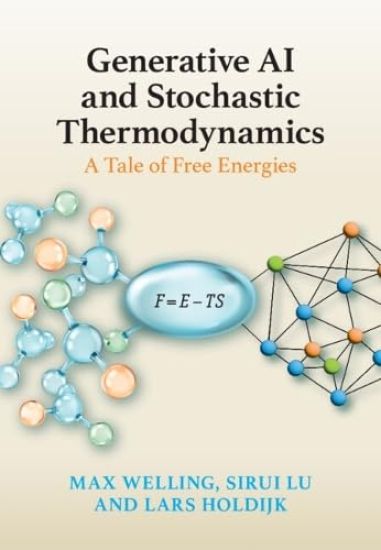
Generative AI and Stochastic Thermodynamics

Generative AI and Stochastic Thermodynamics

Max Welling; Sirui Lu; Lars Holdijk

Cambridge University Press
2026
sidottu
Originating from lectures delivered at the African Institute of Mathematical Sciences, this book presents a unifying perspective on traditional and modern methods in generative AI and stochastic thermodynamics. By relating the core topics in machine learning to the notion of (variational) free-energy, a bridge is built between methods such as latent variable models, variational auto-encoders, optimal control, optimal transport, normalizing flows and diffusion models and concepts such as entropy production and fluctuation theorems in stochastic thermodynamics. Structured into three main parts, the book commences by setting up the required mathematical and statistical physics preliminaries needed to make it broadly accessible. The largest part of the book then focuses on building intuition of major advances in generative AI by considering discrete time processes and their relationship to topics in stochastic thermodynamics. Finally, the authors take a short excursion to the continuous time domain for the more advanced learner.
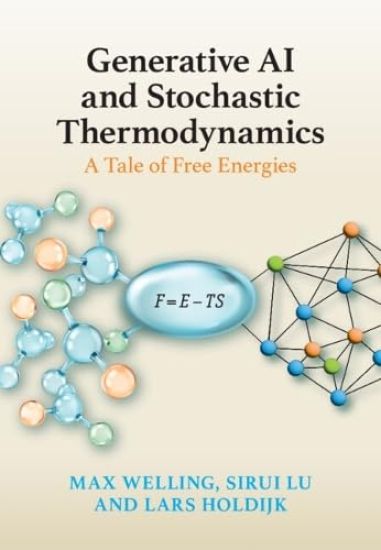
Generative AI and Stochastic Thermodynamics

Generative AI and Stochastic Thermodynamics

Max Welling; Sirui Lu; Lars Holdijk

Cambridge University Press
2026
nidottu
Originating from lectures delivered at the African Institute of Mathematical Sciences, this book presents a unifying perspective on traditional and modern methods in generative AI and stochastic thermodynamics. By relating the core topics in machine learning to the notion of (variational) free-energy, a bridge is built between methods such as latent variable models, variational auto-encoders, optimal control, optimal transport, normalizing flows and diffusion models and concepts such as entropy production and fluctuation theorems in stochastic thermodynamics. Structured into three main parts, the book commences by setting up the required mathematical and statistical physics preliminaries needed to make it broadly accessible. The largest part of the book then focuses on building intuition of major advances in generative AI by considering discrete time processes and their relationship to topics in stochastic thermodynamics. Finally, the authors take a short excursion to the continuous time domain for the more advanced learner.