Kirjojen hintavertailu. Mukana 12 390 323 kirjaa ja 12 kauppaa.

Kirjailija

Lars Oxelheim

Kirjat ja teokset yhdessä paikassa: 7 kirjaa, julkaisuja vuosilta 1990-2020, suosituimpien joukossa The Oxford Handbook of Economic and Institutional Transparency. Vertaile teosten hintoja ja tarkista saatavuus suomalaisista kirjakaupoista.

7 kirjaa

Kirjojen julkaisuhaarukka 1990-2020.

Corporate Foreign Exchange Risk Management

Corporate Foreign Exchange Risk Management

Lars Oxelheim; Alf Alviniussen; Hakan Jankensgard

John Wiley Sons Inc
2020
sidottu
A practical and accessible guide that demystifies ForEx risk for managers in all areas of business Virtually any organisation active in the global economy is impacted by fluctuations in foreign exchange (FX or ForEx) markets. Managers need to understand this increasingly complex issue and measure their firm’s exposure to risk. Corporate Foreign Exchange Risk Management is an in-depth yet accessible guide on effective ForEx exposure management. Designed for professionals responsible for managing a profit & loss or balance sheet influenced by ForEx fluctuations, it enables risk managers to navigate the interconnected worlds of financial management and economics. This innovative guide integrates academic discussion of the economics of risk management decisions and pragmatic advice for various situations in which performance measures affected by accounting standards are paid considerable attention. Readers are provided with the tools and knowledge required to handle a broad range of issues related to ForEx risk management. Clear, non-technical chapters demystify concepts that often appear complicated and confusing to managers. Written by globally-recognised experts in corporate finance, risk management and international business, this book: Employs a reader-friendly narrative style to explain complex conceptsProvides a clear, actionable risk management strategy which can be used in a variety of businessesPlaces all concepts in relatable, real-world contextsExplains important academic research to practitioners in plain EnglishIncludes effective pedagogical tools and explanations, straightforward examples and end-of-chapter summaries which highlight key points Corporate Foreign Exchange Risk Management is a must-read for any manager who deals with corporate exposure to ForEx risk, as well as analysts wishing to better understand the relation between corporate performance and ForEx fluctuations and students of corporate risk management.
The Oxford Handbook of Economic and Institutional Transparency

The Oxford Handbook of Economic and Institutional Transparency

Jens Forssbaeck; Lars Oxelheim

Oxford University Press Inc
2014
sidottu
In recent years, the term 'transparency' has emerged as one of the most popular and keenly-touted concepts around. In the economic-political debate, the principle of transparency is often advocated as a prerequisite for accountability, legitimacy, policy efficiency, and good governance, as well as a universal remedy against corruption, corporate and political scandals, financial crises, and a host of other problems. But transparency is more than a mere catch-phrase. Increased transparency is a bearing ideal behind regulatory reform in many areas, including financial reporting and banking regulation. Individual governments as well as multilateral bodies have launched broad-based initiatives to enhance transparency in both economic and other policy domains. Parallel to these developments, the concept of transparency has seeped its way into academic research in a wide range of social science disciplines, including the economic sciences. This increased importance of transparency in economics and business studies has called for a reference work that surveys existing research on transparency and explores its meaning and significance in different areas. The Oxford Handbook of Economic and Institutional Transparency is such a reference. Comprised of authoritative yet accessible contributions by leading scholars, this Handbook addresses questions such as: What is transparency? What is the rationale for transparency? What are the determinants and the effects of transparency? And is transparency always beneficial, or can it also be detrimental (if so, when)? The chapters are presented in three sections that correspond to three broad themes. The first section addresses transparency in different areas of economic policy. The second section covers institutional transparency and explores the role of transparency in market integration and regulation. Finally, the third section focuses on corporate transparency. Taken together, this volume offers an up-to-date account of existing work on and approaches to transparency in economic research, discusses open questions, and provides guidance for future research, all from a blend of disciplinary perspectives.
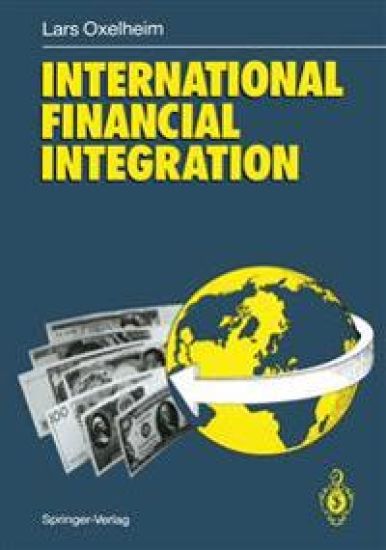
International Financial Integration

International Financial Integration

Lars Oxelheim

Springer-Verlag Berlin and Heidelberg GmbH Co. K
2011
nidottu
There is widespread agreement in the current social and economic debate that the nations of the world are becoming increasingly integrated. Many structural signs in society also suggest that this is so. Integration has become a catchword in the prepara­ tions for the internal market of the EC, and a keynote in the debate about association for the European countries which do not belong to the Community. But when we turn to the question of how this integration should be measured, there is very little con­ sensus. Instead there are numerous problems, not only about how to measure integra­ tion but even about how to define it. In this book I shall discuss the import and implications of a particular type of integration, namely financial integration, and then look at the most important problems connected with measuring it. In the empirical investigation reported below I felt the need for an integrated micro-macro approach. Further, I decided to illustrate the measurement problems by studying a small and relatively open economy where exchange controls have been imposed by the government in an attempt to reduce the flow of interest-sensitive capital out of the country, and thus to acquire autonomy for the national monetary policy. An interview study has been carried out with a view to illustrating among other things how expectations are formed among the major actors on the financial market, and this provided additional input for an analysis of the level of financial integration.
EU och den globala krisen. Europaperspektiv 2010

EU och den globala krisen. Europaperspektiv 2010

Lars Oxelheim; Lars Pehrson

Santérus Förlag
2010
sidottu
Hösten 2008 drabbades världen av den djupaste ekonomiska nedgången sedan 1930-talet. För Europas vidkommande har det inneburit kraftigt inbromsad tillväxt, stigande arbetslöshet och stora underskott i de offentliga finanserna. Regeringar och centralbanker har tvingats ta till drastiska åtgärder för att rädda bank- och finanssektorn från en kollaps. Krisdrabbade industrier, däribland bilindustrin, har fått ta del av massiva statliga stöd­åtgärder. Frågan är vilka konsekvenser krisen har för den fortsatta ­europeiska integrationen. Kommer Europa att gå försvagat eller stärkt ur den globala krisen? Den utmaning som krisen innebär för den Europeiska Unionen ger upphov till en rad frågor: Vilka gemensamma regler bör gälla för statliga stöd­åtgärder? Hur bör regelsystem och tillsyn av banker och finansmarknader utformas? Hur kan medlemsländerna förbättra samordningen av sina ­krisåtgärder? Vilken roll har euron spelat för att mildra effekterna av krisen? Hur kommer Europas roll i den globala ekonomin och politiken att påverkas? Vad kommer att hända med förtroendet för EU bland medborgarna? Dessa är några av de frågor som behandlas i denna bok. Detta är den trettonde årgången av årsboken Europaperspektiv. Här presenteras nio essäer av forskare inom juridik, statskunskap och ekonomiska ­ämnen, som utifrån olika angreppssätt diskuterar hur den Europeiska ­Unionen hanterat den globala krisen och bedömer vilka konsekvenser ­krisen får för marknader, rättssystem, och unionens politiska system. Deltagande författare: Rikard Bengtsson, Tony Johansson, Eleonor Kristoffersson, Jonas Ljungberg, Sophie Nachemson-Ekwall, Thomas Ordeberg, Maria Oskarson, Annina Persson, Helena Svalery, Göran von Sydow, Jonas Vlachos
Corporate Decision-Making with Macroeconomic Uncertainty

Corporate Decision-Making with Macroeconomic Uncertainty

Lars Oxelheim; Clas Wihlborg

Oxford University Press Inc
2008
sidottu
Very few firms make any attempt in their annual reports to inform market participants about the impact of macroeconomic developments on performance. However, the market is not oblivious to this fact, so the firm, as well as financial analysts, need to pay attention. Corporate Decision-Making with Macroeconomic Uncertainty: Performance and Risk Management develops and presents in an easily comprehensible way the essential elements of a corporate strategy for managing uncertainty in the macroeconomic environment. This Macroeconomic Uncertainty Strategy, or MUST, enhances firm value by allowing management and external stakeholders to distinguish between changes in the intrinsic competitiveness of the firm and changes in performance caused by macroeconomic fluctuations. These fluctuations, manifested as changes in exchange rates, interest rates, and inflation rates, are beyond management's control, but they have a substantial impact on performance. The book includes methods to identify the impact of these fluctuations, to develop strategies for macroeconomic risk management, to develop reports to external stakeholders, to evaluate the relative performance of subsidiaries and business units in multinational companies, and to evaluate performance as part of the due diligence process in an M & A context. The authors' use of value-based management, various performance measurements, and the concept of real options makes the book rich and compelling.
Money Markets and Politics

Money Markets and Politics

Jens Forssbaeck; Lars Oxelheim

Edward Elgar Publishing Ltd
2003
sidottu
The dramatic evolution of financial markets in the 1980s and 1990s, accompanied by increasing institutional integration between nations (most notably in the EU), have fostered a widespread belief that governments - particularly those of small economies - have essentially lost the power to pursue sovereign, independent economic policies. At the same time, it is widely assumed that the loss of monetary-policy control is a major opportunity cost for a country adopting a rigid exchange-rate regime or, in the European context, for countries joining the EMU.This book sheds light on these arguments by examining the relationship between the international integration of domestic money markets and the degree of monetary-policy independence in eleven small, open economies in Europe. The authors address these important issues in the context of a broad-based historical analysis of market formation and growth, exchange-rate policies and deregulation. They find that political motives, in conjunction with competitive forces, path dependence and institutional factors, are a major determinant of market development. Moreover, they reveal that credible commitment to a stability goal is a far more reliable predictor of monetary-policy autonomy than the adoption of a specific exchange-rate regime.This accessible investigation of the relationship between domestic money-market development, international financial integration and the monetary-policy options available to small, open economies will be welcomed by students and researchers of macroeconomics, financial economics and political economy. The extensive empirical research and original conclusions will also be of interest and benefit to corporate decisionmakers, bankers, policymakers and regulators.
International Financial Integration

International Financial Integration

Lars Oxelheim

Springer-Verlag Berlin and Heidelberg GmbH Co. K
1990
sidottu
There is widespread agreement in the current social and economic debate that the nations of the world are becoming increasingly integrated. Many structural signs in society also suggest that this is so. Integration has become a catchword in the prepara­ tions for the internal market of the EC, and a keynote in the debate about association for the European countries which do not belong to the Community. But when we turn to the question of how this integration should be measured, there is very little con­ sensus. Instead there are numerous problems, not only about how to measure integra­ tion but even about how to define it. In this book I shall discuss the import and implications of a particular type of integration, namely financial integration, and then look at the most important problems connected with measuring it. In the empirical investigation reported below I felt the need for an integrated micro-macro approach. Further, I decided to illustrate the measurement problems by studying a small and relatively open economy where exchange controls have been imposed by the government in an attempt to reduce the flow of interest-sensitive capital out of the country, and thus to acquire autonomy for the national monetary policy. An interview study has been carried out with a view to illustrating among other things how expectations are formed among the major actors on the financial market, and this provided additional input for an analysis of the level of financial integration.