Kirjojen hintavertailu. Mukana 12 390 323 kirjaa ja 12 kauppaa.

Kirjailija

Lars Peter Hansen

Kirjat ja teokset yhdessä paikassa: 6 kirjaa, julkaisuja vuosilta 2013-2024, suosituimpien joukossa Uncertainty Within Economic Models. Vertaile teosten hintoja ja tarkista saatavuus suomalaisista kirjakaupoista.

6 kirjaa

Kirjojen julkaisuhaarukka 2013-2024.

Rational Expectations Econometrics

Rational Expectations Econometrics

Lars Peter Hansen; Thomas Sargent

TAYLOR FRANCIS LTD
2024
nidottu
At the core of the rational expectations revolution is the insight that economic policy does not operate independently of economic agents' knowledge of that policy and their expectations of the effects of that policy. This means that there are very complicated feedback relationships existing between policy and the behaviour of economic agents, and these relationships pose very difficult problems in econometrics when one tries to exploit the rational expectations insight in formal economic modelling. This volume consists of work by two rational expectations pioneers dealing with the nuts and bolts problems of modelling the complications introduced by rational expectations. Each paper deals with aspects of the problem of making inferences about parameters of a dynamic economic model on the basis of time series observations. Each exploits restrictions on an econometric model imposed by the hypothesis that agents within the model have rational expectations.
Rational Expectations Econometrics

Rational Expectations Econometrics

Lars Peter Hansen; Thomas Sargent

CRC Press
2019
sidottu
At the core of the rational expectations revolution is the insight that economic policy does not operate independently of economic agents' knowledge of that policy and their expectations of the effects of that policy. This means that there are very complicated feedback relationships existing between policy and the behaviour of economic agents, and these relationships pose very difficult problems in econometrics when one tries to exploit the rational expectations insight in formal economic modelling. This volume consists of work by two rational expectations pioneers dealing with the "nuts and bolts" problems of modelling the complications introduced by rational expectations. Each paper deals with aspects of the problem of making inferences about parameters of a dynamic economic model on the basis of time series observations. Each exploits restrictions on an econometric model imposed by the hypothesis that agents within the model have rational expectations.
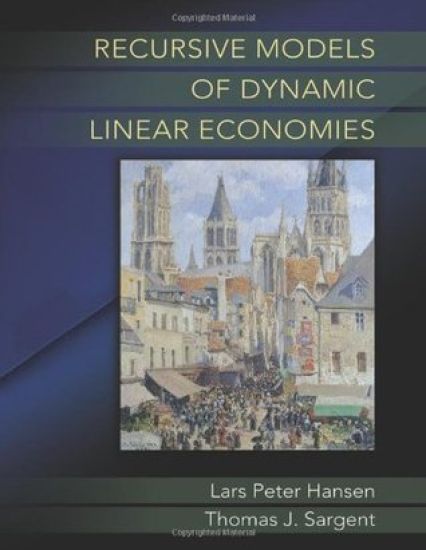
Recursive Models of Dynamic Linear Economies

Recursive Models of Dynamic Linear Economies

Lars Peter Hansen; Thomas J. Sargent

Princeton University Press
2018
pokkari
A guide to the economic modeling of household preferences, from two leaders in the fieldA common set of mathematical tools underlies dynamic optimization, dynamic estimation, and filtering. In Recursive Models of Dynamic Linear Economies, Lars Peter Hansen and Thomas Sargent use these tools to create a class of econometrically tractable models of prices and quantities. They present examples from microeconomics, macroeconomics, and asset pricing. The models are cast in terms of a representative consumer. While Hansen and Sargent demonstrate the analytical benefits acquired when an analysis with a representative consumer is possible, they also characterize the restrictiveness of assumptions under which a representative household justifies a purely aggregative analysis.Hansen and Sargent unite economic theory with a workable econometrics while going beyond and beneath demand and supply curves for dynamic economies. They construct and apply competitive equilibria for a class of linear-quadratic-Gaussian dynamic economies with complete markets. Their book, based on the 2012 Gorman lectures, stresses heterogeneity, aggregation, and how a common structure unites what superficially appear to be diverse applications. An appendix describes MATLAB programs that apply to the book's calculations.
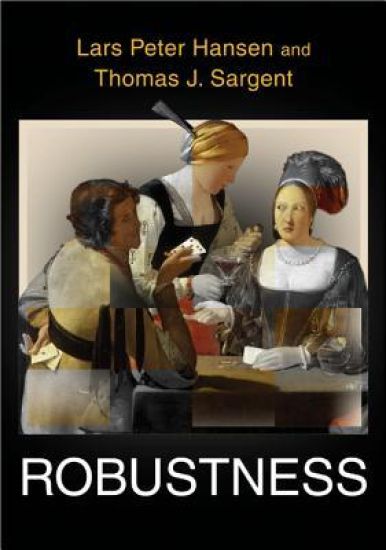
Robustness

Robustness

Lars Peter Hansen; Thomas J. Sargent

Princeton University Press
2016
pokkari
The standard theory of decision making under uncertainty advises the decision maker to form a statistical model linking outcomes to decisions and then to choose the optimal distribution of outcomes. This assumes that the decision maker trusts the model completely. But what should a decision maker do if the model cannot be trusted? Lars Hansen and Thomas Sargent, two leading macroeconomists, push the field forward as they set about answering this question. They adapt robust control techniques and apply them to economics. By using this theory to let decision makers acknowledge misspecification in economic modeling, the authors develop applications to a variety of problems in dynamic macroeconomics. Technical, rigorous, and self-contained, this book will be useful for macroeconomists who seek to improve the robustness of decision-making processes.
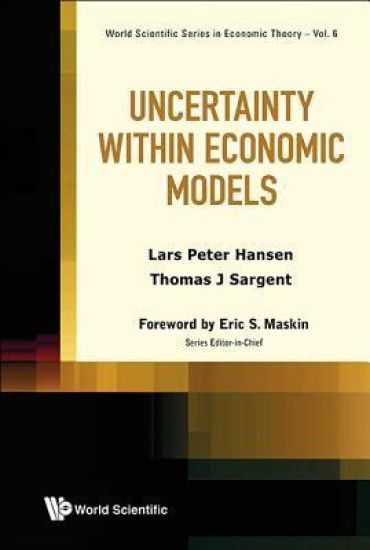
Uncertainty Within Economic Models

Uncertainty Within Economic Models

Lars Peter Hansen; Thomas J Sargent

World Scientific Publishing Co Pte Ltd
2014
sidottu
Written by Lars Peter Hansen (Nobel Laureate in Economics, 2013) and Thomas Sargent (Nobel Laureate in Economics, 2011), Uncertainty within Economic Models includes articles adapting and applying robust control theory to problems in economics and finance. This book extends rational expectations models by including agents who doubt their models and adopt precautionary decisions designed to protect themselves from adverse consequences of model misspecification. This behavior has consequences for what are ordinarily interpreted as market prices of risk, but big parts of which should actually be interpreted as market prices of model uncertainty. The chapters discuss ways of calibrating agents' fears of model misspecification in quantitative contexts.
Recursive Models of Dynamic Linear Economies

Recursive Models of Dynamic Linear Economies

Lars Peter Hansen; Thomas J. Sargent

Princeton University Press
2013
sidottu
A common set of mathematical tools underlies dynamic optimization, dynamic estimation, and filtering. In Recursive Models of Dynamic Linear Economies, Lars Peter Hansen and Thomas Sargent use these tools to create a class of econometrically tractable models of prices and quantities. They present examples from microeconomics, macroeconomics, and asset pricing. The models are cast in terms of a representative consumer. While Hansen and Sargent demonstrate the analytical benefits acquired when an analysis with a representative consumer is possible, they also characterize the restrictiveness of assumptions under which a representative household justifies a purely aggregative analysis. Hansen and Sargent unite economic theory with a workable econometrics while going beyond and beneath demand and supply curves for dynamic economies. They construct and apply competitive equilibria for a class of linear-quadratic-Gaussian dynamic economies with complete markets. Their book, based on the 2012 Gorman lectures, stresses heterogeneity, aggregation, and how a common structure unites what superficially appear to be diverse applications. An appendix describes MATLAB programs that apply to the book's calculations.