Kirjojen hintavertailu. Mukana 12 657 676 kirjaa ja 12 kauppaa.

Kirjailija

Laura Dassow Walls

Kirjat ja teokset yhdessä paikassa: 12 kirjaa, julkaisuja vuosilta 1995-2020, suosituimpien joukossa The Scientists. Vertaile teosten hintoja ja tarkista saatavuus suomalaisista kirjakaupoista.

12 kirjaa

Kirjojen julkaisuhaarukka 1995-2020.

The Scientists

The Scientists

Naomi Pasachoff; Jay Pasachoff; Robert Iliffe; Frank A.J.L. James; Jordi Cat; Patrick Moore; Martin Rudwick; Laura Dassow Walls; Roger McCoy; Michael Hunter; Jean-Pierre Poirier; Alan Rocke; Nathan Brooks; Georgina Ferry; Virendra Singh; Frank Close; Andrew Whitaker; Robert Paradowski

Thames Hudson Ltd
2012
sidottu
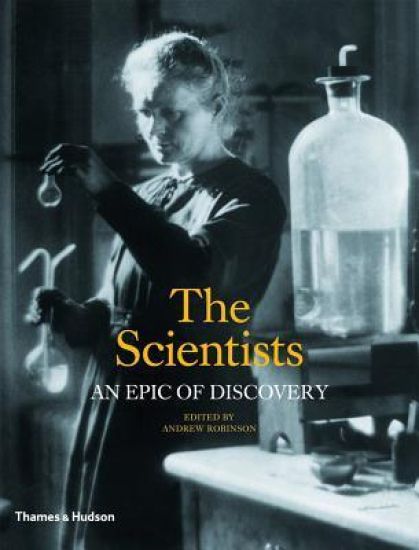
This book tells the remarkable lives of the pioneers of science – from Galileo and Newton, Faraday and Darwin, Pasteur and Marie Curie, to Einstein, Freud, Turing, and Crick and Watson. A series of seventy articles, written by an international team of distinguished scientists, historians of science and science writers, provides an unrivalled account of the lives and personalities behind the greatest scientific breakthroughs of all time. Organized thematically, starting at the ‘Universe’, and moving smaller through the ‘Earth’ and ‘Molecules and Matter’ to ‘Inside the Atom’, with the final two sections looking at ‘Life’ and ‘Body and Mind’, it covers all the major scientific disciplines, including astronomy, biology, biochemistry, chemistry, computing, ecology, geology, medicine, neurology, physics and psychology, as well as mathematics. The Scientists will intrigue budding scientists, those fascinated by the lives of great individuals, and anyone curious to know how over the centuries we came to understand the physical world around us and inside us.
The Daily Henry David Thoreau

The Daily Henry David Thoreau

Henry David Thoreau; Laura Dassow Walls

University of Chicago Press
2020
pokkari
"Live in each season as it passes; breathe the air, drink the drink, taste the fruit, and resign yourself to the influence of each." Modernity rules our lives by clock and calendar, dividing the stream of time into units and coordinating every passing moment with the universal globe. Henry David Thoreau subverted both clock and calendar, using them not to regulate time's passing but to open up and explore its presence. This little volume thus embodies, in small compass, Thoreau's own ambition to "live in season"--to turn with the living sundial of the world, and, by attuning ourselves to nature, to heal our modern sense of discontinuity with our surroundings. Ralph Waldo Emerson noted with awe that from flowers alone, Thoreau could tell the calendar date within two days; children remembered long into adulthood how Thoreau showed them white waterlilies awakening not by the face of a clock but at the first touch of the sun. As Thoreau wrote in Walden, "Time is but the stream I go a-fishing in. I drink at it; but while I drink I see the sandy bottom and detect how shallow it is." Drawn from the full range of Thoreau's journals and published writings, and arranged according to season, The Daily Henry David Thoreau allows us to discover the endless variation and surprise to be found in the repetitions of mundane cycles. Thoreau saw in the kernel of each day an earth enchanted, one he honed into sentences tuned with an artist's eye and a musician's ear. Thoreau's world lives on in his writing so that we too may discover, even in a fallen world, a beauty worth defending.
Henry David Thoreau

Henry David Thoreau

Laura Dassow Walls

University of Chicago Press
2018
pokkari
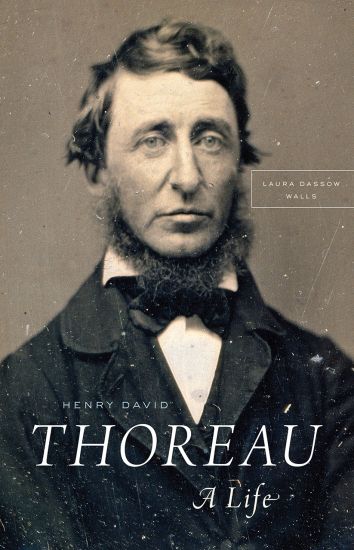
“Walden. Yesterday I came here to live.” That entry from the journal of Henry David Thoreau, and the intellectual journey it began, would by themselves be enough to place Thoreau in the American pantheon. His attempt to “live deliberately” in a small woods at the edge of his hometown of Concord has been a touchstone for individualists and seekers since the publication of Walden in 1854. But there was much more to Thoreau than his brief experiment in living at Walden Pond. A member of the vibrant intellectual circle centered on his neighbor Ralph Waldo Emerson, he was also an ardent naturalist, a manual laborer and inventor, a radical political activist, and more. Many books have taken up various aspects of Thoreau’s character and achievements, but, as Laura Dassow Walls writes, “Thoreau has never been captured between covers; he was too quixotic, mischievous, many-sided.” Two hundred years after his birth, and two generations after the last full-scale biography, Walls restores Henry David Thoreau to us in all his profound, inspiring complexity. Walls traces the full arc of Thoreau’s life, from his early days in the intellectual hothouse of Concord, when the American experiment still felt fresh and precarious, and “America was a family affair, earned by one generation and about to pass to the next.” By the time he died in 1862, at only forty-four years of age, Thoreau had witnessed the transformation of his world from a community of farmers and artisans into a bustling, interconnected commercial nation. What did that portend for the contemplative individual and abundant, wild nature that Thoreau celebrated? Drawing on Thoreau’s copious writings, published and unpublished, Walls presents a Thoreau vigorously alive in all his quirks and contradictions: the young man shattered by the sudden death of his brother; the ambitious Harvard College student; the ecstatic visionary who closed Walden with an account of the regenerative power of the Cosmos. We meet the man whose belief in human freedom and the value of labor made him an uncompromising abolitionist; the solitary walker who found society in nature, but also found his own nature in the society of which he was a deeply interwoven part. And, running through it all, Thoreau the passionate naturalist, who, long before the age of environmentalism, saw tragedy for future generations in the human heedlessness around him. “The Thoreau I sought was not in any book, so I wrote this one,” says Walls. The result is a Thoreau unlike any seen since he walked the streets of Concord, a Thoreau for our time and all time.
Henry David Thoreau

Henry David Thoreau

Laura Dassow Walls

University of Chicago Press
2017
sidottu
Walden. Yesterday I came here to live. That entry from the journal of Henry David Thoreau, and the intellectual journey it began, would by themselves be enough to place Thoreau in the American pantheon. His attempt to "live deliberately" in a small woods at the edge of his hometown of Concord has been a touchstone for individualists and seekers since the publication of Walden in 1854. But there was much more to Thoreau than his brief experiment in living at Walden Pond. A member of the vibrant intellectual circle centered on his neighbor Ralph Waldo Emerson, he was also an ardent naturalist, a manual laborer and inventor, a radical political activist, and more. Many books have taken up various aspects of Thoreau's character and achievements, but, as Laura Dassow Walls writes, "Thoreau has never been captured between covers; he was too quixotic, mischievous, many-sided." Two hundred years after his birth, and two generations after the last full-scale biography, Walls restores Henry David Thoreau to us in all his profound, inspiring complexity. Walls traces the full arc of Thoreau's life, from his early days in the intellectual hothouse of Concord, when the American experiment still felt fresh and precarious, and "America was a family affair, earned by one generation and about to pass to the next." By the time he died in 1862, at only forty-four years of age, Thoreau had witnessed the transformation of his world from a community of farmers and artisans into a bustling, interconnected commercial nation. What did that portend for the contemplative individual and abundant, wild nature that Thoreau celebrated? Drawing on Thoreau's copious writings, published and unpublished, Walls presents a Thoreau vigorously alive in all his quirks and contradictions: the young man shattered by the sudden death of his brother; the ambitious Harvard College student; the ecstatic visionary who closed Walden with an account of the regenerative power of the Cosmos. We meet the man whose belief in human freedom and the value of labor made him an uncompromising abolitionist; the solitary walker who found society in nature, but also found his own nature in the society of which he was a deeply interwoven part. And, running through it all, Thoreau the passionate naturalist, who, long before the age of environmentalism, saw tragedy for future generations in the human heedlessness around him. "The Thoreau I sought was not in any book, so I wrote this one," says Walls. The result is a Thoreau unlike any seen since he walked the streets of Concord, a Thoreau for our time and all time.
Views of Nature

Views of Nature

Alexander Von Humboldt; Stephen T. Jackson; Laura Dassow Walls; Mark W. Person

University of Chicago Press
2016
nidottu
While the influence of Alexander von Humboldt (1769 1859) looms large over the natural sciences, his legacy reaches far beyond the field notebooks of naturalists. Von Humboldt's 1799 1804 research expedition to Central and South America with botanist Aime Bonpland not only set the course for the great scientific surveys of the nineteenth century, but also served as the raw material for his many volumes works of both scientific rigor and aesthetic beauty that inspired such essayists and artists as Emerson, Goethe, Thoreau, Poe, and Frederic Edwin Church. Views of Nature, or Ansichten der Natur, was von Humboldt's best-known and most influential work and his personal favorite. While the essays that comprise it are themselves remarkable as innovative, early pieces of nature writing they were cited by Thoreau as a model for his own work the book's extensive endnotes incorporate some of von Humboldt's most beautiful prose and mature thinking on vegetation structure, its origins in climate patterns, and its implications for the arts. Written for both a literary and a scientific audience, Views of Nature was translated into English (twice), Spanish, and French in the nineteenth century, and it was read widely in Europe and the Americas. But in contrast to many of von Humboldt's more technical works, Views of Nature has been unavailable in English for more than one hundred years. Largely neglected in the United States during the twentieth century, von Humboldt's contributions to the humanities and the sciences are now undergoing a revival to which this new translation will be a critical contribution.
Views of Nature

Views of Nature

Alexander Von Humboldt; Stephen T. Jackson; Laura Dassow Walls; Mark W. Person

University of Chicago Press
2014
sidottu
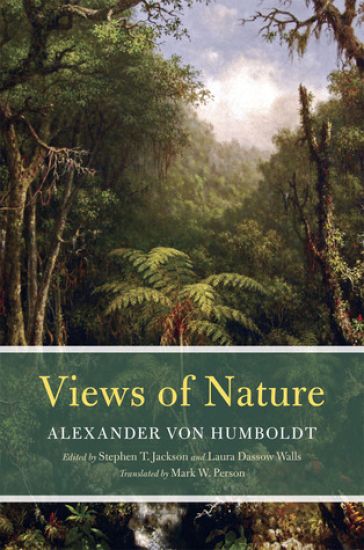
The legacy of Alexander von Humboldt (1769-1859) looms large over the natural sciences. His 1799-1804 research expedition to Central and South America with botanist Aime Bonpland set the course for the great scientific surveys of the nineteenth century and inspired such essayists and artists as Emerson, Goethe, Thoreau, Poe, and Frederic Edwin Church. Views of Nature was von Humboldt's best-known and most influential work - and his personal favorite. While the essays that comprise it are themselves remarkable as innovative, early pieces of nature writing - they were cited by Thoreau as a model for his own work - the book's extensive footnotes incorporate some of von Humboldt's most beautiful prose and mature thinking on vegetation structure, its origins in climate patterns, and its implications for the arts. Written for both a literary and scientific audience, Views of Nature was translated into English (twice), Spanish, and French in the nineteenth century, and it was read widely in Europe and the Americas. But in contrast to many of von Humboldt's more technical works, Views of Nature has been unavailable in English for more than one hundred years. Largely neglected in the United States during the twentieth century, von Humboldt's contributions to the humanities and the sciences are now undergoing a revival to which this new translation will be a critical contribution.
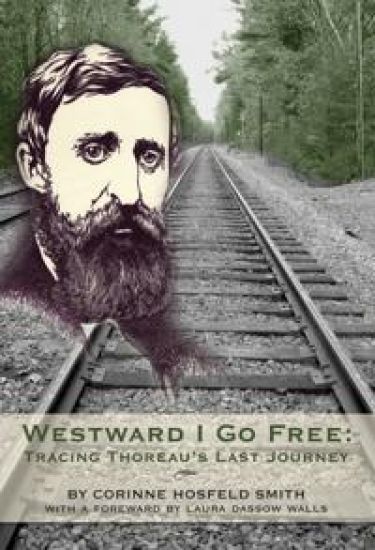
Westward I Go Free

Westward I Go Free

Corinne Hosfeld Smith; Laura Dassow Walls

Green Frigate Books
2012
nidottu
While Henry David Thoreau’s travels to the Maine Woods and Cape Cod were well documented and have been followed by “Thoreauvians” for decades, his 1861 “journey west” with Horace Mann, Jr.—which took the duo from Massachusetts to Minnesota and back—was left to be veiled in mystery. This book details this, the last, longest, and least-known of Thoreau’s excursions. The story of two 19th-century men and the 21st-century woman who was determined to follow their 4,000-mile path, this account will intrigue history buffs as they follow in the footsteps of a popular American writer and naturalist.
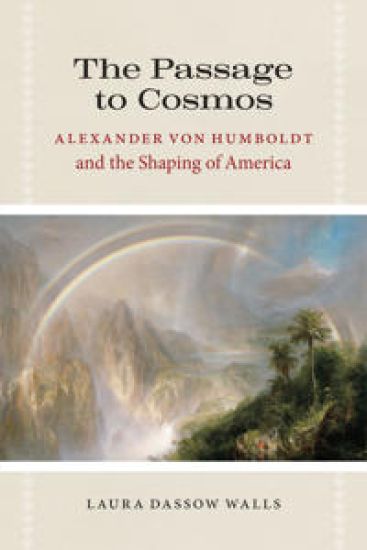
The Passage to Cosmos

The Passage to Cosmos

Laura Dassow Walls

University of Chicago Press
2011
nidottu
Explorer, scientist, writer, and humanist, Alexander von Humboldt was the most famous intellectual of the age that began with Napoleon and ended with Darwin. With "Cosmos", the book that crowned his career, Humboldt offered to the world his vision of humans and nature as integrated halves of a single whole. In it, Humboldt espoused the idea that, while the universe of nature exists apart from human purpose, its beauty and order, the very idea of the whole it composes, are human achievements: cosmos comes into being in the dance of world and mind, subject and object, science and poetry. Laura Dassow Walls here traces Humboldt's ideas for "Cosmos" to his 1799 journey to the Americas, where he first experienced the diversity of nature and of the world's people - and envisioned a new cosmopolitanism that would link ideas, disciplines, and nations into a global web of knowledge and cultures. In reclaiming Humboldt's transcultural and transdisciplinary project, Walls situates America in a lively and contested field of ideas, actions, and interests, and reaches beyond to a new worldview that integrates the natural and social sciences, the arts, and the humanities.
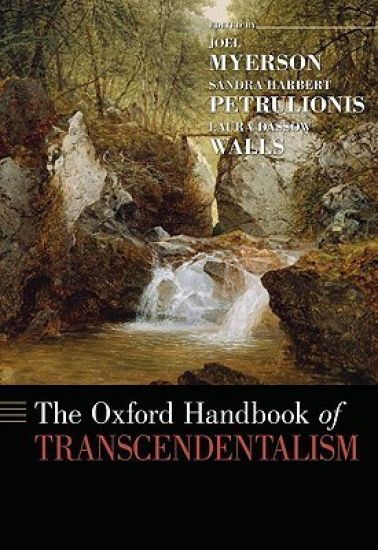
The Oxford Handbook of Transcendentalism

The Oxford Handbook of Transcendentalism

Joel Myerson; Sandra Harbert Petrulionis; Laura Dassow Walls

Oxford University Press Inc
2010
sidottu
The Oxford Handbook of Transcendentalism offers an eclectic, comprehensive interdisciplinary approach to the immense cultural impact of the movement that encompassed literature, art, architecture, science, and politics.
The Passage to Cosmos

The Passage to Cosmos

Laura Dassow Walls

University of Chicago Press
2009
sidottu
Explorer, scientist, writer, and humanist, Alexander von Humboldt was the most famous intellectual of the age that began with Napoleon and ended with Darwin. With "Cosmos", the book that crowned his career, Humboldt offered to the world his vision of humans and nature as integrated halves of a single whole. In it, Humboldt espoused the idea that, while the universe of nature exists apart from human purpose, its beauty and order, the very idea of the whole it composes, are human achievements: cosmos comes into being in the dance of world and mind, subject and object, science and poetry. Laura Dassow Walls here traces Humboldt's ideas for "Cosmos" to his 1799 journey to the Americas, where he first experienced the diversity of nature and of the world's people - and envisioned a new cosmopolitanism that would link ideas, disciplines, and nations into a global web of knowledge and cultures. In reclaiming Humboldt's transcultural and transdisciplinary project, Walls situates America in a lively and contested field of ideas, actions, and interests, and reaches beyond to a new worldview that integrates the natural and social sciences, the arts, and the humanities.
Emerson's Life in Science

Emerson's Life in Science

Laura Dassow Walls

Cornell University Press
2003
sidottu
Ralph Waldo Emerson has traditionally been cast as a dreamer and a mystic, concerned with the ideals of transcendentalism rather than the realities of contemporary science and technology. In Laura Dassow Walls's view Emerson was a leader of the secular avant-garde in his day. He helped to establish science as the popular norm of truth in America and to modernize American popular thought. In addition, he became a hero to a post-Darwinian generation of Victorian Dissenters, exemplifying the strong connection between transcendentalism and later nineteenth-century science. In his early years as a minister, Emerson read widely in natural philosophy (or physics), chemistry, geology, botany, and comparative anatomy. When he left the church, it was to seek the truths written in the book of nature rather than in books of scripture. While visiting the Paris Museum of Natural History during his first European tour, Emerson experienced a revelation so intense that he declared, "I will be a naturalist." Once he was back in the United States, his first step in realizing this ambition was to deliver a series of lectures on natural science. These lectures formed the basis for his first publication, Nature (1836), and his writings ever after reflected his intense and continuing interest in science. Walls finds that Emerson matured just as the concept of "the two cultures" emerged, when the disciplines of literature and science were divorcing each other even as he called repeatedly for their marriage. Consequently, Walls writes, half of Emerson's thought has been invisible to us: science was central to Emerson, to his language, to the basic organization of his career. In Emerson's Life in Science, she makes the case that no study of literary history can be complete without embracing science as part of literature. Conversely, she maintains, no history of science is complete unless we consider the role played by writers of literature who helped to install science in the popular imagination.
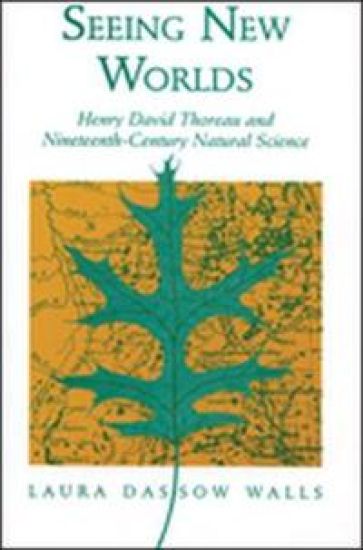
Seeing New Worlds

Seeing New Worlds

Laura Dassow Walls

University of Wisconsin Press
1995
nidottu
Thoreau was a poet, a naturalist, a major American writer. Was he also a scientist? He was, Laura Dassow Walls suggests. Her book, the first to consider Thoreau as a serious and committed scientist, will change the way we understand his accomplishment and the place of science in American culture.Walls reveals that the scientific texts of Thoreau’s day deeply influenced his best work, from Walden to the Journal to the late natural history essays. Here we see how, just when literature and science were splitting into the “two cultures” we know now, Thoreau attempted to heal the growing rift. Walls shows how his commitment to Alexander von Humboldt’s scientific approach resulted in not only his “marriage” of poetry and science but also his distinctively patterned nature studies. In the first critical study of his “The Dispersion of Seeds” since its publication in 1993, she exposes evidence that Thoreau was using Darwinian modes of reasoning years before the appearance of Origin of Species.This book offers a powerful argument against the critical tradition that opposes a dry, mechanistic science to a warm, “organic” Romanticism. Instead, Thoreau’s experience reveals the complex interaction between Romanticism and the dynamic, law-seeking science of its day. Drawing on recent work in the theory and philosophy of science as well as literary history and theory, Seeing New Worlds bridges today’s “two cultures” in hopes of stimulating a fuller consideration of representations of nature.