Kirjojen hintavertailu. Mukana 12 595 353 kirjaa ja 12 kauppaa.

Kirjailija

Laura E. Pérez

Kirjat ja teokset yhdessä paikassa: 5 kirjaa, julkaisuja vuosilta 2007-2023, suosituimpien joukossa Chicana Art. Vertaile teosten hintoja ja tarkista saatavuus suomalaisista kirjakaupoista.

5 kirjaa

Kirjojen julkaisuhaarukka 2007-2023.

Amalia Mesa-Bains

Amalia Mesa-Bains

Laura E. Pérez; Maria Esther Fernández

University of California Press
2023
sidottu
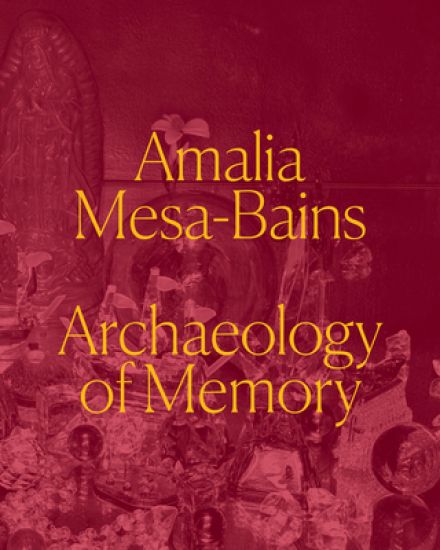
This first major retrospective of Amalia Mesa-Bains unearths her significant contributions to Chicanx/Latinx art and feminism. Best known for her pioneering altar installations, Amalia Mesa-Bains is one of the most innovative feminist and Latinx artists of her generation. In her forty-year career as an artist, activist, educator, and scholar, she has explored the experiences, spiritual practices, and histories of Mexican American women and addressed the colonial erasure and recovery of Mexican, African American, and Indigenous Californians. Appropriately called an "archaeological" practice, Mesa-Bains's art creates sacred spaces imbued with cultural memory, leading viewers on a magical journey of discovery through what might otherwise be lost to existing canons of history.Amalia Mesa-Bains: The Archaeology of Memory is the exhibition catalog accompanying the first major retrospective of her work, bringing her installations from the 1970s to the present together for the first time. Featuring an essay by the artist and an interview with her, the book also brings together top-tier scholars who explore the ecofeminism, migrant histories, spirituality, and politics of erasure that ground her interdisciplinary practice. As a whole, the book cements Mesa-Bains's place as a trailblazing artist within the history of art. Published in association with the Berkeley Art Museum and Pacific Film Archive. Exhibition dates: Berkeley Art Museum and Pacific Film Archive: February 4-August 13, 2023 Phoenix Art Museum: November 2023-March 2024 El Museo del Barrio, New York City: April 2024-August 2024 San Antonio Art Museum: October 2024-January 2025 Cheech Marin Center for Chicano Arts and Culture, Riverside, CA: March 2025-August 2025
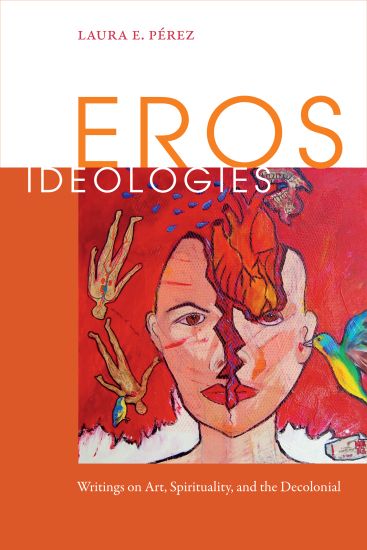
Eros Ideologies

Eros Ideologies

Laura E. Pérez

Duke University Press
2019
pokkari
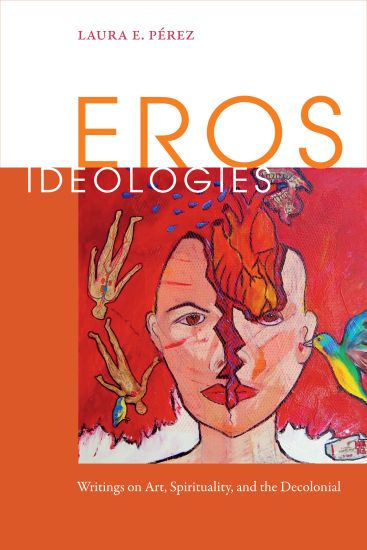
In Eros Ideologies Laura E. PÉrez explores the decolonial through Western and non-Western thought concerning personal and social well-being. Drawing upon Jungian, people-of-color, and spiritual psychology alongside non-Western spiritual philosophies of the interdependence of all life-forms, she writes of the decolonial as an ongoing project rooted in love as an ideology to frame respectful coexistence of social and cultural diversity. In readings of art that includes self-portraits by Frida Kahlo, Ana Mendieta, and Yreina D. CervÁntez, the drawings and paintings of Chilean American artist Liliana Wilson, and Favianna Rodriguez's screen-printed images, PÉrez identifies art as one of the most valuable laboratories for creating, imagining, and experiencing new forms of decolonial thought. Such art expresses what PÉrez calls eros ideologies: understandings of social and natural reality that foreground the centrality of respect and care of self and others as the basis for a more democratic and responsible present and future. Employing a range of writing styles and voices-from the poetic to the scholarly-PÉrez shows how art can point to more just and loving ways of being.
Eros Ideologies

Eros Ideologies

Laura E. Pérez

Duke University Press
2019
sidottu
In Eros Ideologies Laura E. PÉrez explores the decolonial through Western and non-Western thought concerning personal and social well-being. Drawing upon Jungian, people-of-color, and spiritual psychology alongside non-Western spiritual philosophies of the interdependence of all life-forms, she writes of the decolonial as an ongoing project rooted in love as an ideology to frame respectful coexistence of social and cultural diversity. In readings of art that includes self-portraits by Frida Kahlo, Ana Mendieta, and Yreina D. CervÁntez, the drawings and paintings of Chilean American artist Liliana Wilson, and Favianna Rodriguez's screen-printed images, PÉrez identifies art as one of the most valuable laboratories for creating, imagining, and experiencing new forms of decolonial thought. Such art expresses what PÉrez calls eros ideologies: understandings of social and natural reality that foreground the centrality of respect and care of self and others as the basis for a more democratic and responsible present and future. Employing a range of writing styles and voices-from the poetic to the scholarly-PÉrez shows how art can point to more just and loving ways of being.
Chicana Art

Chicana Art

Laura E. Pérez

Duke University Press
2007
sidottu
In Alma Lopez’s digital print Lupe & Sirena in Love (1999), two icons-the Virgin of Guadalupe and the mermaid Sirena, who often appears on Mexican lottery cards-embrace one another, symbolically claiming a place for same-sex desire within Mexican and Chicano/a religious and popular cultures. Ester Hernandez’s 1976 etching Libertad/Liberty depicts a female artist chiseling away at the Statue of Liberty, freeing from within it a regal Mayan woman and, in the process, creating a culturally composite Lady Liberty descended from indigenous and mixed bloodlines. In her painting Coyolxauhqui Last Seen in East Oakland (1993), Irene Perez reimagines as whole the body of the Aztec warrior goddess dismembered in myth. These pieces are part of the dynamic body of work presented in this pioneering, lavishly illustrated study, the first book primarily focused on Chicana visual arts.Creating an invaluable archive, Laura E. PÉrez examines the work of more than forty Chicana artists across a variety of media including painting, printmaking, sculpture, performance, photography, film and video, comics, sound recording, interactive CD-ROM, altars and other installation forms, and fiction, poetry, and plays. While key works from the 1960s and 1970s are discussed, most of the pieces considered were produced between 1985 and 2001. Providing a rich interpretive framework, PÉrez describes how Chicana artists invoke a culturally hybrid spirituality to challenge racism, bigotry, patriarchy, and homophobia. They make use of, and often radically rework, pre-Columbian Mesoamerican and other non-Western notions of art and art-making, and they struggle to create liberating versions of familiar iconography such as the Virgin of Guadalupe and the Sacred Heart. Filled with representations of spirituality and allusions to non-Western visual and cultural traditions, the work of these Chicana artists is a vital contribution to a more inclusive canon of American arts.
Chicana Art

Chicana Art

Laura E. Pérez

Duke University Press
2007
pokkari
In Alma Lopez’s digital print Lupe & Sirena in Love (1999), two icons-the Virgin of Guadalupe and the mermaid Sirena, who often appears on Mexican lottery cards-embrace one another, symbolically claiming a place for same-sex desire within Mexican and Chicano/a religious and popular cultures. Ester Hernandez’s 1976 etching Libertad/Liberty depicts a female artist chiseling away at the Statue of Liberty, freeing from within it a regal Mayan woman and, in the process, creating a culturally composite Lady Liberty descended from indigenous and mixed bloodlines. In her painting Coyolxauhqui Last Seen in East Oakland (1993), Irene Perez reimagines as whole the body of the Aztec warrior goddess dismembered in myth. These pieces are part of the dynamic body of work presented in this pioneering, lavishly illustrated study, the first book primarily focused on Chicana visual arts.Creating an invaluable archive, Laura E. PÉrez examines the work of more than forty Chicana artists across a variety of media including painting, printmaking, sculpture, performance, photography, film and video, comics, sound recording, interactive CD-ROM, altars and other installation forms, and fiction, poetry, and plays. While key works from the 1960s and 1970s are discussed, most of the pieces considered were produced between 1985 and 2001. Providing a rich interpretive framework, PÉrez describes how Chicana artists invoke a culturally hybrid spirituality to challenge racism, bigotry, patriarchy, and homophobia. They make use of, and often radically rework, pre-Columbian Mesoamerican and other non-Western notions of art and art-making, and they struggle to create liberating versions of familiar iconography such as the Virgin of Guadalupe and the Sacred Heart. Filled with representations of spirituality and allusions to non-Western visual and cultural traditions, the work of these Chicana artists is a vital contribution to a more inclusive canon of American arts.