Kirjojen hintavertailu. Mukana 12 595 353 kirjaa ja 12 kauppaa.

Kirjailija

Laurence B Siegel

Kirjat ja teokset yhdessä paikassa: 4 kirjaa, julkaisuja vuosilta 2012-2024, suosituimpien joukossa On Progress and Prosperity. Vertaile teosten hintoja ja tarkista saatavuus suomalaisista kirjakaupoista.

Mukana myös kirjoitusasut: Laurence B. Siegel

4 kirjaa

Kirjojen julkaisuhaarukka 2012-2024.

On Progress and Prosperity

On Progress and Prosperity

Laurence B Siegel; Theodore R Aronson

Montesquieu Press
2024
sidottu
In the last 250 years, the world has gone from poor to rich, sick to healthy, and isolated to connected. How did we get here, and why do some seemingly intractable problems remain? What are the best ways forward? What do the best minds in fields as diverse as economics, social thought, progress studies, and investment management have to say about these questions? In his second book of essays, book reviews, interviews, and other writings, Laurence B. Siegel, author of Fewer, Richer, Greener and Unknown Knowns (to which this book is a sequel), provides a window into some of the greatest minds in these fields, including Steven Pinker, Henry Kissinger, Michael Lewis, Malcolm Gladwell, and Harry Markowitz. Topics include: - Progress, growth, and productivity- Investing and finance- Technology and innovation - Policy and governance, and- Provocative takes on the big questions in economics, investing, human flourishing, and public affairs.Filled with stories, anecdotes, personalities, and vivid graphics, and conveyed with a sense of humor, this book provides refreshing and useful perspectives on the mysteries of economics, investing, and human progress.
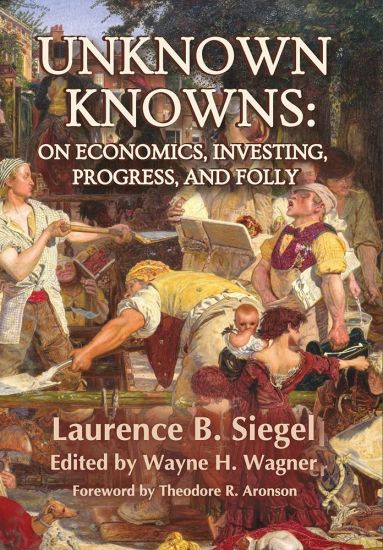
Unknown Knowns

Unknown Knowns

Laurence B Siegel; Theodore R Aronson

Montesquieu Press
2021
sidottu
In the last 250 years the world has gone from poor to rich, sick to healthy, and isolated to connected. We still face many problems, but we are constantly discovering new ways to solve them. Investment returns have also reflected these improvements, and have rewarded patient investors for providing the capital needed to achieve this progress.Yet we seem to have arrived in this place without much of an idea of how we did it, and many are uncertain about whether the future will be worth living in. In Unknown Knowns, Laurence B. Siegel, author of Fewer, Richer, Greener, shows why the future will be even better than the past. In addition, reflecting on his career as an investment manager, Siegel presents practical advice for investors, based on a solid grounding in economics.This book consists of articles, book reviews, and interviews, many written with Siegel's valued co-authors. The book reviews and interviews provide a window into some of the greatest minds in economics and investment management, including Jack Bogle, Mohamed A. El-Erian, Paul Volcker, and Nassim Taleb. The articles unravel some of the greatest mysteries that now confront us, from the retirement and pension crisis to the future of democracy and liberalism.Some of the ground covered includes: Progress, growth, and productivityInvesting and financeSavings and retirementMonetary policy and inflationPolicy and governance, andProvocative takes on the big questions in economics, social science, and human affairs.Filled with stories, anecdotes, personalities, and data, this book provides refreshing and useful perspectives. It can help you grasp some of the wrenching changes of the last decade and anticipate those to come, leading you more deeply into the fields of economics, investing, and progress - all conveyed with a sense of humor and an appreciation for the folly as well as the wisdom that surrounds us.
Fewer, Richer, Greener

Fewer, Richer, Greener

Laurence B. Siegel

John Wiley Sons Inc
2020
sidottu
How the world has become much better and why optimism is abundantly justified Why do so many people fear the future? Is their concern justified, or can we look forward to greater wealth and continued improvement in the way we live? Our world seems to be experiencing stagnant economic growth, climatic deterioration, dwindling natural resources, and an unsustainable level of population growth. The world is doomed, they argue, and there are just too many problems to overcome. But is this really the case? In Fewer, Richer, Greener, author Laurence B. Siegel reveals that the world has improved—and will continue to improve—in almost every dimension imaginable. This practical yet lighthearted book makes a convincing case for having gratitude for today’s world and optimism about the bountiful world of tomorrow. Life has actually improved tremendously. We live in the safest, most prosperous time in all human history. Whatever the metric—food, health, longevity, education, conflict—it is demonstrably true that right now is the best time to be alive. The recent, dramatic slowing in global population growth continues to spread prosperity from the developed to the developing world. Technology is helping billions of people rise above levels of mere subsistence. This technology of prosperity is cumulative and rapidly improving: we use it to solve problems in ways that would have be unimaginable only a few decades ago. An optimistic antidote for pessimism and fear, this book: Helps to restore and reinforce our faith in the futureDocuments and explains how global changes impact our present and influence our futureDiscusses the costs and unforeseen consequences of some of the changes occurring in the modern worldOffers engaging narrative, accurate data and research, and an in-depth look at the best books on the topic by leading thinkersTraces the history of economic progress and explores its consequences for human life around the world Fewer, Richer, Greener: Prospects for Humanity in an Age of Abundance is a must-read for anyone who wishes to regain hope for the present and wants to build a better future.
Frontiers of Modern Asset Allocation

Frontiers of Modern Asset Allocation

Laurence B. Siegel

John Wiley Sons Inc
2012
sidottu
Innovative approaches to putting asset allocation into practice Building on more than 15 years of asset-allocation research, Paul D. Kaplan, who led the development of the methodologies behind the Morningstar Rating(TM) and the Morningstar Style Box(TM), tackles key challenges investor professionals face when putting asset-allocation theory into practice. This book addresses common issues such as: How should asset classes be defined?Should equities be divided into asset classes based on investment style, geography, or other factors?Should asset classes be represented by market-cap-weighted indexes or should other principles, such as fundamental weights, be used?How do actively managed funds fit into asset-class mixes? Kaplan also interviews industry luminaries who have greatly influenced the evolution of asset allocation, including Harry Markowitz, Roger Ibbotson, and the late Benoit Mandelbrot. Throughout the book, Kaplan explains allocation theory, creates new strategies, and corrects common misconceptions, offering original insights and analysis. He includes three appendices that put theory into action with technical details for new asset-allocation frameworks, including the next generation of portfolio construction tools, which Kaplan dubs "Markowitz 2.0."