Kirjojen hintavertailu. Mukana 12 363 183 kirjaa ja 12 kauppaa.

Kirjailija

Laurence Prusak

Kirjat ja teokset yhdessä paikassa: 9 kirjaa, julkaisuja vuosilta 1997-2023, suosituimpien joukossa The Smart Mission. Vertaile teosten hintoja ja tarkista saatavuus suomalaisista kirjakaupoista.

9 kirjaa

Kirjojen julkaisuhaarukka 1997-2023.

The Smart Mission

The Smart Mission

Edward J. Hoffman; Matthew Kohut; Laurence Prusak

MIT PRESS LTD
2023
pokkari
Why human skills and expertise, not technical tools, are what make projects succeed.The project is the basic unit of work in many industries. Software applications, antiviral vaccines, launch-ready spacecraft: all were produced by a team and managed as a project. Project management emphasizes control, processes, and tools—but, according to The Smart Mission, that is not the right way to run a project. Human skills and expertise, not technical tools, are what make projects successful. Projects run on knowledge. This paradigm-shifting book—by three project management experts, all of whom have decades of experience at NASA and elsewhere—challenges the conventional wisdom on project management, focusing on the human dimension: learning, collaboration, teaming, communication, and culture.The authors emphasize three themes: projects are fundamentally about how teams work and learn together to get things done; the local level—not an organization’s upper levels—is where the action happens; and projects don’t operate in a vacuum but exist within organizations that are responsible to stakeholders. Drawing on examples and case studies from NASA and other organizations, the authors identify three project models—micro, macro, and global—and their different knowledge needs. Successful organizations have a knowledge-based culture. Successful project management guides the interplay of knowledge, projects, and people.
Knowledge in Organisations

Knowledge in Organisations

Laurence Prusak

Routledge
2016
sidottu
First Published in 1997. The second in the readers' series, Resources for the Knowledge-Based Economy, Knowledge In Organisations gives an overview of how knowledge is valued and used in organisations. It gives readers excellent grounding in how best to understand the highest valued asset they have in their organisations.
Storytelling in Organizations

Storytelling in Organizations

Laurence Prusak; Katalina Groh; Stephen Denning; John Seely Brown

Routledge
2016
sidottu
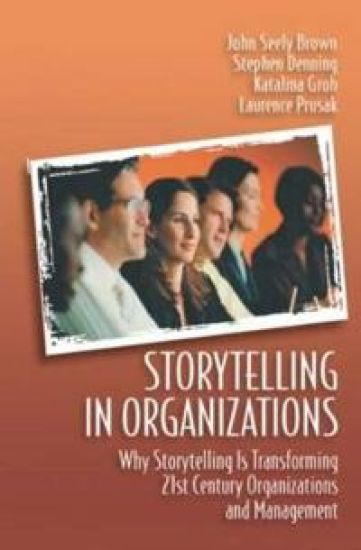
This book is the story of how four busy executives, from different backgrounds and different perspectives, were surprised to find themselves converging on the idea of narrative as an extraordinarily valuable lens for understanding and managing organizations in the twenty-first century. The idea that narrative and storytelling could be so powerful a tool in the world of organizations was initially counter-intuitive. But in their own words, John Seely Brown, Steve Denning, Katalina Groh, and Larry Prusak describe how they came to see the power of narrative and storytelling in their own experience working on knowledge management, change management, and innovation strategies in organizations such as Xerox, the World Bank, and IBM. Storytelling in Organizations lays out for the first time why narrative and storytelling should be part of the mainstream of organizational and management thinking. This case has not been made before. The tone of the book is also unique. The engagingly personal and idiosyncratic tone comes from a set of presentations made at a Smithsonian symposium on storytelling in April 2001. Reading it is as stimulating as spending an evening with Larry Prusak or John Seely Brown. The prose is probing, playful, provocative, insightful and sometime profound. It combines the liveliness and freshness of spoken English with the legibility of a ready-friendly text. Interviews will all the authors done in 2004 add a new dimension to the material, allowing the authors to reflect on their ideas and clarify points or highlight ideas that may have changed or deepened over time.
Storytelling in Organizations

Storytelling in Organizations

Laurence Prusak; Katalina Groh; Stephen Denning; John Seely Brown

Butterworth-Heinemann Ltd
2004
nidottu
This book is the story of how four busy executives, from different backgrounds and perspectives, were surprised to find themselves converging on the idea of narrative as a valuable lens for understanding and managing organizations. The authors describe the power of narrative and storytelling in their own experience working on knowledge management, change management, and innovation strategies in organizations such as Xerox, the World Bank, and IBM. Storytelling in Organizations lays out for the first time why narrative and storytelling should be part of the mainstream of organizational and management thinking.
What's the Big Idea

What's the Big Idea

Thomas H. Davenport; Laurence Prusak; H. James Wilson

Harvard Business Review Press
2003
sidottu
This work shows how to bring the best new management thinking into an organization and turn it into results. It includes stories and real data collected from a study of 100 "idea practitioners".
In Good Company

In Good Company

Don Cohen; Laurence Prusak

Harvard Business Review Press
2001
sidottu
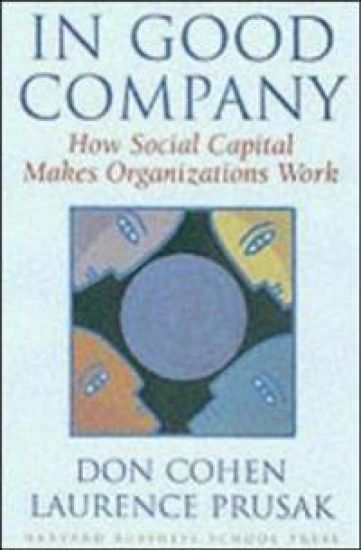
Knowledge has always resided in organizations - but it wasn't until the Information Age put a premium on ideas that intellectual capital was recognized as a critical resource. Now, forces like technology, globalization, and the rise of free agency and virtual workplaces are bringing another form of 'hidden' capital to the forefront. "In Good Company" is the first book to examine the role that social capital - a company's 'stock' of human connections such as trust, personal networks, and a sense of community - plays in thriving organizations. Written by leading knowledge management experts Don Cohen and Laurence Prusak, this groundbreaking book argues that social capital is so integral to business life that without it, cooperative action - and consequently productive work - isn't possible. The authors help today's leaders understand the nature and value of social capital, suggest ways they can encourage and enhance it, and explore how they can protect this vital but increasingly vulnerable resource in a volatile, virtual world.Drawing on major social and economic theories, and the experiences of organizations including the World Bank, Aventis Pharma, Alcoa, Russell Reynolds, and UPS, "In Good Company" identifies the social elements that contribute to knowledge sharing, innovation, and high productivity. The authors convincingly show how almost every managerial decision-from hiring, firing, and promotion to implementing new technologies to designing office space - is an opportunity for social capital investment or loss. They also reveal the benefits that derive from investments in social capital, such as greater commitment and cooperation, increased talent retention, and more intelligent responses to customer needs. A landmark book on the critical role that relationships play in organizational success, "In Good Company" helps employees at all levels recognize the power of social capital to help people work better, and make organizations better places to work. Don Cohen is a writer, consultant, and the editor of "Knowledge Directions". Laurence Prusak is Executive Director of the IBM Institute for Knowledge Management and co-author of "Working Knowledge: How Organizations Manage What They Know".
Working Knowledge

Working Knowledge

Thomas H. Davenport; Laurence Prusak

Harvard Business Review Press
2000
pokkari
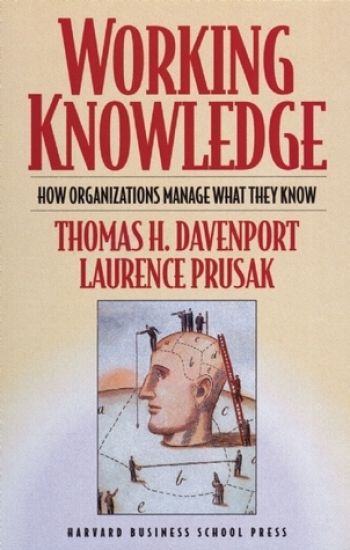
This influential book establishes the enduring vocabulary and concepts in the burgeoning field of knowledge management. It serves as the hands-on resource of choice for companies that recognize knowledge as the only sustainable source of competitive advantage going forward. Drawing from their work with more than thirty knowledge-rich firms, Davenport and Prusak--experienced consultants with a track record of success--examine how all types of companies can effectively understand, analyze, measure, and manage their intellectual assets, turning corporate wisdom into market value. They categorize knowledge work into four sequential activities--accessing, generating, embedding, and transferring--and look at the key skills, techniques, and processes of each. While they present a practical approach to cataloging and storing knowledge so that employees can easily leverage it throughout the firm, the authors caution readers on the limits of communications and information technology in managing intellectual capital.
Working Knowledge

Working Knowledge

Thomas H. Davenport; Laurence Prusak

Harvard Business Review Press
1998
sidottu
The definitive primer on knowledge management, this book will establish the enduring vocabulary and concepts and serve as the hands-on resource of choice for fast companies that recognize knowledge as the only sustainable source of competitive advantage. Drawing on their work with more than 30 knowledge-rich firms, the authors - experienced consultants with a track record of success-examine how all types of companies can effectively understand, analyze, measure, and manage their intellectual assets, turning corporate knowledge into market value. They consider such questions as: What key cultural and behavioral issues must managers address to use knowledge effectively? What are the best ways to incorporate technology into knowledge work? What does a successful knowledge project look like - and how do you know when it has succeeded? In the end, say the authors, the human qualities of knowledge - experience, intuition, and beliefs - are the most valuable and the most difficult to manage. Applying the insights of "Working Knowledge" is every manager's first step on that rewarding road to long-term success.