Kirjojen hintavertailu. Mukana 12 657 676 kirjaa ja 12 kauppaa.

Kirjailija

Laurie Cohen

Kirjat ja teokset yhdessä paikassa: 13 kirjaa, julkaisuja vuosilta 2003-2025, suosituimpien joukossa Countryside. Vertaile teosten hintoja ja tarkista saatavuus suomalaisista kirjakaupoista.

13 kirjaa

Kirjojen julkaisuhaarukka 2003-2025.

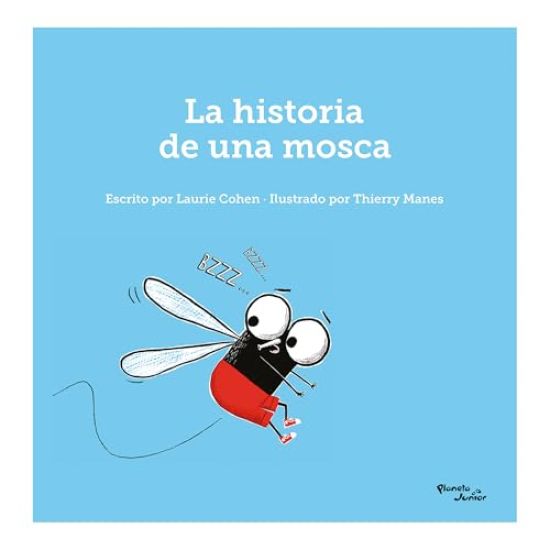
La Historia de Una Mosca / The Story of a Fly

La Historia de Una Mosca / The Story of a Fly

Laurie Cohen

Planeta Publishing
2025
sidottu
Una mosca sin alas, pero con grandes sue os. Porque volar no siempre requiere alas.Una mosca sin alas nos ense a que, con creatividad y determinaci n, podemos superar cualquier obst culo. Una historia llena de ingenio y diversi n Una gran aventura puede dar comienzo cuando una mosca se queda sin su posesi n m s preciada: sus alas Ahora, qu puede hacer sin ellas? ENGLISH DESCRIPTIONA wingless fly, yet full of big dreams. Because flying doesn't always require wings.A wingless fly teaches us that, with creativity and determination, we can overcome any obstacle. A story filled with ingenuity and fun A great adventure begins when a fly loses its most treasured possession--its wings Now, what can it do without them?
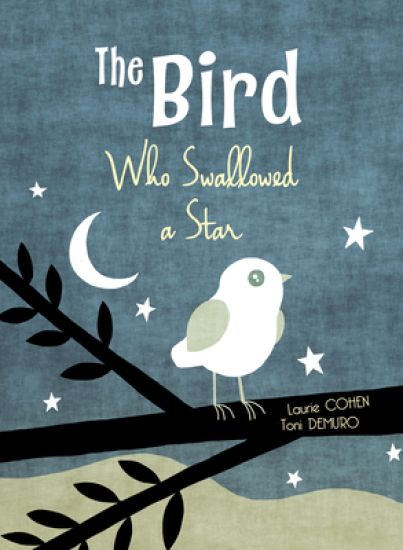
The Bird Who Swallowed a Star

The Bird Who Swallowed a Star

Laurie Cohen

Schiffer Publishing Ltd
2021
sidottu
The sadness of one little bird who shines bright is captured in the form of a tale that tackles the theme of exclusion and difference. One night, a bird swallows a star, making him as bright as a diamond. Because of that, nobody wants him around. Except an amazing traveler who crosses the vast desert. Discover how one little bird, who is excluded by all of his fellow animals for being different, is able to find solace and friendship after shedding a few glittering tears. The text plays on repetition to help build confidence in emerging readers, and the wonder of what follows and the open ending encourage everyone to let their imaginations shine.
Imagining Women's Careers

Imagining Women's Careers

Laurie Cohen

Oxford University Press
2014
sidottu
It is over twenty years since scholars began to question the adequacy of the extant career theory for illuminating women's lives. Since then the literature has developed apace. This book contributes to these on-going debates. This book is about women's careers, how they think about and enact their working lives, and how these patterns change, or stay the same, over time. It focuses on seventeen women, based in the same northern English city, working in a variety of occupations, who left their organizational positions to set up their own businesses. In the early 90s they participated in a research study of this career transition, and a decade and a half later were interviewed for a second time. Imagining Women's Careers is based on these accounts. It investigates the women's transition to self-employment and on-going career development; contextual change between the two periods and why, in career terms, this mattered; their experiences of late career and retirement; and the role of others in their career-making. The concept of the career imagination is introduced, defining and delimiting what is possible, legitimate and appropriate in career terms, and prescribing its own criteria for success. In part, the book is about change: women moving from young to middle, or middle to old age; society moving out of and back into recession; an academic literature which has deconstructed and redefined the concept of career itself. However it is also about continuity: enduring relationships, commitments to people and places, deeply held values and identities.
ASHE Reader Series: Economics and Finance of Higher Education

ASHE Reader Series: Economics and Finance of Higher Education

John Weidman; John Yeager; Laurie Cohen

Pearson Learning Solutions
2014
nidottu
Since the publication of the 2nd Edition of this Reader in 2001, there has been a large increase in the amount of research and scholarly publication on issues of higher education finance. This is not surprising, given the pattern of decreased public funding and increased student cost over this period. Strategic planning and its relationship to budgeting under growing financial constraints have been of continuing interest among both higher education scholars and practitioners. What has changed, however, is the greater inclusion of explicitly economic perspectives in publications dealing with various aspects of postsecondary education. Because of these changing publication patterns, it was appropriate to add the word "Economics" to the title of this edition. Inside you'll find a mix of scholarly and practitioner-oriented publications, as well as thoughtful scholar-written section introductions that bring the reader up to date on the current issues.
Smolensk under the Nazis

Smolensk under the Nazis

Laurie Cohen

University of Rochester Press
2013
sidottu
Drawing on oral-history interviews and other sources, this work provides fascinating accounts of how Soviets, Jews, and Roma fared in the Russian city of Smolensk under the 26-month Nazi occupation. The 1941 German invasion of the Soviet Union ("Operation Barbarossa") significantly altered the lives of the civilians in occupied Russian territories, yet these individuals' stories are overlooked by most scholarly treatments ofthe attack and its aftermath. This study, drawing on oral-history interviews and a broad range of archival sources, provides a fascinating and detailed account of the everyday life of Soviets, Jews, Roma, and Germans in the city of Smolensk during its twenty-six months under Nazi rule. Smolensk under the Nazis records the profound and painful effects of the invasion and occupation on the 30,000 civilian residents (out of a prewar population ofroughly 155,000) who remained in this border town. It also compares Nazi and Stalinist local propaganda efforts, as well as examining the stance of Russian civilians, thereby investigating what it meant to support -- or hinder --the new Nazi-German and collaborating Russian authorities. By underlining the human dimensions of the war and its often neglected long-term effects, Laurie Cohen promotes a more complex understanding of life under occupation. Smolensk under the Nazis thus complements recent works on everyday life in occupied Ukraine, Belarus, and the Baltic States as well as on the siege of Leningrad. Laurie R. Cohen is Adjunct Professor at the Universities of Innsbruck and Klagenfurt.
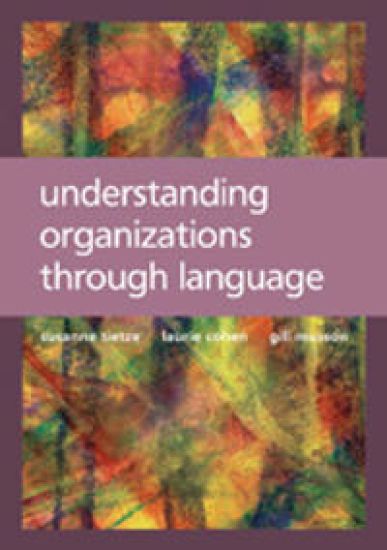
Understanding Organizations through Language

Understanding Organizations through Language

Susanne Tietze; Laurie Cohen; Gillian Musson

SAGE Publications Inc
2003
sidottu
`Makes fascinating reading and at the same time provides a good grounding in the study of the language of organizations, both for those who know little of the area and for those who are looking for a comprehensive overview of the field. Overall I would warmly recommend this book as an asset for students and teachers of organizational behaviour and for those with a general interest in the way in which language shapes our lives and work' - Organization Studies `The book is extremely clear in its explanation of how language works.... The authors treat their readers as curious, intelligent and concerned to find new and powerful tools to come at the workings of organizations from a lateral and newly illuminating perspective' - Virginia Valentine, Semiotic Solutions, London `The authors are able to apply their personal fascination with language to give students insights into organisational behaviour that significantly surpasses what is normally achieved by the tired old rituals of standard organizational behaviour texts and teaching' - Tony Watson, Nottingham Trent University Taking issue with functional approaches to communication, Understanding Organizations through Language offers a viable alternative based on `webs of meaning'. Instead of viewing communication as a thing that can be unproblematically controlled and managed, the authors use semiology as a theoretical bedrock to develop a new metaphor for communication. Understanding Organizations through Language applies this approach to areas of interest, including: metaphor, story-telling, discourse, gender, leadership and electronic communication. Spanning the gap between highly theoretical organization studies texts and highly prescriptive communication texts, the book talks to the reader in a sophisticated yet approachable style. This style is complemented by a range of examples, activities and mini case studies. Also included are chapter summaries and further reading suggestions, making this a useful text for both academics and students. Advanced undergraduates and postgraduates will utilize this book for any course dealing with communication, particularly courses in HRM and organizational behaviour.
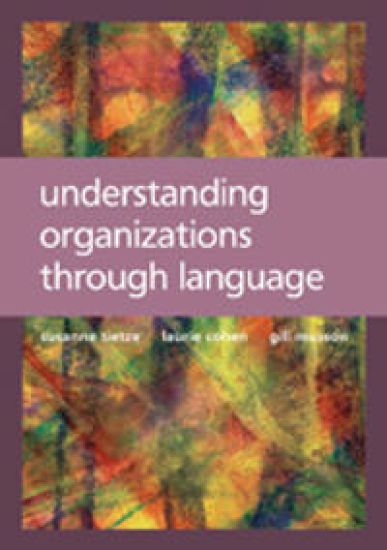
Understanding Organizations through Language

Understanding Organizations through Language

Susanne Tietze; Laurie Cohen; Gillian Musson

SAGE Publications Inc
2003
nidottu
`Makes fascinating reading and at the same time provides a good grounding in the study of the language of organizations, both for those who know little of the area and for those who are looking for a comprehensive overview of the field. Overall I would warmly recommend this book as an asset for students and teachers of organizational behaviour and for those with a general interest in the way in which language shapes our lives and work' - Organization Studies `The book is extremely clear in its explanation of how language works.... The authors treat their readers as curious, intelligent and concerned to find new and powerful tools to come at the workings of organizations from a lateral and newly illuminating perspective' - Virginia Valentine, Semiotic Solutions, London `The authors are able to apply their personal fascination with language to give students insights into organisational behaviour that significantly surpasses what is normally achieved by the tired old rituals of standard organizational behaviour texts and teaching' - Tony Watson, Nottingham Trent University Taking issue with functional approaches to communication, Understanding Organizations through Language offers a viable alternative based on `webs of meaning'. Instead of viewing communication as a thing that can be unproblematically controlled and managed, the authors use semiology as a theoretical bedrock to develop a new metaphor for communication. Understanding Organizations through Language applies this approach to areas of interest, including: metaphor, story-telling, discourse, gender, leadership and electronic communication. Spanning the gap between highly theoretical organization studies texts and highly prescriptive communication texts, the book talks to the reader in a sophisticated yet approachable style. This style is complemented by a range of examples, activities and mini case studies. Also included are chapter summaries and further reading suggestions, making this a useful text for both academics and students. Advanced undergraduates and postgraduates will utilize this book for any course dealing with communication, particularly courses in HRM and organizational behaviour.