Kirjojen hintavertailu. Mukana 12 160 808 kirjaa ja 12 kauppaa.

Kirjailija

Lawrence Kramer

Kirjat ja teokset yhdessä paikassa: 24 kirjaa, julkaisuja vuosilta 1993-2026, suosituimpien joukossa Experience. Vertaile teosten hintoja ja tarkista saatavuus suomalaisista kirjakaupoista.

24 kirjaa

Kirjojen julkaisuhaarukka 1993-2026.

Franz Schubert

Franz Schubert

Lawrence Kramer

Cambridge University Press
2003
pokkari
This is the first book to examine Schubert’s songs as active shaping forces in the culture of their era rather than as mere reflections of it. Responding to rising new forms of social organisation, Schubert discovered that songs could serve as a medium for shuffling and reshuffling the basic building blocks of identity and desire, especially sexual desire. His songs project a kaleidoscopic array of unexpected human types, all of whom are eligible for a sympathetic response, even the strangest and most disconcerting. Schubert sought to validate these subjective types without subordinating them to a central social or sexual norm. The book describes and contextualises this process and tracks it concretely in a wide variety of songs. Combining close attention to both music and poetry, the book addresses both specialists and non-specialists in a lively, accessible style unburdened by excessive jargon.
After the Lovedeath

After the Lovedeath

Lawrence Kramer

University of California Press
2000
pokkari
This elegantly written book is a bold attempt to reinterpret the nature of sexual violence and to imagine the possibility of overcoming it. Lawrence Kramer traces today's sexual identities to their nineteenth-century sources, drawing on the music, literature, and thought of the period to show how normal identity both promotes and rationalizes violence against women. To make his case, Kramer uses operatic lovedeaths, Beethoven's 'Kreutzer Sonata' and the Tolstoy novella named after it; the writings of Walt Whitman and Alfred Lord Tennyson, psychoanalysis, and the logic of dreams. In formal and informal reflections, he explores the self-contradictions of masculinity, the shifting alignments of femininity, authority, and desire, and the interdependency of hetero- and homosexuality. At the same time, he imagines alternatives that could allow gender to be freed from the existing system of polarities that inevitably promote sexual violence. Kramer's writing avoids the conventional dress of intellectual authority and moves between music and literature in a style that is both intimate and effective. He combines informed scholarship with candid personal utterance and makes clear what is at stake in this crucial debate. "After the Lovedeath" will have a profound impact on anyone interested in new ways to think about gender.
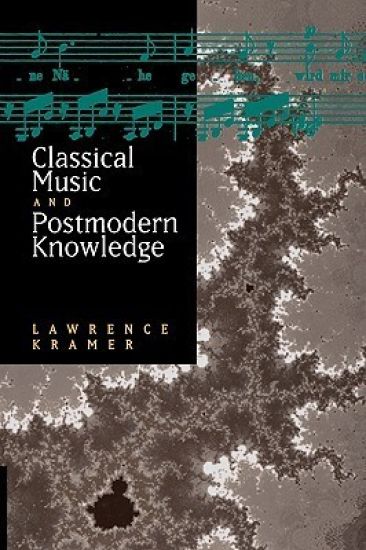
Classical Music and Postmodern Knowledge

Classical Music and Postmodern Knowledge

Lawrence Kramer

University of California Press
1996
pokkari
A leading cultural theorist and musicologist opens up new possibilities for understanding mainstream Western art music--the "classical" music composed between the eighteenth and early twentieth centuries that is, for many, losing both its prestige and its appeal. When this music is regarded esoterically, removed from real-world interests, it increasingly sounds more evasive than transcendent. Now Lawrence Kramer shows how classical music can take on new meaning and new life when approached from postmodernist standpoints. Kramer draws out the musical implications of contemporary efforts to understand reason, language, and subjectivity in relation to concrete human activities rather than to universal principles. Extending the rethinking of musical expression begun in his earlier Music as Cultural Practice, he regards music not only as an object that invites aesthetic reception but also as an activity that vitally shapes the personal, social, and cultural identities of its listeners. In language accessible to nonspecialists but informative to specialists, Kramer provides an original account of the postmodernist ethos, explains its relationship to music, and explores that relationship in a series of case studies ranging from Haydn and Mendelssohn to Ives and Ravel.
Music as Cultural Practice, 1800-1900

Music as Cultural Practice, 1800-1900

Lawrence Kramer

University of California Press
1993
pokkari
In Music as Cultural Practice, Lawrence Kramer adapts the resources of contemporary literary theory to forge a genuinely new discourse about music. Rethinking fundamental questions of meaning and expression, he demonstrates how European music of the nineteenth century collaborates on equal terms with textual and sociocultural practices in the constitution of self and society. In Kramer's analysis, compositional processes usually understood in formal or emotive terms reappear as active forces in the work of cultural formation. Thus Beethoven's last piano sonata, Op. 111, forms both a realization and a critique of Romantic utopianism; Liszt's Faust Symphony takes bourgeois gender ideology into a troubled embrace; Wagner's Tristan und Isolde articulates a basic change in the cultural construction of sexuality. Through such readings, Kramer works toward the larger conclusion that nineteenth-century European music is concerned as much to challenge as to exemplify an ideology of organic unity and subjective wholeness. Anyone interested in music, literary criticism, or nineteenth-century culture will find this book pertinent and provocative.