Kirjojen hintavertailu. Mukana 12 390 323 kirjaa ja 12 kauppaa.

Kirjailija

Lawrence L. Langer

Kirjat ja teokset yhdessä paikassa: 9 kirjaa, julkaisuja vuosilta 1977-2022, suosituimpien joukossa The Afterdeath of the Holocaust. Vertaile teosten hintoja ja tarkista saatavuus suomalaisista kirjakaupoista.

9 kirjaa

Kirjojen julkaisuhaarukka 1977-2022.

Hierarchy and Mutuality in Paradise Lost, Moby-Dick and The Brothers Karamazov
The three works considered in Hierarchy and Mutuality in Paradise Lost, Moby-Dick and The Brothers Karamazov display a striking overlap in their concern with hierarchy and mutuality as parallel and often intersecting way of how human beings relate to each other and to divine forces in the universe. All three contain adversarial protagonists whose stature often commands admiration from audiences less ready to confront their motives and deeds than to be swayed by their verbal harangues. Why the quest for personal power should disturb the serenity of mutual love with such compelling force is an issue that Milton, Melville and Dostoevsky address with varying degrees of self-consciousness. In their texts the seeds of disaster seem to sprout in both spiritual and barren soil, sometimes nurtured by a hierarchy that gave them birth, at others in reaction against a hierarchy that would stifle their energy. The purpose of this study is to analyze the origins and the consequences of such tensions.
The Afterdeath of the Holocaust

The Afterdeath of the Holocaust

Lawrence L. Langer

Springer Nature Switzerland AG
2022
nidottu
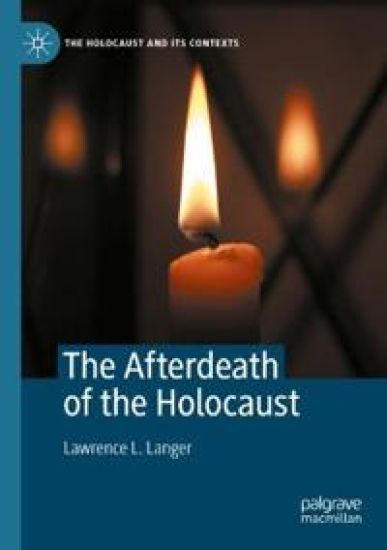
This book consists of ten essays that examine the ways in which language has been used to evoke what Lawrence L. Langer calls the ‘deathscape’ and the ‘hopescape’ of the Holocaust. The chapters in this collection probe the diverse impacts that site visits, memoirs, survivor testimonies, psychological studies, literature and art have on our response to the atrocities committed by the Germans during World War II. Langer also considers the misunderstandings caused by erroneous, embellished and sentimental accounts of the catastrophe, and explores some reasons why they continue to enter public and printed discourse with such ease.
The Afterdeath of the Holocaust

The Afterdeath of the Holocaust

Lawrence L. Langer

Springer Nature Switzerland AG
2021
sidottu
This book consists of ten essays that examine the ways in which language has been used to evoke what Lawrence L. Langer calls the ‘deathscape’ and the ‘hopescape’ of the Holocaust. The chapters in this collection probe the diverse impacts that site visits, memoirs, survivor testimonies, psychological studies, literature and art have on our response to the atrocities committed by the Germans during World War II. Langer also considers the misunderstandings caused by erroneous, embellished and sentimental accounts of the catastrophe, and explores some reasons why they continue to enter public and printed discourse with such ease.
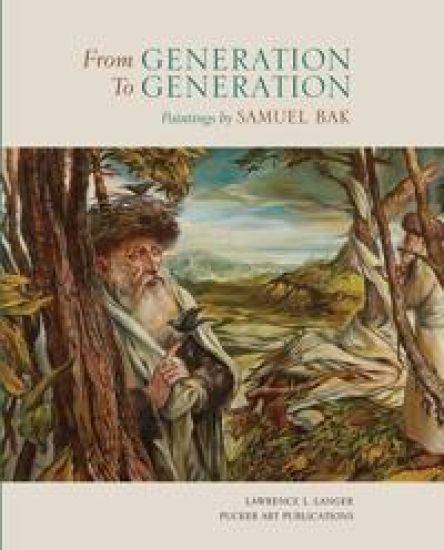
From Generation to Generation

From Generation to Generation

Lawrence L. Langer

Pucker Art Publications
2016
sidottu
Samuel Bak’s recent collection considers the hidden dialogue of generations, with the secret entanglement of different ages. It is indeed a playful cycle, whose playfulness, and even parody, becomes apparent to the beholder literate in Jewish memory and religious imagination. Bak’s images are replete with allusions, citations, intimate references, playing with themes that are as intuitive as they are rooted in Jewish learning and tradition. In his illuminating essay, Lawrence Langer reminds us that Bak thinks of his work as ‘learned paintings’ disclosing themselves, like sacred texts, in layers of meaning corresponding to the layers of learning. Langer beautifully unravels some of their themes, taking us through the worlds of Torah and Chassidism, to the ‘elsewhere’ of the modern age."—Asher D. Biemann, professor of religious studies, University of Virginia
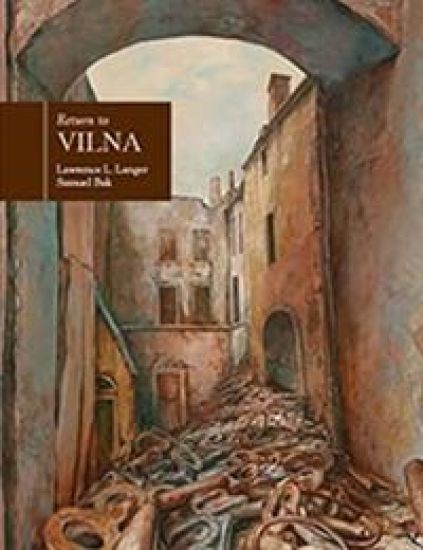
Return to Vilna

Return to Vilna

Samuel Bak; Lawrence L. Langer

Pucker Gallery,US
2007
sidottu
This book is a tribute to the artist's return to his birthplace, to the place of his childhood, once filled with happiness; to the streets of his tenuous survival during World War II, and to the memorial for his grandparents and father. Bak's journey was marked by memories and profound sadness and a great awareness of his responsibility to express the spirits of all who were destroyed during the Holocaust. Scholar Lawrence L. Langer provides commentary on the rich symbolic significance and uniqueness of the artist's work.
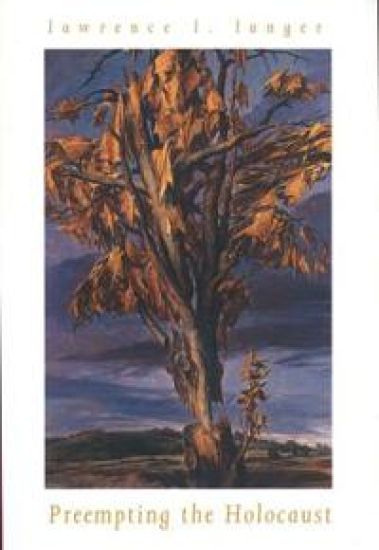
Preempting the Holocaust

Preempting the Holocaust

Lawrence L. Langer

Yale University Press
2000
pokkari
Lawrence L. Langer, perhaps the most important literary critic of the Holocaust, here explores the use of Holocaust themes in literature, memoirs, film, and painting. Among the authors he examines are Primo Levi, Elie Wiesel, Cynthia Ozick, Art Spiegelman, and Simon Wiesenthal. He appraises the art of Samuel Bak, considered by many the premier Holocaust painter of our time, and assesses the “Holocaust Project” by Judy Chicago. He also offers a critical interpretation of Undzere Kinder, a neglected but important Yiddish film made in Poland after the war about Holocaust orphans. Langer focuses his attention on a variety of controversial issues: the attempt of a number of commentators to appropriate the subject of the Holocaust for private moral agendas; the ordeal of women in the concentration camps; the conflicting claims of individual and community survival in the Kovno ghetto; the current tendency to conflate the Holocaust with other modern atrocities, thereby blurring the distinctive features of each; and the sporadic impulse to shift the emphasis from the crime, the criminals, and the victimized to the question of forgiveness and the need for healing. He concludes with some reflections on the challenge of teaching the Holocaust to generations of students who know less and less of its history but continue to manifest an eager curiosity about its human impact and psychological roots.
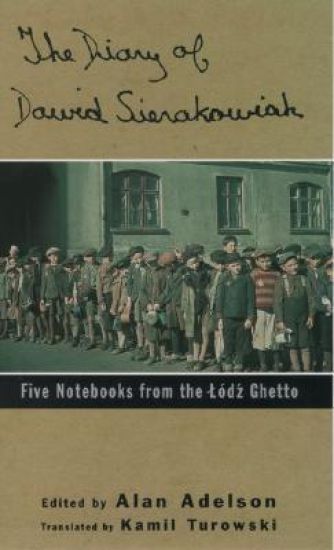
The Diary of Dawid Sierakowiak

The Diary of Dawid Sierakowiak

Dawid Sierakowiak; Lawrence L. Langer

Oxford University Press Inc
1998
nidottu
"In the evening I had to prepare food and cook supper, which exhausted me totally. In politics there's absolutely nothing new. Again, out of impatience I feel myself beginning to fall into melancholy. There is really no way out of this for us." This is Dawid Sierakowiak's final diary entry. Soon after writing it, the young author died of tuberculosis, exhaustion, and starvation--the Holocaust syndrome known as "ghetto disease." After the liberation of the Lódz Ghetto, his notebooks were found stacked on a cookstove, ready to be burned for heat. Young Sierakowiak was one of more than 60,000 Jews who perished in that notorious urban slave camp, a man-made hell which was the longest surviving concentration of Jews in Nazi Europe. The diary comprises a remarkable legacy left to humanity by its teenage author. It is one of the most fastidiously detailed accounts ever rendered of modern life in human bondage. Off mountain climbing and studying in southern Poland during the summer of 1939, Dawid begins his diary with a heady enthusiasm to experience life, learn languages, and read great literature. He returns home under the quickly gathering clouds of war. Abruptly Lódz is occupied by the Nazis, and the Sierakowiak family is among the city's 200,000 Jews who are soon forced into a sealed ghetto, completely cut off from the outside world. With intimate, undefended prose, the diary's young author begins to describe the relentless horror of their predicament: his daily struggle to obtain food to survive; trying to make reason out of a world gone mad; coping with the plagues of death and deportation. Repeatedly he rallies himself against fear and pessimism, fighting the cold, disease, and exhaustion which finally consume him. Physical pain and emotional woe hold him constantly at the edge of endurance. Hunger tears Dawid's family apart, turning his father into a thief who steals bread from his wife and children. The wonder of the diary is that every bit of hardship yields wisdom from Dawid's remarkable intellect. Reading it, you become a prisoner with him in the ghetto, and with discomfiting intimacy you begin to experience the incredible process by which the vast majority of the Jews of Europe were annihilated in World War II. Significantly, the youth has no doubt about the consequence of deportation out of the ghetto: "Deportation into lard," he calls it. A committed communist and the unit leader of an underground organization, he crusades for more food for the ghetto's school children. But when invited to pledge his life to a suicide resistance squad, he writes that he cannot become a "professional revolutionary." He owes his strength and life to the care of his family.
Holocaust Testimonies

Holocaust Testimonies

Lawrence L. Langer

Yale University Press
1993
pokkari
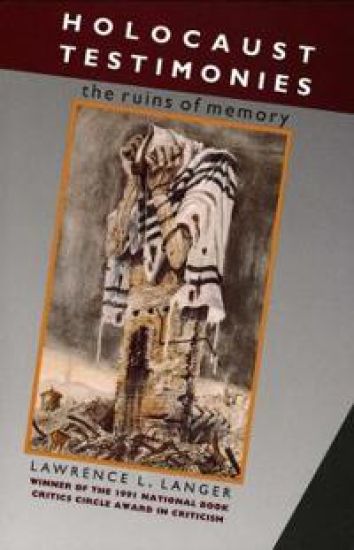
Winner of the 1991 National Book Critics Circle Award in Criticism This important an original book is the first sustained analysis of the unique ways in which oral testimony of survivors contributes to our understanding of the Holocaust. It also sheds light on the forms and functions of memory as victims relive devastating experiences of pain, humiliation, and loss. Drawing on the Fortunoff Video Archives for Holocaust Testimonies at Yale University, Lawrence L. Langer shows how oral Holocaust testimonies complement historical studies by enabling us to confront the human dimensions of the catastrophe. Quoting extensively from these interviews, Langer develops a technique for interpreting them as we might a written text. He contrasts written and oral narratives, noting that while survivor memoirs by authors such as Primo Levi and Charlotte Delbo transform reality through style, imagery, chronology, or a coherent moral vision, oral testimonies resist these organizing impulses and allow instead a kind of unshielded truth to emerge, just as powerful in its impact as the visions taking shape in written memoirs. He argues that it is necessary to deromanticize the survival experience and that to burden it with accolades about the “indomitable human spirit” is to slight its painful complexity and ambivalence. Finally he explores the perplexing task of establishing a meaningful connection between consequential living and inconsequential dying, between moral striving and the sprit of anguish and sense of a diminished self that pervades these haunting Holocaust testimonies.
The Holocaust and the Literary Imagination

The Holocaust and the Literary Imagination

Lawrence L. Langer

Yale University Press
1977
pokkari
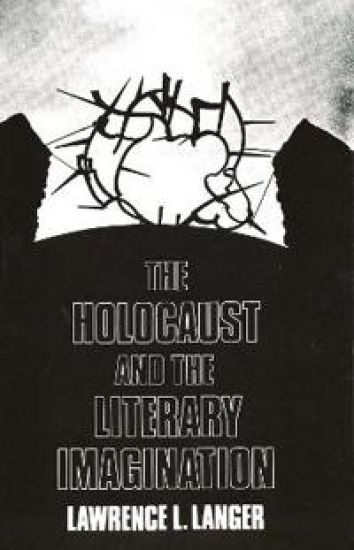
The immense service that Langer’s careful, thoughtful, immensely intelligent and restrained study renders is that the esthetics of atrocity cease to be an exclusive domain of the victims. Many of his writers are not Jewish and several were not imprisoned or interned, and yet all of them have been driven by the death-camp universe. The atrocity of that time and the atrocities that have succeeded Auschwitz represent a continuity that may almost be called a new tradition, one in which the phantasmagoric and horrific is real and the gentle and generous a prodigy to be remarked with amazement.“The Holocaust and the Literary Imagination is a pioneering work of criticism for it impels us, readers and writers alike, to inquire after the basic paradox: how can literature delight and transfix or warn and modify a humanity from whom nothing is hidden, nothing prohibited, for whom nothing is shocking or unreal.” –Arthur A. Cohen, New York Times Book Review“A stimulating, perceptive study of the literature of the Holocaust…. Langer’s examination of possible stylistic approaches to the subject, from the delicate whimsy of Aichinger to the graphic bestiality of Kosinski’s The Painted Bird is in each case detailed and subtle.” –The New Republic