Kirjojen hintavertailu. Mukana 12 390 323 kirjaa ja 12 kauppaa.

Kirjailija

Lawrence R. Schehr

Kirjat ja teokset yhdessä paikassa: 10 kirjaa, julkaisuja vuosilta 1995-2009, suosituimpien joukossa French Postmodern Masculinities. Vertaile teosten hintoja ja tarkista saatavuus suomalaisista kirjakaupoista.

10 kirjaa

Kirjojen julkaisuhaarukka 1995-2009.

French Postmodern Masculinities

French Postmodern Masculinities

Lawrence R. Schehr

Liverpool University Press
2009
sidottu
As traditional notions of masculinity have been put into question, there have been representational reactions to and articulations of changing masculinities in post-modern culture. Certain contemporary French cultural productions are illustrative of these changing masculinities and this book offers the first comprehensive examination of these manifestations. Acclaimed critic Lawrence Schehr uses analysis of AIDS narratives, mainstream films, popular novels, more mainstream novels, a graphic novel, and rightist polemics to explore the changing meaning of masculinity in French society. French Postmodern Masculinities will appeal to a broad range of researchers and postgraduate students working in French cultural studies, cinema, and twentieth- and twenty-first-century French literature.
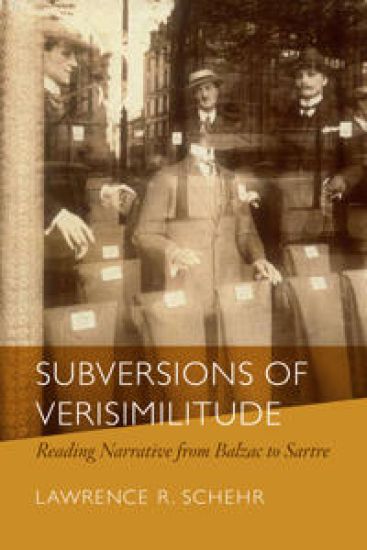
Subversions of Verisimilitude

Subversions of Verisimilitude

Lawrence R. Schehr

Fordham University Press
2009
sidottu
Subversions of Verisimilitude focuses on the ways in which a number of French literary narratives written in the realist tradition show a dynamic balance between the desire of the author/narrator to present a verisimilar world and the need for aesthetic balance. While the works studied-narratives by Balzac, Flaubert, Zola, Colette, Proust, and Sartre-range over the course of a century, from 1835 to 1938, they share a perspective on the relations between and the need to engage questions of realist verisimilitude and narrative interest and aesthetics. The book discusses some of the subversive paths taken in realism and, specifically, in canonical narratives solidly anchored in the tradition. The goal here is to analyze these realist texts, regardless of the narrative mode chosen, in order to see the deviations and detours from realism, mostly for aesthetic ends.The book contributes to our understanding of nineteenth- and twentieth-century narrative and furthers our knowledge of the ways in which critical theory illuminates such canonical works.
French Gay Modernism

French Gay Modernism

Lawrence R. Schehr

University of Illinois Press
2004
sidottu
The first four decades of the twentieth century saw male homosexuality appear in French literature with increasing frequency and boldness. Departing from earlier, more muted presentations, André Gide, Marcel Proust, Jean Cocteau, René Crevel, Francis Carco, and a host of less-famous writers, all created overtly gay characters are gave them increasingly numerous and significant roles. Far from being simply shunned or marginalized, a number of these works were instead accepted as canonical. Lawrence Schehr's French Gay Modernism is the only study devoted to the analyzing these representations of male homosexuality in early twentieth-century French literature. Schehr explains how earlier representations of homosexuality, encoded rather than conspicuous, served as a basis for later writers to treat homosexual behavior as sets of relationships rather than as secrets or scandals. The prominence of authors such as Proust and Gide also helped other writers take up homosexual relationships in their work, often by adopting the same representational strategies. Schehr doesn't limit his study to high literary culture, however. He devotes considerable attention to popular writers whose homosexual characters encounter contempt, scorn, and worse and whose portrayals of homosexual couples and society were at once more open and more at risk.
Figures of Alterity

Figures of Alterity

Lawrence R. Schehr

Stanford University Press
2003
sidottu
This book focuses on the extension of realist writing toward alterity, toward otherness, in its ongoing efforts to enable individuals to speak and be heard correctly. Through a series of close readings of six authors from Balzac to Proust, the author shows the ways realist narrative engages the problem of bringing the other into the realm of the discursively representable. The acts of representation involved in that development were not necessarily coterminous with either the representation of the exotic and its attendant stereotypes or with the representation of individuals themselves. The representation of the other was the extension of discourse to what was previously unrepresentable. The author argues that the unrepresentable is often perceived as oppositional because of the structuring of discourse by hierarchies and metaphysics, whereby any bivalent pair is made into an oppositional pair.
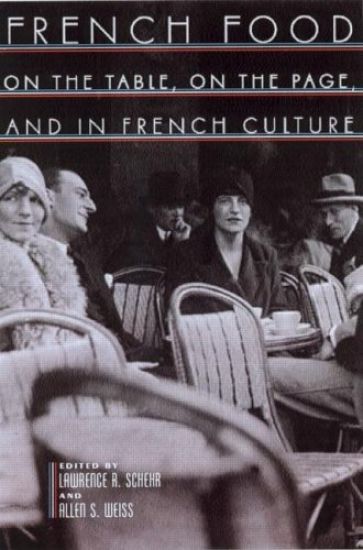
French Food

French Food

Lawrence R. Schehr; Allen S. Weiss

Routledge
2001
sidottu
More than a book about food alone, French Food uses diet as a window into issues of nationality, literature, and culture in France and abroad. Outstanding contributors from cultural studies, literary criticism, performance studies, and the emerging field of food studies explore a wide range of food matters.
French Food

French Food

Lawrence R. Schehr; Allen S. Weiss

Routledge
2001
nidottu
More than a book about food alone, French Food uses diet as a window into issues of nationality, literature, and culture in France and abroad. Outstanding contributors from cultural studies, literary criticism, performance studies, and the emerging field of food studies explore a wide range of food matters.
Parts of an Andrology

Parts of an Andrology

Lawrence R. Schehr

Stanford University Press
1997
sidottu
The subject of this original and provocative work is the white male body, a counterpoint in gender studies to the many readings of the representation of the female body. To look at the construction of this figure, the author examines a group of discontinuous works that are representative of the discontinuity in the intermittent representation of the male body. Especially in nineteenth-century narrative, where Edgar Allan Poe and Guy de Maupassant write astutely on the subject, there is never continuity in representing the male body. "The Pit and the Pendulum" and Bel-Ami are flickering, episodic investigations into the male body as subject, as sentient feeling, as the subject of torture or of adulation. Not until the twentieth century can this male subject be continuously represented. Though the male body is often at center stage, in works that treat it as a metonymy of its own phallic and phallocentric power, this body has less often been seen relative to pleasure and pain, to aesthetics, to human vulnerability. An introductory chapter explores a work by Alberto Moravia, Io e lui, as well as various manifestations of the male body's most salient part, the penis, in contemporary discourse and aesthetics. Another chapter deals with writings about the forbidden activity of masturbation and focuses on the work of three disparate writers: Paul Bonnetain, Michel Tournier, and Philip Roth. In the final chapter, the author discusses several works that focus on the representation of the male body during the gay liberation movement in France and the subsequent celebration of the male body, ending with the inscription of the male body in the literature of AIDS. Among the authors discussed are Guy Hocquenghem, Hervé Guibert, and Michel Foucault.
Rendering French Realism

Rendering French Realism

Lawrence R. Schehr

Stanford University Press
1997
sidottu
Realist novels are usually seen as verisimilar representations of the world, and even when that verisimilitude is critically examined (as it has been by Marxist and feminist critics), the criticism has referred to extra-literary matters, such as bourgeois ideology or defects in the portrayal of women. This book takes as its thesis that the point defining realism is the point at which the processes of representation break down, a sort of black hole of textuality, a rent in the tissue. The author argues that our notions of continuity, of readability, of representability, or our ideas about unity and ideological shift—or even our notions of what is hidden, occulted, or absent—all come from the nineteenth-century realist model itself. Instead of assuming representability, the author argues that we should look at places where the texts do not continue the representationalist model, where there is a sudden falling off, an abyss. Instead of seeing that point as a shortcoming, the author argues that it is equal to the mimetic successes of representation. After an initial chapter dealing with the limits and ruptures of textuality, the book considers the work of Stendhal, from its early state as a precursor to the later realism to La Chartreuse de Parme, which shows how the act of communication for Stendhal is always made of silences, gaps, and interruptions. The author then reads several works of Balzac, showing how he, while setting up the praxes of continuity on which his oeuvre depends, ruptures the works at various strategic points. In a chapter entitled "Romantic Interruptions," works of Nerval and the younger Dumas, seemingly unrelated to the realist project, are shown to be marked by the ideological, representational, and semiotic assumptions that produced Balzac. The book concludes with Flaubert, looking both at how Flaubert incessantly makes things "unfit" and how critics, even the most perspicacious postmodern ones, often try to smooth over the permanent crisis of rupture that is the sign of Flaubert's writing.