Kirjojen hintavertailu. Mukana 12 390 323 kirjaa ja 12 kauppaa.

Kirjailija

Lee S. Shulman

Kirjat ja teokset yhdessä paikassa: 8 kirjaa, julkaisuja vuosilta 1978-2011, suosituimpien joukossa Educating Nurses. Vertaile teosten hintoja ja tarkista saatavuus suomalaisista kirjakaupoista.

Mukana myös kirjoitusasut: Lee S Shulman

8 kirjaa

Kirjojen julkaisuhaarukka 1978-2011.

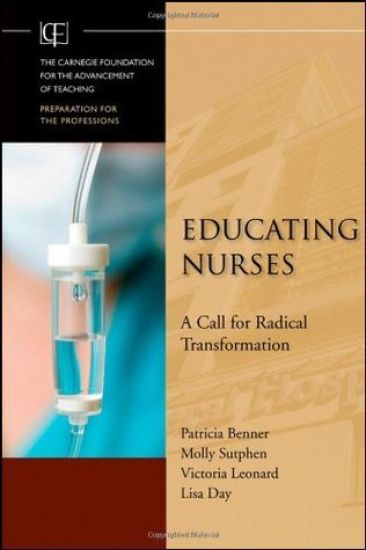
Educating Nurses

Educating Nurses

Patricia Benner; Molly Sutphen; Victoria Leonard; Lisa Day; Lee S. Shulman

John Wiley Sons Inc
2010
sidottu
The authors outline a clear vision of what nursing education can and should be and provide practical exemplars of how we can achieve this vision. This is a call for us to work together as guardians of the discipline to assure that future nurses enter the health care system ready and able to meet the challenges ahead. — PAMELA M. IRONSIDE, director, Center for Research in Nursing Education, Indiana University The profession of nursing in the United States is at a significant moment. Since the last national nursing education study almost forty years ago, profound changes in science, technology, and the nature and settings of nursing practice have reshaped the field. Yet schools have lagged behind in adapting to these changes. Added to this, the profession faces a shortage of nurses and nursing faculty. To meet these challenges, the authors assert that schools, service providers, and the profession must change. They recommend four controversial yet essential changes that are needed to transform nursing education. A volume in The Carnegie Foundation for the Advancement of Teaching’s ­Preparation for the Professions series, the book discusses key topics for the future of the field and offers revolutionary recommendations for change.
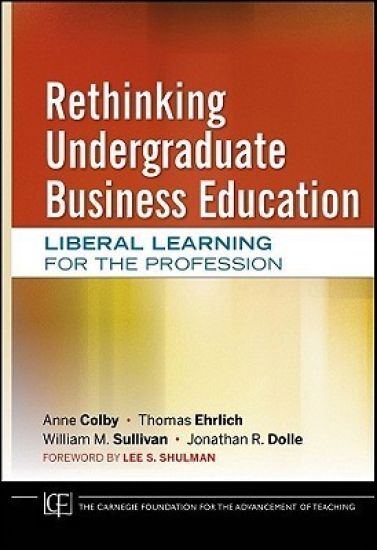
Rethinking Undergraduate Business Education

Rethinking Undergraduate Business Education

Anne Colby; Thomas Ehrlich; William M. Sullivan; Jonathan R. Dolle; Lee S. Shulman

John Wiley Sons Inc
2011
sidottu
Business is the largest undergraduate major in the United States and still growing. This reality, along with the immense power of the business sector and its significance for national and global well-being, makes quality education critical not only for the students themselves but also for the public good. The Carnegie Foundation for the Advancement of Teaching's national study of undergraduate business education found that most undergraduate programs are too narrow, failing to challenge students to question assumptions, think creatively, or understand the place of business in larger institutional contexts. Rethinking Undergraduate Business Education examines these limitations and describes the efforts of a diverse set of institutions to address them by integrating the best elements of liberal arts learning with business curriculum to help students develop wise, ethically grounded professional judgment.
Becoming an Engaged Campus

Becoming an Engaged Campus

Carole A. Beere; James C. Votruba; Gail W. Wells; Lee S. Shulman

John Wiley Sons Inc
2011
sidottu
Becoming an Engaged Campus offers campus leaders a systematic and detailed approach to creating an environment where public engagement can grow and flourish. The book explains not only what to do to expand community engagement and how to do it, but it also explores how to document, evaluate, and communicate university engagement efforts. Praise for Becoming an Engaged Campus "This provocative yet exceedingly practical book looks at all of the angles and lays bare the opportunities and barriers for campus-community engagement while providing detailed pathways toward change. This comprehensive treatise marks a significant shift in the literature from the what and why of public engagement to the how. It is simply superb!" ?KEVIN KECSKES, associate vice provost for engagement, Portland State University "Becoming an Engaged Campus is an essential guidebook for university leaders. It details the specific ways that campuses must align all aspects of the institution if they are to be successful in the increasingly important work of community outreach and engagement." ?GEORGE L. MEHAFFY, vice president for academic leadership and change, American Association of State Colleges and Universities "Most colleges and universities make the rhetorical claim of community engagement; this book is an excellent primer on how to transform the rhetoric into reality. The authors do not speak in abstract terms. They describe the specific structures, policies, and programs that have made Northern Kentucky University a national model of how a large urban university can transform its impact on the region it is supposed to serve." ?WILLIAM E. KIRWAN, chancellor, University System of Maryland
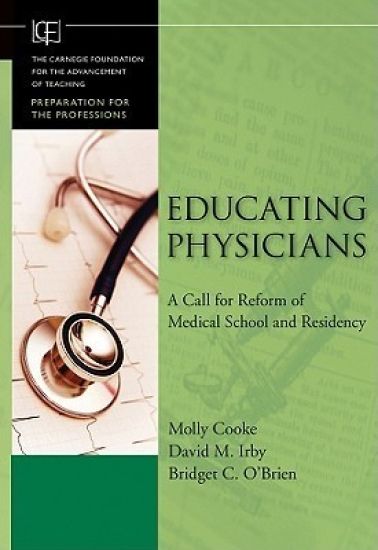
Educating Physicians

Educating Physicians

Molly Cooke; David M. Irby; Bridget C. O'Brien; Lee S. Shulman

John Wiley Sons Inc
2010
sidottu
EDUCATING PHYSICIANS The current blueprint for medical education in North America was drawn up in 1910 by Abraham Flexner in his report Medical Education in the United States and Canada. The basic features outlined by Flexner remain in place today. Yet with the past century's enormous societal changes, the practice of medicine and its scientific, pharmacological, and technological foundations have been transformed. Now medical education in the United States is at a crossroads: those who teach medical students and residents must choose whether to continue in the direction established over a hundred years ago or to take a fundamentally different course, guided by contemporary innovation and new understandings about how people learn. Emerging from an extensive study of physician education by The Carnegie Foundation for the Advancement of Teaching, Educating Physicians calls for a major overhaul of the present approach to preparing doctors for their careers. The text addresses major issues for the future of the field and takes a comprehensive look at the most pressing concerns in physician education today. The key findings of the study recommend four goals for medical education: standardization of learning outcomes and individualization of the learning process; integration of formal knowledge and clinical experience; development of habits of inquiry and innovation; and focus on professional identity formation. Like The Carnegie Foundation's revolutionizing Flexner Report of 1910, Educating Physicians is destined to change the way administrators and faculty in medical schools and programs prepare their physicians for the future.
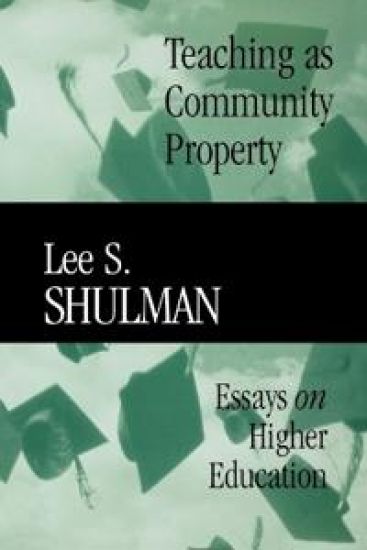
Teaching as Community Property

Teaching as Community Property

Lee S. Shulman

John Wiley Sons Inc
2009
nidottu
For almost two decades, acclaimed education scholar and current president of The Carnegie Foundation for the Advancement of Teaching, Lee S. Shulman has been bringing uncommon wit, passion, and vision to issues of teaching and learning in higher education. Teaching as Community Property brings together a brilliant collection of Shulman's papers and presentations since 1987, giving readers a unique window into his ideas and proposals for the improvement of teaching and learning in higher education. What emerges is a vision of Shulman's overarching agenda--to improve the quality of teaching for all students by making teaching a more respected dimension of all the disciplines and professional fields.
A New Agenda for Higher Education

A New Agenda for Higher Education

William M. Sullivan; Matthew S Rosin; Lee S. Shulman; Gary D. Fenstermacher

John Wiley Sons Inc
2008
sidottu
In A New Agenda for Higher Education, the authors endorse higher educationâ??s utility for enhancing the practical as well as intellectual dimensions of life by developing a third, different conception of educational purpose. Based on The Carnegie Foundation for the Advancement of Teaching seminar that brought together educators from six professional fields with faculty from the liberal arts and sciences, A New Agenda for Higher Education proposes an educational aim of â??practical reason,â?? focusing on the interdependence of liberal education and professional training.
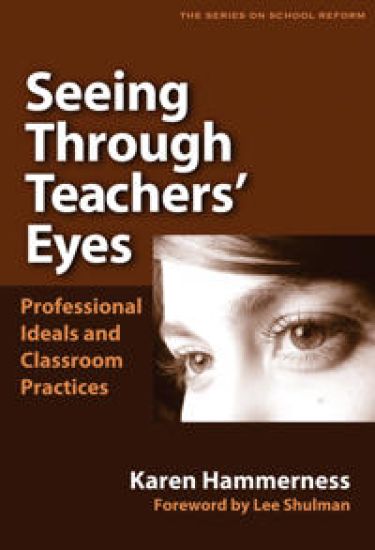
Seeing Through Teachers' Eyes

Seeing Through Teachers' Eyes

Karen Hammerness; Lee S. Shulman

Teachers' College Press
2006
nidottu
What sources of inspiration help sustain teachers' commitments, motivations, and care for their work? How do teachers use their ideals to inform their practice and their learning? The author proposes that many teachers have images of ideal classroom practice which she calls ""teachers' vision."" In this book, Karen Hammerness uses vision to shed light on the complex relationship between teachers' ideals and the realities of school life. Through the compelling stories of four teachers, she reveals how teacher educators can help new teachers articulate, develop, and sustain their visions and assist them as they navigate the gap between their visions and their daily work. She shows us how vision can: illuminate those emotional and passionate moments in the classroom that enrich and enliven their work as teachers; explain what teachers learn about their students, their teaching, and their schools; and reveal why some teachers choose to stay in teaching and others leave the profession.