Kirjojen hintavertailu. Mukana 12 200 358 kirjaa ja 12 kauppaa.

Kirjailija

Leif Edvinsson

Kirjat ja teokset yhdessä paikassa: 22 kirjaa, julkaisuja vuosilta 1997-2021, suosituimpien joukossa National Intellectual Capital and the Financial Crisis in China, Hong Kong, Singapore, and Taiwan. Vertaile teosten hintoja ja tarkista saatavuus suomalaisista kirjakaupoista.

22 kirjaa

Kirjojen julkaisuhaarukka 1997-2021.

National Intellectual Capital and the Financial Crisis in China, Hong Kong, Singapore, and Taiwan

National Intellectual Capital and the Financial Crisis in China, Hong Kong, Singapore, and Taiwan

Carol Yeh-Yun Lin; Leif Edvinsson; Jeffrey Chen; Tord Beding

Springer-Verlag New York Inc.
2012
nidottu
In the first decade of the twenty-first century, the biggest event of worldwide proportion was the 2008 global financial crisis, which was caused primarily by ineffective governance, failed surveillance systems, and implementation flaws. While fiscal and monetary policies succeeded in pulling many countries out of a financial freefall, most economies have performed beneath pre-recession levels as governments continued to struggle with their finances. Examining the financial crisis from the viewpoint of intangible assets provides a different perspective from traditional economic approaches. National Intellectual Capital (NIC), comprised mainly of human capital, market capital, process capital, renewal capital, and financial capital, is a valuable intangible asset and a key source of national competitive advantage in today’s knowledge economy. The authors—pioneers in the field—present extensive data and a rigorous conceptual framework to analyze the connections between the global financial crisis and NIC development. Covering the period from 2005 to 2010 across 48 countries, the authors establish a positive correlation between NIC and GDP per capita and consider the impact of NIC investment for short-term recovery and long-term risk control and strategy formulation.Each volume in a series of SpringerBriefs on NIC and the financial crisis provides in-depth coverage of the impact of thecrisis, the aftermath, future prospects, and policy implications for a regional cluster. This volume focuses on China, Hong Kong, Singapore, and Taiwan.

World Class Cooking for Solving Global Challenges

World Class Cooking for Solving Global Challenges

Eunika Mercier-Laurent; Leif Edvinsson

Emerald Publishing Limited
2021
sidottu
When faced with new global challenges propelled by social, financial, economic, health and environmental crisis, the leaders of today need alternative answers to those posed by traditional policies. In this book, Mercier-Laurent and Edvinsson consider a cutting-edge thought methodology for solving global challenges - by looking at societal innovation through the lens of an analogy to cooking. How might we apply the power of cooking to connect imagination, knowledge, know-how and pleasure to real-world problems? Envisioning an ecosystem dynamic which connects various components, and requires multiple resources with the aim of securing sustainable well-being, the authors showcase initiatives for societal innovation which involve the use of diverse talents, evolving behaviours, thinking differently, adapting to the use of technology and close attention to human purpose. Demonstrating that the possibilities of technology are underused for solving critical problems because of the continual perpetuation of the same cognitive approaches, time and time again, this book makes a crucial intervention by serving up a new perspective on obtaining a sustainable and prosperous future that traditional approaches have so far not reached. By presenting a broad range of promising experiments from around the world, the authors inspire readers to re-imagine their idea of how societal innovation might be achieved. In this book they provide the first of many new recipes for successful global change-making.
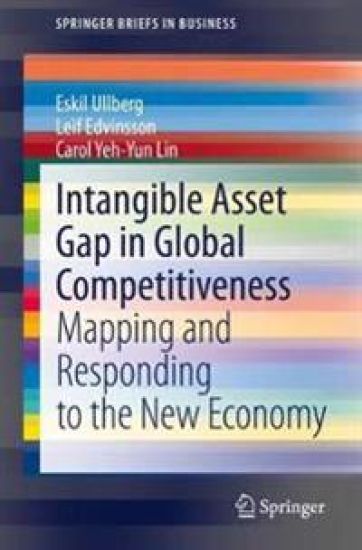
Intangible Asset Gap in Global Competitiveness

Intangible Asset Gap in Global Competitiveness

Eskil Ullberg; Leif Edvinsson; Carol Yeh-Yun Lin

Springer Nature Switzerland AG
2020
nidottu
This book examines the role of intangible assets (IA) in companies and countries for achieving sustainable economic growth. The authors particularly focus on Sweden and other Nordic countries to analyse the IA gap using a systematized “IA metrics” approach. They also discuss the incentives needed for strategic investments into useful IA to gain national competitiveness from an economic, social and environmental policy perspective. The authors contend that despite the increasing importance of IA and intellectual capital (IC) in the economy, the current discussion has only been centered on intellectual property, which is one of the more prominent forms of intangibles. As this book demonstrates, IC and IA encompass wider dimensions of human, process, market, and renewal capital, among others. Featuring real case examples from Spotify, Minecraft and Izettle, this book offers a strategy for the resurrection of competitive advantage in the globalized economy and the advancement of some key United Nations Sustainable Development Goals (SDGs).
Navigating Intellectual Capital After the Financial Crisis

Navigating Intellectual Capital After the Financial Crisis

Carol Yeh-Yun Lin; Leif Edvinsson; Jeffrey Chen; Tord Beding

Springer-Verlag New York Inc.
2016
nidottu
In the first decade of the twenty-first century, the biggest event of worldwide proportion was the 2008 global financial crisis, which was caused primarily by ineffective governance, failed surveillance systems and implementation flaws. While fiscal and monetary policies succeeded in pulling many countries out of a financial freefall, most economies have performed beneath pre-recession levels as governments continued to struggle with their finances.Examining the financial crisis from the viewpoint of intangible assets provides a different perspective from traditional economic approaches. National Intellectual Capital (NIC), comprised mainly of human capital, market capital, process capital, renewal capital and financial capital, is a valuable intangible asset and a key source of national competitive advantage in today’s knowledge economy. The authors—pioneers in the field—present extensive data and a rigorous conceptual framework to analyze the connections between the global financial crisis and NIC development. Covering the period from 2005 to 2010 across 48 countries, the authors establish a positive correlation between NIC and GDP per capita and consider the impact of NIC investment for short-term recovery and long-term risk control and strategy formulation.This book summarizes and synthesizes the data presented in a series of eleven SpringerBriefs volumes on “National Intellectual Capital and the Financial Crisis,” concerning the co-developments between NIC and GDP growth and describes the internal and external factors that influenced the relative success or failure of national strategies in weathering the crisis. The authors go on to explore the impacts of various policy reforms, including stimulus packages and consolidations employed around the world, with particular respect to the factors enhancing or impeding short-term recovery versus long-term growth. Finally, they propose a new model of “sustainable nationalintellectual capital” and challenge readers to consider how to pass on a healthy globe and harmonious society to the next generation.
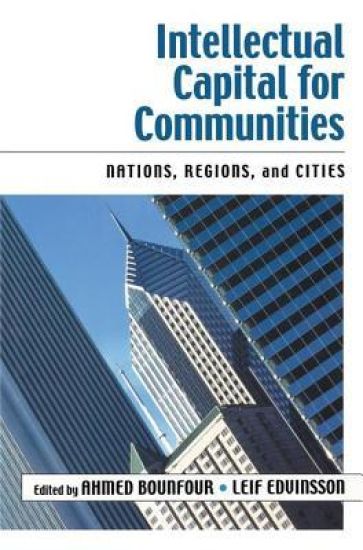
Intellectual Capital for Communities

Intellectual Capital for Communities

Ahmed Bounfour; Leif Edvinsson

Routledge
2016
sidottu
In the knowledge economy, the value of corporations is directly related to their knowledge and intellectual capital. But broaden the perspective a little wider and you begin to see the possibilities: Think of cities, regions, even entire nations, in addition to the public sector. If intangibles and intellectual capital are important to the private sector, they are also important to the productivity and competitiveness of the public sector, and so to communities and nations as a whole. In this book, Editors Ahmed Bounfour and Leif Edivinsson have brought together the best minds in intellectual capital throughout the world to focus on a new and fertile area of research: measuring and managing the intellectual capital of communities. This is a creative and cutting-edge area of research that has the potential to change how public sector planning and development is done. Once there is a clear way to identify where wealth is created in a given region/nation, this process has the potential to reveal a huge knowledge repository in the public sector with a significant—but idle—potential for collective wealth creation—the wealth of nations in waiting.
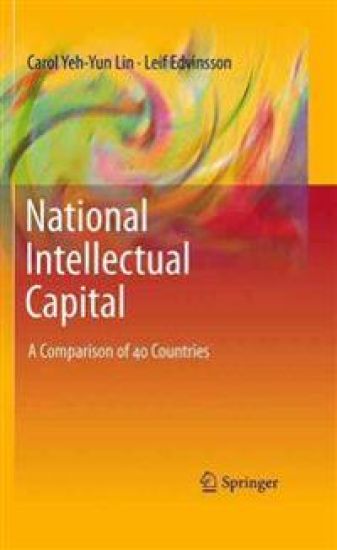
National Intellectual Capital

National Intellectual Capital

Carol Yeh-Yun Lin; Leif Edvinsson

Springer-Verlag New York Inc.
2014
nidottu
Over the past decade, knowledge assets and intellectual capital have been attracting an increasing amount of attention, not only from academics and CEOs, but also from national policy makers. To date, most studies of intellectual capital have focused at the organizational level, with an emphasis on explaining the role of “intangible assets” as a differentiator between accounting value and market value as a possible source of corporate competitive advantage. More recently, pioneers in the field, including the authors of this book, have begun to apply these methodologies to a broader scope, with the objective of comparing the intellectual capital indices at the national or regional level. As a result, an increasing number of world organizations and researchers are commissioned to investigate this future-oriented crucial national issue. Yet, the linkage between the value of intangible assets and how to quantify or benchmark it is still tenuous, not to mention easily misunderstood by a layman for guiding better decision making. With the belief that numbers talk and statistics hide valuable information, this book serves to present the authors’ research findings, covering 14 years (1995-2008) of intellectual capital information, comprised of human capital, market capital, process capital, renewal capital, and financial capital for 40 countries. The last three chapters go beyond analysis of current intellectual capital factors, and present practical tools for launching initiatives at the national level. The book will serve as an essential resource for researchers, policy makers, and business leaders concerned with issues of economic growth and competitiveness, innovation, and business creation.
Navigating Intellectual Capital After the Financial Crisis

Navigating Intellectual Capital After the Financial Crisis

Carol Yeh-Yun Lin; Leif Edvinsson; Jeffrey Chen; Tord Beding

Springer-Verlag New York Inc.
2014
sidottu
In the first decade of the twenty-first century, the biggest event of worldwide proportion was the 2008 global financial crisis, which was caused primarily by ineffective governance, failed surveillance systems and implementation flaws. While fiscal and monetary policies succeeded in pulling many countries out of a financial freefall, most economies have performed beneath pre-recession levels as governments continued to struggle with their finances.Examining the financial crisis from the viewpoint of intangible assets provides a different perspective from traditional economic approaches. National Intellectual Capital (NIC), comprised mainly of human capital, market capital, process capital, renewal capital and financial capital, is a valuable intangible asset and a key source of national competitive advantage in today’s knowledge economy. The authors—pioneers in the field—present extensive data and a rigorous conceptual framework to analyze the connections between the global financial crisis and NIC development. Covering the period from 2005 to 2010 across 48 countries, the authors establish a positive correlation between NIC and GDP per capita and consider the impact of NIC investment for short-term recovery and long-term risk control and strategy formulation.This book summarizes and synthesizes the data presented in a series of eleven SpringerBriefs volumes on “National Intellectual Capital and the Financial Crisis,” concerning the co-developments between NIC and GDP growth and describes the internal and external factors that influenced the relative success or failure of national strategies in weathering the crisis. The authors go on to explore the impacts of various policy reforms, including stimulus packages and consolidations employed around the world, with particular respect to the factors enhancing or impeding short-term recovery versus long-term growth. Finally, they propose a new model of “sustainable nationalintellectual capital” and challenge readers to consider how to pass on a healthy globe and harmonious society to the next generation.
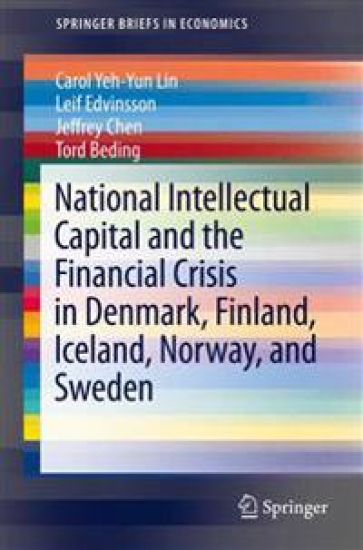
National Intellectual Capital and the Financial Crisis in Denmark, Finland, Iceland, Norway, and Sweden

National Intellectual Capital and the Financial Crisis in Denmark, Finland, Iceland, Norway, and Sweden

Carol Yeh-Yun Lin; Leif Edvinsson; Jeffrey Chen; Tord Beding

Springer-Verlag New York Inc.
2013
nidottu
In the first decade of the twenty-first century, the biggest event of worldwide proportion was the 2008 global financial crisis, which was caused primarily by ineffective governance, failed surveillance systems, and implementation flaws. While fiscal and monetary policies succeeded in pulling many countries out of a financial freefall, most economies have performed beneath pre-recession levels as governments continued to struggle with their finances.Examining the financial crisis from the viewpoint of intangible assets provides a different perspective from traditional economic approaches. National Intellectual Capital (NIC), comprised mainly of human capital, market capital, process capital, renewal capital, and financial capital, is a valuable intangible asset and a key source of national competitive advantage in today’s knowledge economy. The authors—pioneers in the field—present extensive data and a rigorous conceptual framework to analyze the connections between the global financial crisis and NIC development. Covering the period from 2005 to 2010 across 48 countries, the authors establish a positive correlation between NIC and GDP per capita and consider the impact of NIC investment for short-term recovery and long-term risk control and strategy formulation.Each volume in a series of SpringerBriefs on NIC and the financial crisis provides in-depth coverage of the impact of the crisis, the aftermath, future prospects, and policy implications for a regional cluster. This volume focuses on Denmark, Finland, Iceland, Norway, and Sweden.
National Intellectual Capital and the Financial Crisis in Australia, Canada, Japan, New Zealand, and the United States

National Intellectual Capital and the Financial Crisis in Australia, Canada, Japan, New Zealand, and the United States

Carol Yeh-Yun Lin; Leif Edvinsson; Jeffrey Chen; Tord Beding

Springer-Verlag New York Inc.
2013
nidottu
In the first decade of the twenty-first century, the biggest event of worldwide proportion was the 2008 global financial crisis, which was caused primarily by ineffective governance, failed surveillance systems, and implementation flaws. While fiscal and monetary policies succeeded in pulling many countries out of a financial freefall, most economies have performed beneath pre-recession levels as governments continued to struggle with their finances.Examining the financial crisis from the viewpoint of intangible assets provides a different perspective from traditional economic approaches. National Intellectual Capital (NIC), comprised mainly of human capital, market capital, process capital, renewal capital, and financial capital, is a valuable intangible asset and a key source of national competitive advantage in today’s knowledge economy. The authors—pioneers in the field—present extensive data and a rigorous conceptual framework to analyze the connections between the global financial crisis and NIC development. Covering the period from 2005 to 2010 across 48 countries, the authors establish a positive correlation between NIC and GDP per capita and consider the impact of NIC investment for short-term recovery and long-term risk control and strategy formulation. Each volume in a series of Springer Briefs on NIC and the financial crisis provides in-depth coverage of the impact of the crisis, the aftermath, future prospects, and policy implications for a regional cluster. This volume focuses on Australia, Canada, Japan, New Zealand, and the United States of America.
National Intellectual Capital and the Financial Crisis in Argentina, Brazil, Chile, Colombia, Mexico, and Venezuela

National Intellectual Capital and the Financial Crisis in Argentina, Brazil, Chile, Colombia, Mexico, and Venezuela

Carol Yeh-Yun Lin; Leif Edvinsson; Jeffrey Chen; Tord Beding

Springer-Verlag New York Inc.
2013
nidottu
In the first decade of the twenty-first century, the biggest event of worldwide proportion was the 2008 global financial crisis, which was caused primarily by ineffective governance, failed surveillance systems, and implementation flaws. While fiscal and monetary policies succeeded in pulling many countries out of a financial freefall, most economies have performed beneath pre-recession levels as governments continued to struggle with their finances.Examining the financial crisis from the viewpoint of intangible assets provides a different perspective from traditional economic approaches. National Intellectual Capital (NIC), comprised mainly of human capital, market capital, process capital, renewal capital, and financial capital, is a valuable intangible asset and a key source of national competitive advantage in today’s knowledge economy. The authors—pioneers in the field—present extensive data and a rigorous conceptual framework to analyze the connections between the global financial crisis and NIC development. Covering the period from 2005 to 2010 across 48 countries, the authors establish a positive correlation between NIC and GDP per capita and consider the impact of NIC investment for short-term recovery and long-term risk control and strategy formulation.Each volume in a series of SpringerBriefs on NIC and the financial crisis provides in-depth coverage of the impact of the crisis, the aftermath, future prospects, and policy implications for a regional cluster. This volume focuses on Argentina, Brazil, Chile, Columbia, Mexico, and Venezuela.
National Intellectual Capital and the Financial Crisis in Bulgaria, Czech Republic, Hungary, Romania, and Poland

National Intellectual Capital and the Financial Crisis in Bulgaria, Czech Republic, Hungary, Romania, and Poland

Carol Yeh-Yun Lin; Leif Edvinsson; Jeffrey Chen; Tord Beding

Springer-Verlag New York Inc.
2013
nidottu
In the first decade of the twenty-first century, the biggest event of worldwide proportion was the 2008 global financial crisis, which was caused primarily by ineffective governance, failed surveillance systems, and implementation flaws. While fiscal and monetary policies succeeded in pulling many countries out of a financial freefall, most economies have performed beneath pre-recession levels as governments continued to struggle with their finances. Examining the financial crisis from the viewpoint of intangible assets provides a different perspective from traditional economic approaches. National Intellectual Capital (NIC), comprised mainly of human capital, market capital, process capital, renewal capital, and financial capital, is a valuable intangible asset and a key source of national competitive advantage in today’s knowledge economy. The authors—pioneers in the field—present extensive data and a rigorous conceptual framework to analyze the connections between the global financial crisis and NIC development. Covering the period from 2005 to 2010 across 48 countries, the authors establish a positive correlation between NIC and GDP per capita and consider the impact of NIC investment for short-term recovery and long-term risk control and strategy formulation.Each volume in a series of SpringerBriefs on NIC and the financial crisis provides in-depth coverage of the impact of the crisis, the aftermath, future prospects, and policy implications for a regional cluster. This volume focuses on Bulgaria, Czech Republic, Hungary, Romania, and Poland.
National Intellectual Capital and the Financial Crisis in Austria, Belgium, the Netherlands, and Switzerland

National Intellectual Capital and the Financial Crisis in Austria, Belgium, the Netherlands, and Switzerland

Carol Yeh-Yun Lin; Leif Edvinsson; Jeffrey Chen; Tord Beding

Springer-Verlag New York Inc.
2013
nidottu
In the first decade of the twenty-first century, the biggest event of worldwide proportion was the 2008 global financial crisis, which was caused primarily by ineffective governance, failed surveillance systems, and implementation flaws. While fiscal and monetary policies succeeded in pulling many countries out of a financial freefall, most economies have performed beneath pre-recession levels as governments continued to struggle with their finances. Examining the financial crisis from the viewpoint of intangible assets provides a different perspective from traditional economic approaches. National Intellectual Capital (NIC), comprised mainly of human capital, market capital, process capital, renewal capital, and financial capital, is a valuable intangible asset and a key source of national competitive advantage in today’s knowledge economy. The authors—pioneers in the field—present extensive data and a rigorous conceptual framework to analyze the connections between the global financial crisis and NIC development. Covering the period from 2005 to 2010 across 48 countries, the authors establish a positive correlation between NIC and GDP per capita and consider the impact of NIC investment for short-term recovery and long-term risk control and strategy formulation.Each volume in a series of SpringerBriefs on NIC and the financial crisis provides in-depth coverageof the impact of the crisis, the aftermath, future prospects, and policy implications for a regional cluster. This volume focuses on Austria, Belgium, the Netherlands, and Switzerland.
National Intellectual Capital and the Financial Crisis in Israel, Jordan, South Africa, and Turkey

National Intellectual Capital and the Financial Crisis in Israel, Jordan, South Africa, and Turkey

Carol Yeh-Yun Lin; Leif Edvinsson; Jeffrey Chen; Tord Beding

Springer-Verlag New York Inc.
2013
nidottu
In the first decade of the twenty-first century, the biggest event of worldwide proportion was the 2008 global financial crisis, which was caused primarily by ineffective governance, failed surveillance systems, and implementation flaws. While fiscal and monetary policies succeeded in pulling many countries out of a financial freefall, most economies have performed beneath pre-recession levels as governments continued to struggle with their finances. Examining the financial crisis from the viewpoint of intangible assets provides a different perspective from traditional economic approaches. National Intellectual Capital (NIC), comprised mainly of human capital, market capital, process capital, renewal capital, and financial capital, is a valuable intangible asset and a key source of national competitive advantage in today’s knowledge economy. The authors—pioneers in the field—present extensive data and a rigorous conceptual framework to analyze the connections between the global financial crisis and NIC development. Covering the period from 2005 to 2010 across 48 countries, the authors establish a positive correlation between NIC and GDP per capita and consider the impact of NIC investment for short-term recovery and long-term risk control and strategy formulation.Each volume in a series of SpringerBriefs on NIC and the financial crisis provides in-depthcoverage of the impact of the crisis, the aftermath, future prospects, and policy implications for a regional cluster. This volume focuses on Israel, Jordan, South Africa, and Turkey.
National Intellectual Capital and the Financial Crisis in France, Germany, Ireland, and the United Kingdom

National Intellectual Capital and the Financial Crisis in France, Germany, Ireland, and the United Kingdom

Carol Yeh-Yun Lin; Leif Edvinsson; Jeffrey Chen; Tord Beding

Springer-Verlag New York Inc.
2013
nidottu
In the first decade of the twenty-first century, the biggest event of worldwide proportion was the 2008 global financial crisis, which was caused primarily by ineffective governance, failed surveillance systems, and implementation flaws. While fiscal and monetary policies succeeded in pulling many countries out of a financial freefall, most economies have performed beneath pre-recession levels as governments continued to struggle with their finances. Examining the financial crisis from the viewpoint of intangible assets provides a different perspective from traditional economic approaches. National Intellectual Capital (NIC), comprised mainly of human capital, market capital, process capital, renewal capital, and financial capital, is a valuable intangible asset and a key source of national competitive advantage in today’s knowledge economy. The authors—pioneers in the field—present extensive data and a rigorous conceptual framework to analyze the connections between the global financial crisis and NIC development. Covering the period from 2005 to 2010 across 48 countries, the authors establish a positive correlation between NIC and GDP per capita and consider the impact of NIC investment for short-term recovery and long-term risk control and strategy formulation.Each volume in a series of SpringerBriefs on NIC and the financial crisis provides in-depth coverage of the impact of the crisis, the aftermath, future prospects, and policy implications for a regional cluster. This volume focuses on France, Germany, Ireland, and the United Kingdom.
National Intellectual Capital and the Financial Crisis in Indonesia, Malaysia, The Philippines, and Thailand

National Intellectual Capital and the Financial Crisis in Indonesia, Malaysia, The Philippines, and Thailand

Carol Yeh-Yun Lin; Leif Edvinsson; Jeffrey Chen; Tord Beding

Springer-Verlag New York Inc.
2013
nidottu
In the first decade of the twenty-first century, the biggest event of worldwide proportion was the 2008 global financial crisis, which was caused primarily by ineffective governance, failed surveillance systems, and implementation flaws. While fiscal and monetary policies succeeded in pulling many countries out of a financial freefall, most economies have performed beneath pre-recession levels as governments continued to struggle with their finances. Examining the financial crisis from the viewpoint of intangible assets provides a different perspective from traditional economic approaches. National Intellectual Capital (NIC), comprised mainly of human capital, market capital, process capital, renewal capital, and financial capital, is a valuable intangible asset and a key source of national competitive advantage in today’s knowledge economy. The authors—pioneers in the field—present extensive data and a rigorous conceptual framework to analyze the connections between the global financial crisis and NIC development. Covering the period from 2005 to 2010 across 48 countries, the authors establish a positive correlation between NIC and GDP per capita and consider the impact of NIC investment for short-term recovery and long-term risk control and strategy formulation.Each volume in a series of SpringerBriefs on NIC and the financial crisis provides in-depth coverage of the impact of the crisis, the aftermath, future prospects, and policy implications for a regional cluster. This volume focuses on Indonesia, Malaysia, The Philippines, and Thailand.
National Intellectual Capital and the Financial Crisis in Brazil, Russia, India, China, Korea, and South Africa

National Intellectual Capital and the Financial Crisis in Brazil, Russia, India, China, Korea, and South Africa

Carol Yeh-Yun Lin; Leif Edvinsson; Jeffrey Chen; Tord Beding

Springer-Verlag New York Inc.
2012
nidottu
In the first decade of the twenty-first century, the biggest event of worldwide proportion was the 2008 global financial crisis, which was caused primarily by ineffective governance, failed surveillance systems, and implementation flaws. While fiscal and monetary policies succeeded in pulling many countries out of a financial freefall, most economies have performed beneath pre-recession levels as governments continued to struggle with their finances. Examining the financial crisis from the viewpoint of intangible assets provides a different perspective from traditional economic approaches. National Intellectual Capital (NIC), comprised mainly of human capital, market capital, process capital, renewal capital, and financial capital, is a valuable intangible asset and a key source of national competitive advantage in today’s knowledge economy. The authors—pioneers in the field—present extensive data and a rigorous conceptual framework to analyze the connections between the global financial crisis and NIC development. Covering the period from 2005 to 2010 across 48 countries, the authors establish a positive correlation between NIC and GDP per capita and consider the impact of NIC investment for short-term recovery and long-term risk control and strategy formulation.Each volume in a series of SpringerBriefs on NIC and the financial crisis provides in-depth coverage of the impact of the crisis, the aftermath, future prospects, and policy implications for a regional cluster. This volume focuses on the BRICKS—Brazil, Russia, India, China, Korea, and South Africa.
National Intellectual Capital and the Financial Crisis in Greece, Italy, Portugal, and Spain

National Intellectual Capital and the Financial Crisis in Greece, Italy, Portugal, and Spain

Carol Yeh-Yun Lin; Leif Edvinsson; Jeffrey Chen; Tord Beding

Springer-Verlag New York Inc.
2012
nidottu
In the first decade of the twenty-first century, the biggest event of worldwide proportion was the 2008 global financial crisis, which was caused primarily by ineffective governance, failed surveillance systems, and implementation flaws. While fiscal and monetary policies succeeded in pulling many countries out of a financial freefall, most economies have performed beneath pre-recession levels as governments continued to struggle with their finances. Examining the financial crisis from the viewpoint of intangible assets provides a different perspective from traditional economic approaches. National Intellectual Capital (NIC), comprised mainly of human capital, market capital, process capital, renewal capital, and financial capital, is a valuable intangible asset and a key source of national competitive advantage in today’s knowledge economy. The authors—pioneers in the field—present extensive data and a rigorous conceptual framework to analyze the connections between the global financial crisis and NIC development. Covering the period from 2005 to 2010 across 48 countries, the authors establish a positive correlation between NIC and GDP per capita and consider the impact of NIC investment for short-term recovery and long-term risk control and strategy formulation.Each volume in a series of SpringerBriefs on NIC and the financial crisis provides in-depth coverage of the impact of thecrisis, the aftermath, future prospects, and policy implications for a regional cluster. This volume focuses on Greece, Italy, Portugal, and Spain.
Aktivposten Wissenskapital

Aktivposten Wissenskapital

Leif Edvinsson; Gisela Brünig

Vieweg+Teubner Verlag
2011
nidottu
Leif Edvinsson, weltweit fuhrender Knowledge-Guru, stellt in Zusammenarbeit mit der deutschen Wissensexpertin Gisela Brunig seine innovativen Konzepte des Wissensmanagements vor. Mit vielen Fallbeispielen.
National Intellectual Capital

National Intellectual Capital

Carol Yeh-Yun Lin; Leif Edvinsson

Springer-Verlag New York Inc.
2010
sidottu
Over the past decade, knowledge assets and intellectual capital have been attracting an increasing amount of attention, not only from academics and CEOs, but also from national policy makers. To date, most studies of intellectual capital have focused at the organizational level, with an emphasis on explaining the role of “intangible assets” as a differentiator between accounting value and market value as a possible source of corporate competitive advantage. More recently, pioneers in the field, including the authors of this book, have begun to apply these methodologies to a broader scope, with the objective of comparing the intellectual capital indices at the national or regional level. As a result, an increasing number of world organizations and researchers are commissioned to investigate this future-oriented crucial national issue. Yet, the linkage between the value of intangible assets and how to quantify or benchmark it is still tenuous, not to mention easily misunderstood by a layman for guiding better decision making. With the belief that numbers talk and statistics hide valuable information, this book serves to present the authors’ research findings, covering 14 years (1995-2008) of intellectual capital information, comprised of human capital, market capital, process capital, renewal capital, and financial capital for 40 countries. The last three chapters go beyond analysis of current intellectual capital factors, and present practical tools for launching initiatives at the national level. The book will serve as an essential resource for researchers, policy makers, and business leaders concerned with issues of economic growth and competitiveness, innovation, and business creation.
Intellectual Capital for Communities

Intellectual Capital for Communities

Ahmed Bounfour; Leif Edvinsson

Butterworth-Heinemann Ltd
2005
nidottu
In the knowledge economy, the value of corporations is directly related to their knowledge and intellectual capital. But broaden the perspective a little wider and you begin to see the possibilities: Think of cities, regions, even entire nations, in addition to the public sector. If intangibles and intellectual capital are important to the private sector, they are also important to the productivity and competitiveness of the public sector, and so to communities and nations as a whole. In this book, Editors Ahmed Bounfour and Leif Edivinsson have brought together the best minds in intellectual capital throughout the world to focus on a new and fertile area of research: measuring and managing the intellectual capital of communities. This is a creative and cutting-edge area of research that has the potential to change how public sector planning and development is done. Once there is a clear way to identify where wealth is created in a given region/nation, this process has the potential to reveal a huge knowledge repository in the public sector with a significant—but idle—potential for collective wealth creation—the wealth of nations in waiting.