Kirjojen hintavertailu. Mukana 12 390 323 kirjaa ja 12 kauppaa.

Kirjailija

Lesley J. Rogers

Kirjat ja teokset yhdessä paikassa: 8 kirjaa, julkaisuja vuosilta 1998-2026, suosituimpien joukossa The Twofold Brain. Vertaile teosten hintoja ja tarkista saatavuus suomalaisista kirjakaupoista.

Mukana myös kirjoitusasut: Lesley J Rogers

8 kirjaa

Kirjojen julkaisuhaarukka 1998-2026.

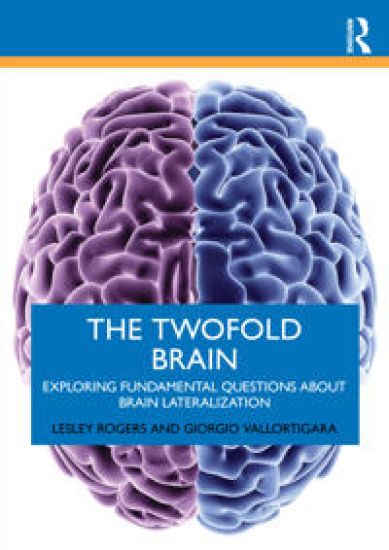
The Twofold Brain

The Twofold Brain

Lesley J. Rogers; Giorgio Vallortigara

TAYLOR FRANCIS LTD
2026
nidottu
The Twofold Brain: Exploring Fundamental Questions about Brain Lateralization challenges the traditional view that brain asymmetry is exclusive to human brains, showing that it is instead widespread in all animals. This unique book deals with new and original ideas about asymmetry of the brain and its function. It first demonstrates how asymmetry emerged early as a biological strategy long before language or culture evolved and was conserved because it worked. It also discusses how from an evolutionary perspective, bilateral bodies create a fundamental problem of duplication – two sides mean redundant sensors, muscles, and neural circuits – but by biasing certain functions toward one side, organisms reduce conflict, speed up processing, and stabilize behaviour. The book then explores the role of interaction among asymmetric organisms in generating individual- or population-level asymmetries as evolutionarily stable strategies, showing that asymmetry thus appears to be a foundational aspect of all nervous systems. The authors' comprehensive approach to brain lateralization allows readers to understand it as an integral aspect of both large and small brains. Each chapter is crafted to answer specific questions, making the book accessible and engaging for both experts and general readers alike. This book will appeal not only to specialists in neurosciences but also to a broader audience with a keen interest in understanding the intricacies of mental processes. Whether you're delving into the nuances of cognitive neuroscience or simply intrigued by the mysteries of the mind, this book offers a captivating journey into the fascinating world of lateralization in human and non-human species.

The Twofold Brain

The Twofold Brain

Lesley J. Rogers; Giorgio Vallortigara

TAYLOR FRANCIS LTD
2026
sidottu
The Twofold Brain: Exploring Fundamental Questions about Brain Lateralization challenges the traditional view that brain asymmetry is exclusive to human brains, showing that it is instead widespread in all animals. This unique book deals with new and original ideas about asymmetry of the brain and its function. It first demonstrates how asymmetry emerged early as a biological strategy long before language or culture evolved and was conserved because it worked. It also discusses how from an evolutionary perspective, bilateral bodies create a fundamental problem of duplication – two sides mean redundant sensors, muscles, and neural circuits – but by biasing certain functions toward one side, organisms reduce conflict, speed up processing, and stabilize behaviour. The book then explores the role of interaction among asymmetric organisms in generating individual- or population-level asymmetries as evolutionarily stable strategies, showing that asymmetry thus appears to be a foundational aspect of all nervous systems. The authors' comprehensive approach to brain lateralization allows readers to understand it as an integral aspect of both large and small brains. Each chapter is crafted to answer specific questions, making the book accessible and engaging for both experts and general readers alike. This book will appeal not only to specialists in neurosciences but also to a broader audience with a keen interest in understanding the intricacies of mental processes. Whether you're delving into the nuances of cognitive neuroscience or simply intrigued by the mysteries of the mind, this book offers a captivating journey into the fascinating world of lateralization in human and non-human species.
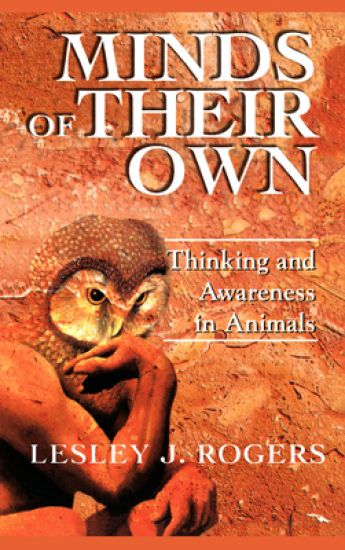
Minds Of Their Own

Minds Of Their Own

Lesley J Rogers

Routledge
2019
sidottu
Do Animals have ideas? Do they experience pain like humans? Do they think about objects that they cannot see? About situations that have occurred in the past? Do they consciously make plans for the future or do they simply react unthinkingly to objects as they appear and situations as they arise? All of these questions have bearing on whether or not animals have consciousness. The advent of computers that ?think? has lead us to consider ?intelligence? in a way we never thought possible a decade ago. But when and how does information processing in the brain become automatic?In Minds of Their Own, Lesley J. Rogers examines the issue of animal thought both sympathetically and critically by looking at the different behavior characteristics of a variety of animals, the evolution of the brain and when consciousness might have evolved. To most people, to be conscious means to be aware of oneself as well as to be aware of others. But does this hold true for animals? The answer may have implications which transcend mere scientific inquiry: if animals are cognizant creatures, what, if any, moral responsibility do humans have to assure their rights? This timely book examines this issue and others by emphasizing comparisons between humans and animals: how we evolved; how we remember; how we learn.
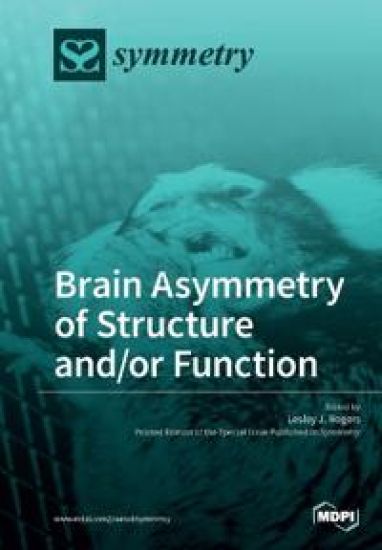
Brain Asymmetry of Structure and/or Function
This edited book brings together research reports on the asymmetry of brain function in various species, including humans, dogs, birds, lizards and bees. As shown in a wide range of species, and, as we now know, not solely in humans, the left and right sides of the brain process information in different ways and control different responses or patterns of behaviour. Since this discovery, many new methods have become available to reveal the processes involved in the development, function and evolution of this important attribute of the brain. Chapters consider the evidence for asymmetry of sensory receptors, left-right differences in information processing and asymmetrical control of behaviour. The latter includes lateralization of bird song and use of the magnetic compass in navigation. Other chapters report studies on handedness, hemispheric asymmetries in emotional processing and perception of symmetry in humans. The importance of the degree, or strength, of asymmetry is discussed and the conclusion is that asymmetry of the brain enhances its efficiency. Other chapters provide evidence that early experience influences the development of asymmetry. All of the contributors have strong backgrounds in research and they discuss up-to-date discoveries on lateralized brain and behaviour.
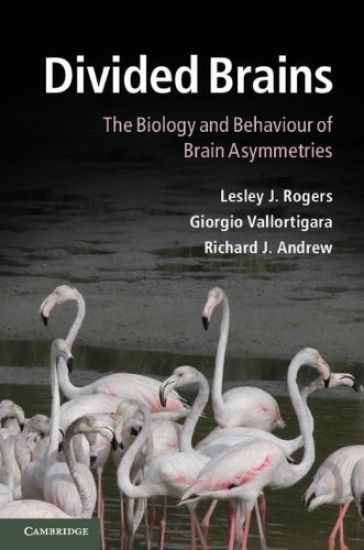
Divided Brains

Divided Brains

Lesley J. Rogers; Giorgio Vallortigara; Richard J. Andrew

Cambridge University Press
2013
sidottu
Asymmetry of the brain and behaviour (lateralization) has traditionally been considered unique to humans. However, research has shown that this phenomenon is widespread throughout the vertebrate kingdom and found even in some invertebrate species. A similar basic plan of organisation exists across vertebrates. Summarising the evidence and highlighting research from the last twenty years, the authors discuss lateralization from four perspectives - function, evolution, development and causation - covering a wide range of animals, including humans. The evolution of lateralization is traced from our earliest ancestors, through fish and reptiles to birds and mammals. The benefits of having a divided brain are discussed, as well as the influence of experience on its development. A final chapter discusses outstanding problems and areas for further investigation. Experts in this field, the authors present the latest scientific knowledge clearly and engagingly, making this a valuable tool for anyone interested in the biology and behaviour of brain asymmetries.
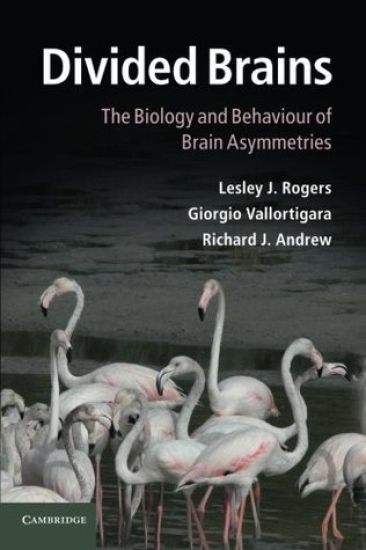
Divided Brains

Divided Brains

Lesley J. Rogers; Giorgio Vallortigara; Richard J. Andrew

Cambridge University Press
2013
pokkari
Asymmetry of the brain and behaviour (lateralization) has traditionally been considered unique to humans. However, research has shown that this phenomenon is widespread throughout the vertebrate kingdom and found even in some invertebrate species. A similar basic plan of organisation exists across vertebrates. Summarising the evidence and highlighting research from the last twenty years, the authors discuss lateralization from four perspectives - function, evolution, development and causation - covering a wide range of animals, including humans. The evolution of lateralization is traced from our earliest ancestors, through fish and reptiles to birds and mammals. The benefits of having a divided brain are discussed, as well as the influence of experience on its development. A final chapter discusses outstanding problems and areas for further investigation. Experts in this field, the authors present the latest scientific knowledge clearly and engagingly, making this a valuable tool for anyone interested in the biology and behaviour of brain asymmetries.
Minds Of Their Own

Minds Of Their Own

Lesley J Rogers

Westview Press Inc
1998
nidottu
Do Animals have ideas? Do they experience pain like humans? Do they think about objects that they cannot see? About situations that have occurred in the past? Do they consciously make plans for the future or do they simply react unthinkingly to objects as they appear and situations as they arise? All of these questions have bearing on whether or not animals have consciousness. The advent of computers that ?think? has lead us to consider ?intelligence? in a way we never thought possible a decade ago. But when and how does information processing in the brain become automatic?In Minds of Their Own, Lesley J. Rogers examines the issue of animal thought both sympathetically and critically by looking at the different behavior characteristics of a variety of animals, the evolution of the brain and when consciousness might have evolved. To most people, to be conscious means to be aware of oneself as well as to be aware of others. But does this hold true for animals? The answer may have implications which transcend mere scientific inquiry: if animals are cognizant creatures, what, if any, moral responsibility do humans have to assure their rights? This timely book examines this issue and others by emphasizing comparisons between humans and animals: how we evolved; how we remember; how we learn.