Kirjojen hintavertailu. Mukana 12 289 744 kirjaa ja 12 kauppaa.

Kirjailija

Lewis H. Siegelbaum

Kirjat ja teokset yhdessä paikassa: 12 kirjaa, julkaisuja vuosilta 1983-2023, suosituimpien joukossa The Politics of Industrial Mobilization in Russia, 1914–17. Vertaile teosten hintoja ja tarkista saatavuus suomalaisista kirjakaupoista.

Mukana myös kirjoitusasut: Lewis H Siegelbaum

12 kirjaa

Kirjojen julkaisuhaarukka 1983-2023.

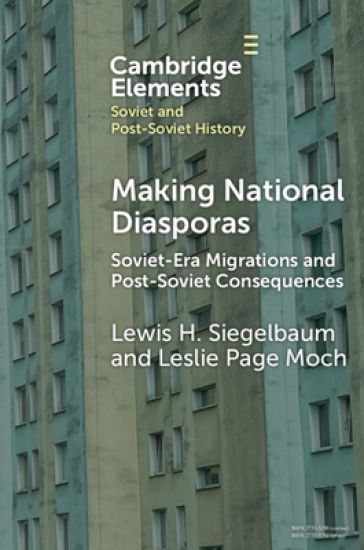
Making National Diasporas

Making National Diasporas

Lewis H. Siegelbaum; Leslie Page Moch

Cambridge University Press
2023
pokkari
This Element explains the historical conditions for the seemingly anomalous presence of people outside of 'their own' Soviet republic and the sometimes-fraught consequences for them and their post-Soviet host countries. The authors begin their inquiry with an analysis of the most massive displacements of the Stalin era – nationality-based deportations, concluding with examples of the life trajectories of deportees' children as they moved transnationally within the Soviet Union and in its successor states. The second section treats disparate parts of the country as magnets attracting Soviet citizens from far afield. Most were cities undergoing vast industrial expansion; others involved incentive programs to develop agriculture and rural-based industries. The final section is devoted to the history of immigration and emigration during the Soviet period as well as since 1991 when millions left one former Soviet republic for another or for lands farther afield.
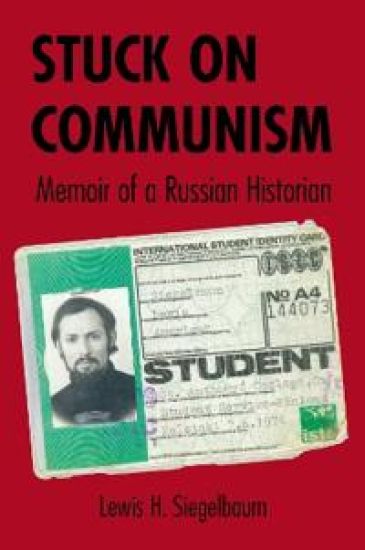
Stuck on Communism

Stuck on Communism

Lewis H. Siegelbaum

Northern Illinois University Press
2019
pokkari
This memoir by one of the foremost scholars of the Soviet period spans three continents and more than half a century—from the 1950s when Lewis Siegelbaum's father was a victim of McCarthyism up through the implosion of the Soviet Union and beyond. Siegelbaum recreates journeys of discovery and self-discovery in the tumult of student rebellion at Columbia University during the Vietnam War, graduate study at Oxford, and Moscow at the height of détente. His story takes the reader into the Soviet archives, the coalfields of eastern Ukraine, and the newly independent Uzbekistan. An intellectual autobiography that is also a biography of the field of Anglophone Soviet history, Stuck on Communism is a guide for how to lead a life on the Left that integrates political and professional commitments. Siegelbaum reveals the attractiveness of Communism as an object of study and its continued relevance decades after its disappearance from the landscape of its origin. Through the journey of a book that is in the end a romance, Siegelbaum discovers the truth in the notion that no matter what historians take as their subject, they are always writing about themselves.
Broad Is My Native Land

Broad Is My Native Land

Lewis H. Siegelbaum; Leslie Page Moch

Cornell University Press
2014
pokkari
Whether voluntary or coerced, hopeful or desperate, people moved in unprecedented numbers across Russia's vast territory during the twentieth century. Broad Is My Native Land is the first history of late imperial, Soviet, and post-Soviet Russia through the lens of migration. Lewis H. Siegelbaum and Leslie Page Moch tell the stories of Russians on the move, capturing the rich variety of their experiences by distinguishing among categories of migrants—settlers, seasonal workers, migrants to the city, career and military migrants, evacuees and refugees, deportees, and itinerants. So vast and diverse was Russian political space that in their journeys, migrants often crossed multiple cultural, linguistic, and administrative borders. By comparing the institutions and experiences of migration across the century and placing Russia in an international context, Siegelbaum and Moch have made a magisterial contribution to both the history of Russia and the study of global migration. The authors draw on three kinds of sources: letters to authorities (typically appeals for assistance); the myriad forms employed in communication about the provision of transportation, food, accommodation, and employment for migrants; and interviews with and memoirs by people who moved or were moved, often under the most harrowing of circumstances. Taken together, these sources reveal the complex relationship between the regimes of state control that sought to regulate internal movement and the tactical repertoires employed by the migrants themselves in their often successful attempts to manipulate, resist, and survive these official directives.
Broad Is My Native Land

Broad Is My Native Land

Lewis H. Siegelbaum; Leslie Page Moch

Cornell University Press
2014
sidottu
Whether voluntary or coerced, hopeful or desperate, people moved in unprecedented numbers across Russia's vast territory during the twentieth century. Broad Is My Native Land is the first history of late imperial, Soviet, and post-Soviet Russia through the lens of migration. Lewis H. Siegelbaum and Leslie Page Moch tell the stories of Russians on the move, capturing the rich variety of their experiences by distinguishing among categories of migrants—settlers, seasonal workers, migrants to the city, career and military migrants, evacuees and refugees, deportees, and itinerants. So vast and diverse was Russian political space that in their journeys, migrants often crossed multiple cultural, linguistic, and administrative borders. By comparing the institutions and experiences of migration across the century and placing Russia in an international context, Siegelbaum and Moch have made a magisterial contribution to both the history of Russia and the study of global migration. The authors draw on three kinds of sources: letters to authorities (typically appeals for assistance); the myriad forms employed in communication about the provision of transportation, food, accommodation, and employment for migrants; and interviews with and memoirs by people who moved or were moved, often under the most harrowing of circumstances. Taken together, these sources reveal the complex relationship between the regimes of state control that sought to regulate internal movement and the tactical repertoires employed by the migrants themselves in their often successful attempts to manipulate, resist, and survive these official directives.
Cars for Comrades

Cars for Comrades

Lewis H. Siegelbaum

Cornell University Press
2011
pokkari
The automobile and Soviet communism made an odd couple. The quintessential symbol of American economic might and consumerism never achieved iconic status as an engine of Communist progress, in part because it posed an awkward challenge to some basic assumptions of Soviet ideology and practice. In this rich and often witty book, Lewis H. Siegelbaum recounts the life of the Soviet automobile and in the process gives us a fresh perspective on the history and fate of the USSR itself. Based on sources ranging from official state archives to cartoons, car-enthusiast magazines, and popular films, Cars for Comrades takes us from the construction of the huge "Soviet Detroits," emblems of the utopian phase of Soviet planning, to present-day Togliatti, where the fate of Russia's last auto plant hangs in the balance. The large role played by American businessmen and engineers in the checkered history of Soviet automobile manufacture is one of the book's surprises, and the author points up the ironic parallels between the Soviet story and the decline of the American Detroit. In the interwar years, automobile clubs, car magazines, and the popularity of rally races were signs of a nascent Soviet car culture, its growth slowed by the policies of the Stalinist state and by Russia's intractable "roadlessness." In the postwar years cars appeared with greater frequency in songs, movies, novels, and in propaganda that promised to do better than car-crazy America. Ultimately, Siegelbaum shows, the automobile epitomized and exacerbated the contradictions between what Soviet communism encouraged and what it provided. To need a car was a mark of support for industrial goals; to want a car for its own sake was something else entirely. Because Soviet cars were both hard to get and chronically unreliable, and such items as gasoline and spare parts so scarce, owning and maintaining them enmeshed citizens in networks of private, semi-illegal, and ideologically heterodox practices that the state was helpless to combat. Deeply researched and engagingly told, this masterful and entertaining biography of the Soviet automobile provides a new perspective on one of the twentieth century's most iconic—and important—technologies and a novel approach to understanding the history of the Soviet Union itself.
Cars for Comrades

Cars for Comrades

Lewis H. Siegelbaum

Cornell University Press
2008
sidottu
The automobile and Soviet communism made an odd couple. The quintessential symbol of American economic might and consumerism never achieved iconic status as an engine of Communist progress, in part because it posed an awkward challenge to some basic assumptions of Soviet ideology and practice. In this rich and often witty book, Lewis H. Siegelbaum recounts the life of the Soviet automobile and in the process gives us a fresh perspective on the history and fate of the USSR itself. Based on sources ranging from official state archives to cartoons, car-enthusiast magazines, and popular films, Cars for Comrades takes us from the construction of the huge "Soviet Detroits," emblems of the utopian phase of Soviet planning, to present-day Togliatti, where the fate of Russia's last auto plant hangs in the balance. The large role played by American businessmen and engineers in the checkered history of Soviet automobile manufacture is one of the book's surprises, and the author points up the ironic parallels between the Soviet story and the decline of the American Detroit. In the interwar years, automobile clubs, car magazines, and the popularity of rally races were signs of a nascent Soviet car culture, its growth slowed by the policies of the Stalinist state and by Russia's intractable "roadlessness." In the postwar years cars appeared with greater frequency in songs, movies, novels, and in propaganda that promised to do better than car-crazy America. Ultimately, Siegelbaum shows, the automobile epitomized and exacerbated the contradictions between what Soviet communism encouraged and what it provided. To need a car was a mark of support for industrial goals; to want a car for its own sake was something else entirely. Because Soviet cars were both hard to get and chronically unreliable, and such items as gasoline and spare parts so scarce, owning and maintaining them enmeshed citizens in networks of private, semi-illegal, and ideologically heterodox practices that the state was helpless to combat. Deeply researched and engagingly told, this masterful and entertaining biography of the Soviet automobile provides a new perspective on one of the twentieth century's most iconic—and important—technologies and a novel approach to understanding the history of the Soviet Union itself.
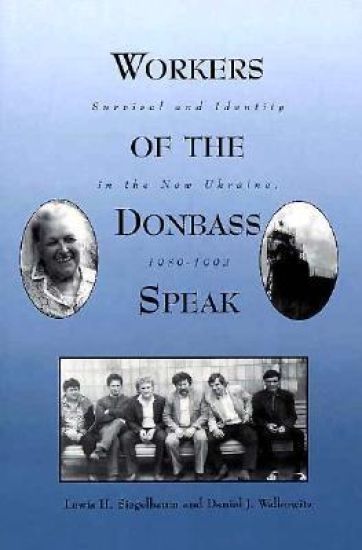
Workers of the Donbass Speak

Workers of the Donbass Speak

Lewis H. Siegelbaum; Daniel J. Walkowitz

State University of New York Press
1995
pokkari
An oral and local history of the coal mining town of Donetsk in the Ukraine. The workers describe their changing political and economic goals and their reaction to Western culture, the rising tides of nationalism and religionIn July 1989 coal miners throughout the Soviet Union engaged in a massive strike that briefly captured world headlines and inaugurated a movement of strike committees that persisted across the Soviet/post-Soviet divide. In this collection of interviews and essays based on encounters over a three-year period, the voices of industrial workers and their families in the eastern Ukrainian city of Donetsk, the coal capital of the Donbass, are heard.The stories collected here allow Western readers to "hear" these people describe their struggles for survival and identity in conditions of economic, political and social disintegration/transformation; and to analyze their testimonies and other kinds of texts in terms of changing meanings of work, gender, and national identity. Included are an examination of the "older generation" that came of age during the Stalin era; an analysis of the miners' movement and the trade union politics that emerged out of the strike of 1989; and a focus on the social crises and cultural disorientations accompanying Ukrainian independence.
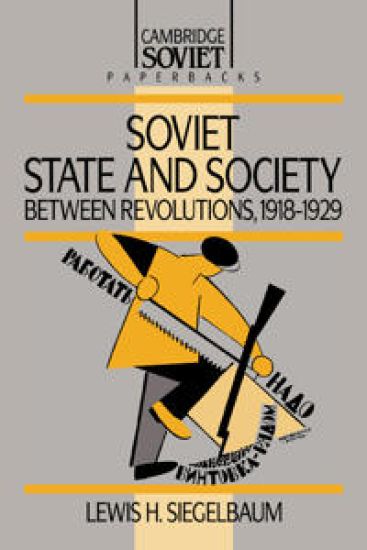
Soviet State and Society between Revolutions, 1918–1929

Soviet State and Society between Revolutions, 1918–1929

Lewis H. Siegelbaum

Cambridge University Press
1992
pokkari
This is the first book to analyse the relationship between the Soviet state and society from the October Revolution of 1917 to the revolution under Stalin of the late 1920s and early 1930s. Professor Lewis Siegelbaum examines the ways in which the promise of a new society made by the 1917 Revolution informed the thinking of those who had experienced the order which preceded it. But how did that old order limit possibilities? How did the new Party leaders, worker activists, artists, and scientists know what to abolish, what to retain, and what to transform? The author explores these questions by tracing the evolution of the ruling Communist Party and its New Economic Policy and the changing fortunes of industrial workers, peasants, and the scientific and cultural intelligentsia. He demonstrates how these different actors sought to appropriate the promise of the 1917 Revolution for their own purposes, highlights the compromises they made, and explains why in the late 1920s these compromises had started to break down.
Soviet State and Society between Revolutions, 1918–1929

Soviet State and Society between Revolutions, 1918–1929

Lewis H. Siegelbaum

Cambridge University Press
1992
sidottu
This is the first book to analyse the relationship between the Soviet state and society from the October Revolution of 1917 to the revolution under Stalin of the late 1920s and early 1930s. Professor Lewis Siegelbaum examines the ways in which the promise of a new society made by the 1917 Revolution informed the thinking of those who had experienced the order which preceded it. But how did that old order limit possibilities? How did the new Party leaders, worker activists, artists, and scientists know what to abolish, what to retain, and what to transform? The author explores these questions by tracing the evolution of the ruling Communist Party and its New Economic Policy and the changing fortunes of industrial workers, peasants, and the scientific and cultural intelligentsia. He demonstrates how these different actors sought to appropriate the promise of the 1917 Revolution for their own purposes, highlights the compromises they made, and explains why in the late 1920s these compromises had started to break down.
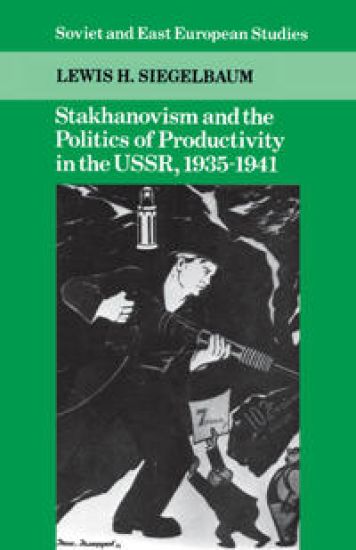
Stakhanovism and the Politics of Productivity in the USSR, 1935–1941
This is a study in English of a major and instructive episode in the history of the Soviet Union. The Stakhanovite movement commemorated the mining of 102 tons of coal by Aleksei Stakhanov on August 30–1, 1935, and it was an important symbol by which the state urged workers to achieve greater productivity. As Lewis Siegelbaum demonstrates, Stakhanovism can be used to explore the social relations within Soviet industry at a critical stage in its development. In this sense, Stakhanovism was an important symbol of a shift in official priorities from construction of the means of production via increasing inputs of labor, to intensive use of capital and labor. Siegelbaum argues that Stakhanovism evolved neither as the product of a master plan nor of spontaneity from below. It developed in response to economic and political contingencies, local initiatives and inertia, and the maneuvering of workers and their bosses alike. Through an interpretation of Stakhanovites as models of the New Soviet Man, this book advances a unique contribution to our understanding of Soviet life in the 1930s.
Stakhanovism and the Politics of Productivity in the USSR, 1935–1941
This is a study in English of a major and instructive episode in the history of the Soviet Union. The Stakhanovite movement commemorated the mining of 102 tons of coal by Aleksei Stakhanov on August 30–1, 1935, and it was an important symbol by which the state urged workers to achieve greater productivity. As Lewis Siegelbaum demonstrates, Stakhanovism can be used to explore the social relations within Soviet industry at a critical stage in its development. In this sense, Stakhanovism was an important symbol of a shift in official priorities from construction of the means of production via increasing inputs of labor, to intensive use of capital and labor. Siegelbaum argues that Stakhanovism evolved neither as the product of a master plan nor of spontaneity from below. It developed in response to economic and political contingencies, local initiatives and inertia, and the maneuvering of workers and their bosses alike. Through an interpretation of Stakhanovites as models of the New Soviet Man, this book advances a unique contribution to our understanding of Soviet life in the 1930s.