Kirjojen hintavertailu. Mukana 12 249 720 kirjaa ja 12 kauppaa.

Kirjailija

Liang Feng

Kirjat ja teokset yhdessä paikassa: 4 kirjaa, julkaisuja vuosilta 2021-2025, suosituimpien joukossa Optinformatics in Evolutionary Learning and Optimization. Vertaile teosten hintoja ja tarkista saatavuus suomalaisista kirjakaupoista.

4 kirjaa

Kirjojen julkaisuhaarukka 2021-2025.

Optinformatics in Evolutionary Learning and Optimization

Optinformatics in Evolutionary Learning and Optimization

Liang Feng; Yaqing Hou; Zexuan Zhu

Springer Nature Switzerland AG
2022
nidottu
This book provides readers the recent algorithmic advances towards realizing the notion of optinformatics in evolutionary learning and optimization. The book also provides readers a variety of practical applications, including inter-domain learning in vehicle route planning, data-driven techniques for feature engineering in automated machine learning, as well as evolutionary transfer reinforcement learning. Through reading this book, the readers will understand the concept of optinformatics, recent research progresses in this direction, as well as particular algorithm designs and application of optinformatics. Evolutionary algorithms (EAs) are adaptive search approaches that take inspiration from the principles of natural selection and genetics. Due to their efficacy of global search and ease of usage, EAs have been widely deployed to address complex optimization problems occurring in a plethora of real-world domains, including image processing, automation of machine learning, neural architecture search, urban logistics planning, etc. Despite the success enjoyed by EAs, it is worth noting that most existing EA optimizers conduct the evolutionary search process from scratch, ignoring the data that may have been accumulated from different problems solved in the past. However, today, it is well established that real-world problems seldom exist in isolation, such that harnessing the available data from related problems could yield useful information for more efficient problem-solving. Therefore, in recent years, there is an increasing research trend in conducting knowledge learning and data processing along the course of an optimization process, with the goal of achieving accelerated search in conjunction with better solution quality. To this end, the term optinformatics has been coined in the literature as the incorporation of information processing and data mining (i.e., informatics) techniques into the optimization process. The primary market of this book is researchers from both academia and industry, who are working on computational intelligence methods and their applications. This book is also written to be used as a textbook for a postgraduate course in computational intelligence emphasizing methodologies at the intersection of optimization and machine learning.
Optinformatics in Evolutionary Learning and Optimization

Optinformatics in Evolutionary Learning and Optimization

Liang Feng; Yaqing Hou; Zexuan Zhu

Springer Nature Switzerland AG
2021
sidottu
This book provides readers the recent algorithmic advances towards realizing the notion of optinformatics in evolutionary learning and optimization. The book also provides readers a variety of practical applications, including inter-domain learning in vehicle route planning, data-driven techniques for feature engineering in automated machine learning, as well as evolutionary transfer reinforcement learning. Through reading this book, the readers will understand the concept of optinformatics, recent research progresses in this direction, as well as particular algorithm designs and application of optinformatics. Evolutionary algorithms (EAs) are adaptive search approaches that take inspiration from the principles of natural selection and genetics. Due to their efficacy of global search and ease of usage, EAs have been widely deployed to address complex optimization problems occurring in a plethora of real-world domains, including image processing, automation of machine learning, neural architecture search, urban logistics planning, etc. Despite the success enjoyed by EAs, it is worth noting that most existing EA optimizers conduct the evolutionary search process from scratch, ignoring the data that may have been accumulated from different problems solved in the past. However, today, it is well established that real-world problems seldom exist in isolation, such that harnessing the available data from related problems could yield useful information for more efficient problem-solving. Therefore, in recent years, there is an increasing research trend in conducting knowledge learning and data processing along the course of an optimization process, with the goal of achieving accelerated search in conjunction with better solution quality. To this end, the term optinformatics has been coined in the literature as the incorporation of information processing and data mining (i.e., informatics) techniques into the optimization process. The primary market of this book is researchers from both academia and industry, who are working on computational intelligence methods and their applications. This book is also written to be used as a textbook for a postgraduate course in computational intelligence emphasizing methodologies at the intersection of optimization and machine learning.
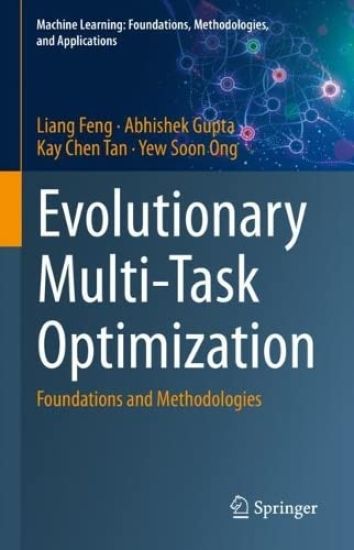
Evolutionary Multi-Task Optimization

Evolutionary Multi-Task Optimization

Liang Feng; Abhishek Gupta; Kay Chen Tan; Yew Soon Ong

SPRINGER VERLAG, SINGAPORE
2025
nidottu
A remarkable facet of the human brain is its ability to manage multiple tasks with apparent simultaneity. Knowledge learned from one task can then be used to enhance problem-solving in other related tasks. In machine learning, the idea of leveraging relevant information across related tasks as inductive biases to enhance learning performance has attracted significant interest. In contrast, attempts to emulate the human brain’s ability to generalize in optimization – particularly in population-based evolutionary algorithms – have received little attention to date. Recently, a novel evolutionary search paradigm, Evolutionary Multi-Task (EMT) optimization, has been proposed in the realm of evolutionary computation. In contrast to traditional evolutionary searches, which solve a single task in a single run, evolutionary multi-tasking algorithm conducts searches concurrently on multiple search spaces corresponding to different tasks or optimization problems,each possessing a unique function landscape. By exploiting the latent synergies among distinct problems, the superior search performance of EMT optimization in terms of solution quality and convergence speed has been demonstrated in a variety of continuous, discrete, and hybrid (mixture of continuous and discrete) tasks. This book discusses the foundations and methodologies of developing evolutionary multi-tasking algorithms for complex optimization, including in domains characterized by factors such as multiple objectives of interest, high-dimensional search spaces and NP-hardness.
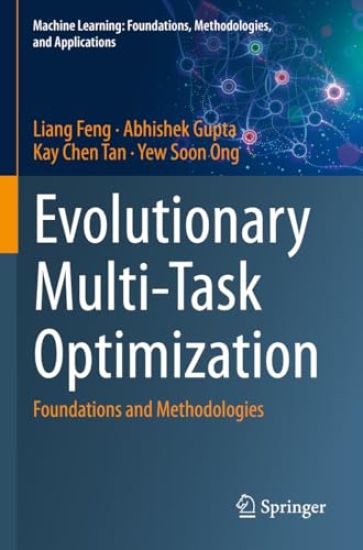
Evolutionary Multi-Task Optimization

Evolutionary Multi-Task Optimization

Liang Feng; Abhishek Gupta; Kay Chen Tan; Yew Soon Ong

SPRINGER VERLAG, SINGAPORE
2023
sidottu
A remarkable facet of the human brain is its ability to manage multiple tasks with apparent simultaneity. Knowledge learned from one task can then be used to enhance problem-solving in other related tasks. In machine learning, the idea of leveraging relevant information across related tasks as inductive biases to enhance learning performance has attracted significant interest. In contrast, attempts to emulate the human brain’s ability to generalize in optimization – particularly in population-based evolutionary algorithms – have received little attention to date. Recently, a novel evolutionary search paradigm, Evolutionary Multi-Task (EMT) optimization, has been proposed in the realm of evolutionary computation. In contrast to traditional evolutionary searches, which solve a single task in a single run, evolutionary multi-tasking algorithm conducts searches concurrently on multiple search spaces corresponding to different tasks or optimization problems,each possessing a unique function landscape. By exploiting the latent synergies among distinct problems, the superior search performance of EMT optimization in terms of solution quality and convergence speed has been demonstrated in a variety of continuous, discrete, and hybrid (mixture of continuous and discrete) tasks. This book discusses the foundations and methodologies of developing evolutionary multi-tasking algorithms for complex optimization, including in domains characterized by factors such as multiple objectives of interest, high-dimensional search spaces and NP-hardness.